






Repair strategies and efficacy analysis of deep electrical burn wounds in children's fingers
-
摘要:
目的 探讨儿童手指深度电烧伤创面修复策略并分析其疗效。 方法 该研究为回顾性观察性研究。2008年1月—2024年1月,首都医科大学附属北京儿童医院收治80例符合入选标准的手指深度电烧伤患儿,其中男54例、女26例,年龄11个月~12岁9个月,共170个手指受累。根据清创后创面特点制订修复策略:对伴肌腱和/或骨骼外露的创面,优先选用局部皮瓣或腹部带蒂皮瓣修复,对其中对供区美观要求较高的患者,采用双层人工真皮+中厚皮进行创面修复。对无肌腱或骨骼外露的创面,采用全厚皮修复全层皮肤缺损者,对其中对供区美观要求较高的患者,采用单纯中厚皮进行创面修复;对合并皮下组织严重缺损且位于关节掌侧的创面,采用双层人工真皮+中厚皮、腹部带蒂皮瓣或局部皮瓣修复。对窄条状创面,若满足无张力闭合、切口方向与手指横纹呈斜行或平行且无重要血管、神经损伤风险,无论是否伴肌腱和/或骨骼外露均直接缝合。按照清创后创面是否伴肌腱和/或骨骼外露分类,统计患指采用的修复方式、创面面积、皮瓣或皮片成活率;末次随访时,采用量角器测量患指关节总主动活动度(TAM)评估患指功能并统计优良比,采用温哥华瘢痕量表(VSS)评估患指瘢痕情况,采用自制量表调查患儿主要照护者对疗效的满意度。 结果 创面伴肌腱和/或骨骼外露的59个患指中,行腹部带蒂皮瓣、局部皮瓣、双层人工真皮+中厚皮移植及直接缝合者分别为31、9、10、9个,其中行直接缝合者创面面积0.20(0.20,0.80)cm2最小,行腹部带蒂皮瓣移植者创面面积2.00(2.00,4.00)cm2最大;行腹部带蒂皮瓣、局部皮瓣、双层人工真皮+中厚皮移植者皮瓣或皮片成活率中位数均为90%;行直接缝合者瘢痕VSS评分3.0(2.0,4.0)分最低,行其余术式者瘢痕VSS评分中位数为4.0~5.0分;行直接缝合者关节TAM优良比9/9最高,其次为行腹部带蒂皮瓣移植者的24/31和行双层人工真皮+中厚皮移植者的7/10;患儿主要照护者对疗效的满意度评分中位数,除行局部皮瓣移植者为8.0分以外,其余均为9.0分。创面无肌腱或骨骼外露的111个患指中,行腹部带蒂皮瓣、局部皮瓣、全厚皮、单纯中厚皮、双层人工真皮+中厚皮移植及直接缝合者分别为9、5、69、11、10、7个,其中行直接缝合者创面面积0.25(0.10,0.50)cm2最小,行腹部带蒂皮瓣移植者创面面积2.00(1.50,3.00)cm2最大;行腹部带蒂皮瓣、局部皮瓣、全厚皮、双层人工真皮+中厚皮移植者皮瓣或皮片成活率中位数均为90%,行单纯中厚皮移植者皮片成活率92%(90%,100%)最高;行直接缝合者瘢痕VSS评分3.0(3.0,4.0)分最低,行双层人工真皮+中厚皮移植者瘢痕VSS评分5.0(5.0,7.0)分高;行局部皮瓣移植者关节TAM优良比5/5最高,行单纯中厚皮移植者关节TAM优良比9/11最低;患儿主要照护者对疗效的满意度评分中位数,除行腹部带蒂皮瓣或局部皮瓣移植者为8.0分以外,其余均为9.0分。 结论 对于儿童手指深度电烧伤,需根据具体情况优先采用皮瓣修复伴肌腱和/或骨骼外露创面,采用皮片修复无肌腱或骨骼外露创面,将符合条件的窄条状创面直接缝合可获得最佳功能与瘢痕评分,个体化修复方案能有效兼顾患指功能恢复与照护者对疗效的满意度。 Abstract:Objective To explore the repair strategies for deep electrical burn wounds in children's fingers and analyze their efficacy. Methods This study was a retrospective observational study. From January 2008 to January 2024, 80 children with deep electrical burn wounds in fingers meeting the inclusion criteria were admitted to Beijing Children's Hospital Affiliated to Capital Medical University, including 54 males and 26 females, aged 11 months to 12 years and 9 months with a total of 170 fingers affected. Repair strategies were formulated based on wound characteristics after debridement. For wounds with exposed tendons and/or bones, local flaps or abdominal pedicled flaps were preferentially used. For some of the patients who had higher aesthetic requirements for the donor sites, bilayer artificial dermis (AD)+split-thickness skin graft (STSG) was applied for wound repair. For wounds without exposed tendons or bones, full-thickness skin graft (FTSG) was used to repair those with full-thickness skin defects, while STSG alone was employed for wound repair in patients who had higher aesthetic requirements for the donor sites. Bilayer AD+STSG, abdominal pedicled flaps, or local flaps were used to repair the wounds with severe subcutaneous tissue defects located on the volar side of joints. For narrow strip-shaped wounds, direct suturing was performed regardless of tendon and/or bone exposure if tension-free closure was achievable, the incision direction was oblique or parallel to finger creases, and there was no risk of major vascular or nerve injury. The wounds were classified according to whether they were accompanied by tendon and/or bone exposure after debridement, the repair methods, wound area, and survival rate of flaps or skin grafts of the affected fingers were recorded. At the final follow-up, the total active motion (TAM) of affected finger joints was measured with a goniometer to assess function of affected fingers and the excellent and good ratio was calculated, the Vancouver scar scale (VSS) was used to evaluate scar conditions of affected fingers, and a self-designed scale was employed to survey the satisfaction of primary caregivers of the child with treatment outcomes. Results Among the 59 affected fingers with wounds accompanied by tendon and/or bone exposure, 31, 9, 10, and 9 of them were treated respectively with abdominal pedicled flaps, local flaps, bilayer AD+STSG, and direct suturing, with the fingers that underwent direct suturing had the smallest wound area of 0.20 (0.20, 0.80) cm2, and the fingers that were transplanted with abdominal pedicled flaps had the largest wound area of 2.00 (2.00, 4.00) cm2. The median survival rate of flaps or skin grafts for the fingers transplanted with abdominal pedicled flaps, local flaps, and bilayer AD+STSG was 90%. The scar VSS score was the lowest 3.0 (2.0, 4.0) for fingers that underwent direct suturing, while the median scar VSS score was 4.0 to 5.0 for fingers that underwent other surgical procedures. The excellent and good ratio of joint TAM was the highest at 9/9 for fingers that underwent direct suturing, followed by 24/31 for fingers that underwent abdominal pedicled flap transplantation and 7/10 for fingers that underwent bilayer AD+STSG transplantation. The median satisfaction score of the primary caregivers of the child with the treatment outcomes was 9.0 points, except for those who underwent local flap transplantation, which was 8 points. Among the 111 affected fingers without tendon or bone exposure, 9, 5, 69, 11, 10, and 7 of them were treated respectively with abdominal pedicled flaps, local flaps, FTSG, STSG alone, bilayer AD+STSG transplantation, and direct suturing, with the fingers that underwent direct suturing had the smallest wound area of 0.25 (0.10, 0.50) cm2, and the fingers that were transplanted with abdominal pedicled flaps had the largest wound area of 2.00 (1.50, 3.00) cm2. The median survival rate of flaps or skin grafts for the fingers transplanted with abdominal pedicled flaps, local flaps, FTSG, and bilayer AD+STSG was 90%. The highest survival rate of skin grafts was 92% (90%, 100%) for fingers that underwent STSG alone transplantation. The scar VSS score was the lowest 3.0 (3.0, 4.0) for fingers that underwent direct suturing, while the scar VSS score was 5.0 (5.0, 7.0) for fingers that underwent bilayer AD+STSG transplantation, which was high. The excellent and good ratio of joint TAM was the highest at 5/5 for fingers that underwent local flap transplantation, while the excellent and good ratio of joint TAM was the lowest at 9/11 for fingers that underwent STSG alone transplantation. The median satisfaction score of the primary caregivers of the child with the treatment outcomes was 9.0 points, except for those who underwent abdominal pedicled flap or local flap transplantation, which was 8.0 points. Conclusions For children's fingers with deep electrical burns, different methods can be used for wound repair according to specific circumstances with skin flaps as the preferred for repairing the wounds with exposed tendons and/or bones, skin grafts for repairing the wounds without tendon or bone exposure, and direct suturing for narrow strip-shaped wounds that meet the conditions to obtain the best functional and scar scores. Individualized repair plans can effectively balance the recovery of finger function and the satisfaction of caregivers with the therapeutic outcome. -
Key words:
- Child /
- Fingers /
- Burns, electric /
- Surgical flaps /
- Treatment outcome /
- Skin grafting /
- Wound repair
-
参考文献
(40) [1] NassarJY, Al QurashiAA, AlbalawiIA,et al.Pediatric burns: a systematic review and meta-analysis on epidemiology, gender distribution, risk factors, management, and outcomes in emergency departments[J].Cureus,2023,15(11):e49012.DOI: 10.7759/cureus.49012. [2] GuptaP,TawarRS,MalviyaM.Groin flap in paediatric age group to salvage hand after electric contact burn: challenges and experience[J].J Clin Diagn Res,2017,11(8):PC01-PC03.DOI: 10.7860/JCDR/2017/29124.10332. [3] TomkinsKL,HollandAJA.Electrical burn injuries in children[J].J Paediatr Child Health,2008,44(12):727-730. [4] DepamphilisMA,CauleyRP,SadeqF,et al.Surgical management and epidemiological trends of pediatric electrical burns[J].Burns,2020,46(7):1693-1699.DOI: 10.1016/j.burns.2020.03.005. [5] 王炜.整形外科学:上册[M].杭州:浙江科学技术出版社,1999:119. [6] 杨焕纳,梁琰,韩大伟,等.人工真皮联合自体皮修复儿童手指电烧伤后骨骼和/或肌腱外露创面的效果[J].中华烧伤与创面修复杂志,2023,39(12):1180-1184.DOI: 10.3760/cma.j.cn501225-20231101-00168. [7] DemirS,DemirTO,ErturkA,et al.Electrical injuries in children: a 10-year experience at a tertiary pediatric burn center[J].J Burn Care Res,2021,42(4):801-809.DOI: 10.1093/jbcr/irab012. [8] HuN,ChenJG,LiuJ,et al.Electrical injuries in children-a 6-year retrospective study[J].Injury,2024,55(6):111482.DOI: 10.1016/j.injury.2024.111482. [9] HanD,WeiY,LiY,et al.Epidemiological and clinical characteristics of 5,569 pediatric burns in central China from 2013 to 2019[J].Front Public Health,2022,10:751615.DOI: 10.3389/fpubh.2022.751615. [10] 蒋梅君,李泽,谢卫国.2 133例电烧伤住院患者流行病学调查[J].中华烧伤杂志,2017,33(12):732-737.DOI: 10.3760/cma.j.issn.1009-2587.2017.12.003. [11] WhitehouseH.Comparison of thigh-based versus groin-based versus lateral-thoracic-based flaps for hand resurfacing: a review article[J].World J Plast Surg,2021,10(3):3-8.DOI: 10.29252/wjps.10.3.3. [12] ChenX,ZhangC,ChengL,et al.Survival and versatility of the flow-through lateral-thigh free flap in severe electrical injuries to the wrist[J].Ann Plast Surg,2020,85(6):612-617.DOI: 10.1097/SAP.0000000000002355. [13] GuoY,LiuX,ChenL.Treating hand high-voltage electrical burn by combination of radial artery perforator flap, artificial dermis, and vacuum sealing drainage[J].Plast Reconstr Surg Glob Open,2023,11(11):e5397.DOI: 10.1097/GOX.0000000000005397. [14] KarimiH,AkhoondinasabMR,Kazem-ZadehJ,et al.Comparison of the results of early flap coverage with late flap coverage in high-voltage electrical injury[J].J Burn Care Res,2017,38(2):e568-e573.DOI: 10.1097/BCR.0000000000000422. [15] Al-QattanMM.A technical tip in the use of abdominal pedicled flaps in hand reconstruction: a case repot[J].Int J Surg Case Rep,2022,92:106863.DOI: 10.1016/j.ijscr.2022.106863. [16] JagoszM,WęgrzynP,SmorągM,et al.In the era of advanced microsurgery, is there still a place for pedicled abdominal flaps? A retrospective analysis[J].J Clin Med,2025,14(5):1696.DOI: 10.3390/jcm14051696. [17] AcharyaAM,RavikiranN,JayakrishnanKN,et al.The role of pedicled abdominal flaps in hand and forearm composite tissue injuries: results of technical refinements for safe harvest[J].J Orthop,2019,16(4):369-376.DOI: 10.1016/j.jor.2019.04.008. [18] 易远历,黄建华,孟宏.边缘切口与正中切口皮瓣修薄整形术比较[J].中国伤残医学,2021,29(3):5-8.DOI: 10.13214/j.cnki.cjotadm.2021.03.002. [19] 陈仕平.臃肿皮瓣整复治疗的临床研究进展[J].微创医学,2019,14(6):783-786.DOI: 10.11864/j.issn.1673.2019.06.30. [20] 储国平,唐晓钰,蒋朝龙,等.腹部多个宽蒂超薄皮瓣修复多手指创面[J].中华手外科杂志,2022,38(4):277-280.DOI: 10.3760/cma.j.cn311653-20210904-00272. [21] 徐军辉,张伟,周锦秀,等.游离移植腹股沟皮瓣修复四肢电烧伤创面的临床效果[J].中华烧伤与创面修复杂志,2023,39(11):1030-1037.DOI: 10.3760/cma.j.cn501225-20230804-00039. [22] 刘峰,张伟,谢卫国,等.微型游离腹股沟穿支皮瓣修复手部小型创面的效果[J].中华烧伤与创面修复杂志,2023,39(10):933-938.DOI: 10.3760/cma.j.cn501225-20230701-00244. [23] 石恩献,顾立强,徐达传.腹股沟皮瓣的研究进展[J].中华显微外科杂志,2020,43(5):519-520,C5-1-C5-2.DOI: 10.3760/cma.j.cn441206-20200819-00325. [24] 郑兴国,江丽兵,夏剑.髂腹股沟带蒂皮瓣与游离皮瓣修复手外伤皮肤缺损的临床疗效对比[J].中华手外科杂志,2024,40(6):551-556.DOI: 10.3760/cma.j.cn311653-20240710-00194. [25] WagnerRD,CarrL,NetscherDT.Current indications for abdominal-based flaps in hand and forearm reconstruction[J].Injury,2020,51(12):2916-2921.DOI: 10.1016/j.injury.2020.02.105. [26] 吴迪,利春叶,杨钦泰,等.示指和中指指腹桡侧缺损的皮瓣修复[J].中华显微外科杂志,2013,36(6):595-597.DOI: 10.3760/cma.j.issn.1001-2036.2013.06.026. [27] 龙航,黄银浩,徐佳丽,等.拇指桡侧指掌侧固有动脉穿支大鱼际皮瓣修复拇指掌侧软组织缺损[J].中华显微外科杂志,2019,42(3):284-286.DOI: 10.3760/cma.j.issn.1001-2036.2019.03.020. [28] 尹善青,黄耀鹏,潘佳栋,等.不同血管来源的小鱼际穿支皮瓣游离移植修复手指指腹皮肤缺损[J].中华整形外科杂志,2019,35(1):53-55.DOI: 10.3760/cma.j.issn.1009-4598.2019.01.012. [29] DuteilleF,LeducA,VerdierJ,et al.Management of finger deep burns: the interest of local flaps[J].Burns,2018,44(2):468-474.DOI: 10.1016/j.burns.2017.08.014. [30] 林慧鑫,周望高,柯于海,等.大鱼际桡侧筋膜蒂皮瓣修复拇指指尖缺损[J].中华显微外科杂志,2021,44(4):384-387.DOI: 10.3760/cma.j.cn441206-20200713-00293. [31] 唐俊华,金国栋,曾永文,等.游离大鱼际皮支皮瓣修复手指掌侧皮肤软组织缺损[J].中华手外科杂志,2019,35(3):194-195.DOI: 10.3760/cma.j.issn.1005-054X.2019.03.012. [32] 刘宇舟,芮永军,陆征峰,等.大鱼际穿支皮瓣与拇指尺背侧筋膜皮瓣瓦合修复拇指桡侧半环形软组织缺损[J].中华手外科杂志,2018,34(6):404-406.DOI: 10.3760/cma.j.issn.1005-054X.2018.06.002. [33] 狄海萍,母心灵,史继静,等.人工真皮联合刃厚皮修复手足骨骼与肌腱外露创面效果的前瞻性随机对照研究[J].中华烧伤杂志,2021,37(12):1130-1136.DOI: 10.3760/cma.j.cn501120-20210325-00103. [34] 《双层人工真皮临床应用专家共识(2019版)》编写组.双层人工真皮临床应用专家共识(2019版)[J].中华烧伤杂志,2019,35(10):705-711.DOI: 10.3760/cma.j.issn.1009-2587.2019.10.001. [35] 杨科跃,孙涛,殷杰,等.人工真皮与皮瓣移植修复指骨间关节周围软组织缺损的疗效比较[J].中华显微外科杂志,2023,46(5):505-510.DOI: 10.3760/cma.j.cn441206-20230510-00082. [36] LiW,ZengS,ChenX,et al.Clinical application of artificial dermis in pediatric deep wounds[J].Injury,2025,56(8):112574.DOI: 10.1016/j.injury.2025.112574. [37] 欧校冉,赵虹谨,李霞,等.人工真皮覆盖联合自体刃厚皮片移植修复大面积深度皮肤软组织缺损创面[J].临床骨科杂志,2022,25(3):389-392.DOI: 10.3969/j.issn.1008-0287.2022.03.026. [38] 李明,郭招娣,汪炜,等.双层人工真皮联合自体皮片移植修复手指皮肤软组织缺损伴骨、肌腱暴露创面的效果[J].组织工程与重建外科杂志,2022,18(4):322-327.DOI: 10.3969/j.issn.1673-0364.2022.04.008. [39] ChanQE,BarziF,HarveyJG,et al.Functional and cosmetic outcome of full-versus split-thickness skin grafts in pediatric palmar surface burns: a prospective, independent evaluation[J].J Burn Care Res,2013,34(2):232-236.DOI: 10.1097/BCR.0b013e31826fc53d. [40] AlsaifA,KaramM,HayreA,et al.Full thickness skin graft versus split thickness skin graft in paediatric patients with hand burns: systematic review and meta-analysis[J].Burns,2023,49(5):1017-1027.DOI: 10.1016/j.burns.2022.09.010. -

图 1 采用全厚皮修复例1患儿无肌腱或骨骼外露的右手拇指Ⅲ度电烧伤创面的效果。1A.术前创面可见黄褐色焦痂;1B.行全厚皮移植后即刻;1C.术后12个月随访时,虎口可见轻微条索瘢痕

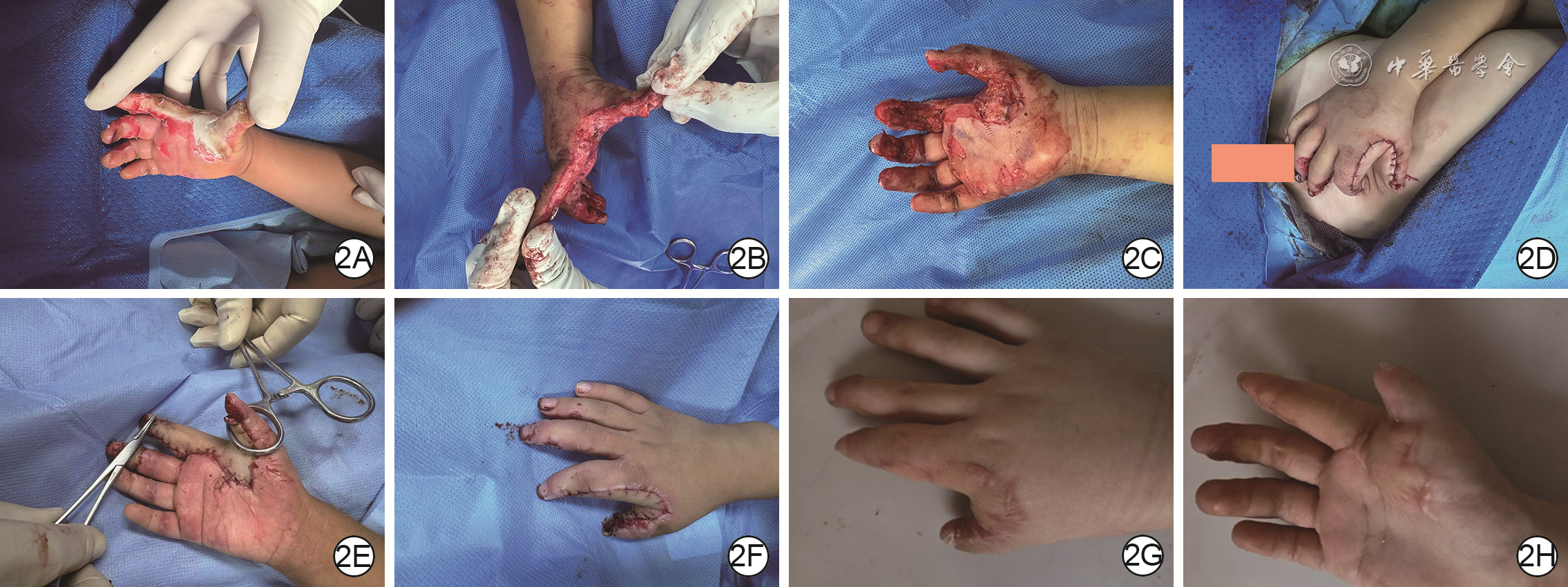
图 2 采用腹部带蒂皮瓣修复例2患儿右手伴肌腱和骨骼外露拇指、示指及严重损伤中指Ⅲ度电烧伤创面的效果。2A.术前,右手拇指及示指掌侧及桡侧可见苍白色焦痂,中指掌侧远端可见黄褐色及苍白色焦痂;2B.清创后,术中侧面观,可见右手拇指及示指骨骼与肌腱外露,中指无肌腱或骨骼外露但皮下软组织缺损严重;2C.清创后,术中正面观,环指及小指可见散在的深Ⅱ度创面;2D.腹部带蒂皮瓣修复手指创面后即刻;2E、2F.分别为皮瓣移植术后3周断蒂后掌面观、背面观,拇指远端少量皮缘坏死;2G、2H.分别为末次术后12个月随访时背面观、掌面观,瘢痕轻度增生,虎口处皮瓣略臃肿
Table 1. 不同修复方式治疗儿童伴肌腱和/或骨骼外露的59个手指深度电烧伤创面的效果比较
修复方式 患指数(个) 创面面积[cm2,M(Q1,Q3)] 手术次数[次,M(Q1,Q3)] 皮瓣或皮片成活率[%,M(Q1,Q3)] 瘢痕VSS评分[分,M(Q1,Q3)] 关节总主动活动度优良比 满意度评分[分,M(Q1,Q3)] 腹部带蒂皮瓣移植 31 2.00(2.00,4.00) 2(2,2) 90(70,90) 5.0(4.0,5.0) 24/31 9.0(8.0,9.0) 局部皮瓣移植 9 1.00(0.50,2.00) 2(1,2) 90(65,90) 4.0(4.0,5.0) 5/9 8.0(7.5,9.0) 双层人工真皮+中厚皮移植 10 1.60(1.00,2.00) 2(2,2) 90(87,91) 5.0(4.0,5.0) 7/10 9.0(7.8,9.0) 直接缝合 9 0.20(0.20,0.80) 1(1,1) — 3.0(2.0,4.0) 9/9 9.0(9.0,9.0) 注:局部皮瓣包括大鱼际带蒂皮瓣、小鱼际带蒂皮瓣和局部推进皮瓣,行双层人工真皮+中厚皮移植创面皮片成活率指中厚皮成活率;分别于腹部带蒂皮瓣、大鱼际带蒂皮瓣、小鱼际带蒂皮瓣断蒂当天术前,局部推进皮瓣移植术后7 d,全厚皮移植术后14 d,中厚皮移植术后3 d计算皮瓣或皮片成活率;手术次数为清创后至创面完全愈合期间数据;“—”表示无此项;VSS为温哥华瘢痕量表;满意度为患儿主要照护者对疗效的满意度;表中最后3项指标为末次随访时统计  下载: 导出CSV
Table 2. 不同修复方式治疗儿童无肌腱或骨骼外露的111个手指深度电烧伤创面的效果比较
修复方式 患指数(个) 创面面积[cm2,M(Q1,Q3)] 手术次数[次,M(Q1,Q3)] 皮瓣或皮片成活率[%,M(Q1,Q3)] 瘢痕VSS评分[分,M(Q1,Q3)] 关节总主动活动度优良比 满意度评分[分,M(Q1,Q3)] 腹部带蒂皮瓣移植 9 2.00(1.50,3.00) 2(2,2) 90(85,100) 5.0(4.5,5.0) 8/9 8.0(8.0,9.0) 局部皮瓣移植 5 1.00(0.50,1.50) 2(1,2) 90(40,90) 5.0(4.0,5.0) 5/5 8.0(8.0,9.0) 全厚皮移植 69 1.00(0.50,2.00) 1(1,1) 90(80,95) 4.0(4.0,5.0) 60/69 9.0(9.0,9.0) 单纯中厚皮移植 11 1.00(0.90,1.90) 1(1,2) 92(90,100) 4.5(3.0,5.0) 9/11 9.0(8.0,9.0) 双层人工真皮+中厚皮移植 10 1.00(0.60,3.00) 2(2,2) 90(90,100) 5.0(5.0,7.0) 9/10 9.0(8.0,9.0) 直接缝合 7 0.25(0.10,0.50) 1(1,1) — 3.0(3.0,4.0) 6/7 9.0(9.0,9.0) 注:局部皮瓣包括大鱼际带蒂皮瓣、小鱼际带蒂皮瓣和局部推进皮瓣,行双层人工真皮+中厚皮移植创面皮片成活率指中厚皮成活率;分别于腹部带蒂皮瓣、大鱼际带蒂皮瓣、小鱼际带蒂皮瓣断蒂当天术前,局部推进皮瓣移植术后7 d,全厚皮移植术后14 d,中厚皮移植术后3 d计算皮瓣或皮片成活率;手术次数为清创后至创面完全愈合期间数据;“—”表示无此项;VSS为温哥华瘢痕量表;满意度为患儿主要照护者对疗效的满意度;表中最后3项指标为末次随访时统计
下载: 导出CSV
-
 李丹 7月28日.mp4

-

 下载:
下载:



图(3) / 表(2)
计量
- 文章访问数: 5032
- HTML全文浏览量: 1114
- PDF下载量: 48
- 被引次数: 0
