





Clinical application and Zunyi Classification of free anterolateral thigh chimeric flaps
-
摘要:
目的 总结游离股前外侧嵌合皮瓣的临床应用与遵义分型。 方法 该研究为回顾性观察性研究。2021年6月—2024年6月,遵义医科大学附属医院收治200例符合入选标准的行游离股前外侧嵌合皮瓣移植的患者,其中男106例、女94例,年龄3~77岁。创面类型为机械损伤创面者175例、慢性创面者18例、其他类型(术后感染、烧伤等)创面者7例,创面位于踝或腕关节以远者171例、膝关节至踝关节以上或肘关节至腕关节以上者24例、骶骨至膝关节以上或肩部至肘关节以上者5例。依据采用不同组织构成的游离股前外侧嵌合皮瓣修复不同缺损的情况,总结游离股前外侧嵌合皮瓣的分型。 结果 成功构建游离股前外侧嵌合皮瓣的遵义分型,包含Ⅰ型(68例患者)、Ⅱ型(81例患者)、Ⅲ型(23例患者)、Ⅳ型(28例患者)。其中Ⅰ型指由1种类型的组织构成的嵌合皮瓣,如双叶、三叶皮瓣等分叶皮瓣,适用于仅需要修复单纯皮肤缺损者;Ⅱ型指由2种类型的组织构成的嵌合皮瓣,根据皮肤是否分叶,又分为Ⅱa型和Ⅱb型,适用于在修复皮肤缺损的同时需要重建1种其他类型的组织的功能者;Ⅲ型指由3种及以上类型的组织构成的嵌合皮瓣,根据皮肤是否分叶,又分为Ⅲa型和Ⅲb型,适用于在修复皮肤缺损的同时需要重建2种及以上其他类型的组织的功能者;Ⅳ型指需要显微外科技术通过血管吻合构建的嵌合皮瓣,可根据创面修复的特定需求,灵活构建各种组成的嵌合皮瓣,适用于大面积皮肤缺损、特殊组织或部位缺损,单个股前外侧区域无法满足修复需求,需要切取额外供区的组织者。 结论 基于嵌合皮瓣组织来源的游离股前外侧嵌合皮瓣的遵义分型,强调受区的功能需要,有助于指导各类复杂创面的修复,便于临床推广。 Abstract:Objective To summarize the clinical application and Zunyi Classification of free anterolateral thigh chimeric flaps. Methods This study was a retrospective observational study. From June 2021 to June 2024, 200 patients who underwent free anterolateral thigh chimeric flap transplantation and met the inclusion criteria were admitted to the Affiliated Hospital of Zunyi Medical University, including 106 males and 94 females, aged 3 to 77 years. The wound types included mechanical trauma wounds in 175 cases, chronic wounds in 18 cases, and other wounds (postoperative infection, burns, etc.) in 7 cases. The wounds were located distal to the ankle or wrist joints in 171 cases; between the knee and above the ankle or between the elbow and above the wrist in 24 cases; and between the sacrum and above the knee, or between the shoulder and above the elbow in 5 cases. The application of free anterolateral thigh chimeric flaps with different tissue components for repairing various defects was analyzed to sum up the classification of free anterolateral thigh chimeric flaps. Results The Zunyi Classification of free anterolateral thigh chimeric flaps was successfully established, including 68 cases of type Ⅰ, 81 cases of type Ⅱ, 23 cases of type Ⅲ, and 28 cases of type Ⅳ. type Ⅰ chimeric flaps were composed of 1 type of tissue, such as bilobed, trilobed, or other lobed flaps, which were suitable for patients requiring repair of simple skin defects. Type Ⅱ chimeric flaps were composed of 2 types of tissue and were further classified into subtypes Ⅱa and Ⅱb based on the presence or absence of lobed skin. They were suitable for patients requiring repair of skin defects along with reconstructing the function of another tissue type. Type Ⅲ chimeric flaps were composed of 3 or more types of tissue and were further classified into subtypes Ⅲa and Ⅲb based on the presence or absence of lobed skin. They were suitable for patients requiring repair of skin defects along with reconstructing the function of 2 or more types of tissue. Type Ⅳ chimeric flaps required microsurgical construction via vascular anastomosis. These flaps could be flexibly designed with customized tissue combinations to meet specific wound reconstruction needs. They were indicated for patients with extensive skin defects, specialized tissue defects, or anatomical regions where reconstruction cannot be achieved by a single anterolateral thigh donor site, necessitating harvest of additional donor tissues. Conclusions The Zunyi Classification of free anterolateral thigh chimeric flaps based on tissue sources of chimeric flaps emphasizes the functional requirements of recipient sites, which helps guide the repair of various complex wounds and facilitates clinical promotion. -
Key words:
- Perforator flap /
- Microsurgery /
- Wounds and injuries /
- Anterolateral thigh flap /
- Chimeric flap /
- Wound repair
-
参考文献
(40) [1] HallockGG.Simultaneous transposition of anterior thigh muscle and fascia flaps: an introduction to the chimera flap principle[J].Ann Plast Surg,1991,27(2):126-131.DOI: 10.1097/00000637-199108000-00006. [2] HallockGG.Further clarification of the nomenclature for compound flaps[J].Plast Reconstr Surg,2006,117(7):151e-160e.DOI: 10.1097/01.prs.0000219178.20541.7f. [3] SơnTT, DungPTV, ThúyTTH,et al.Using free chimeric anterolateral thigh flap for reconstruction of composite dorsal hand defect[J].JPRAS Open,2024,39:106-113.DOI: 10.1016/j.jpra.2023.11.011. [4] LinYT,LinCH,WeiFC.More degrees of freedom by using chimeric concept in the applications of anterolateral thigh flap[J].J Plast Reconstr Aesthet Surg,2006,59(6):622-627.DOI: 10.1016/j.bjps.2005.07.015. [5] 袁才其, 王学志, 肖人洪, 等. 以旋髂浅动脉浅支为蒂的嵌合皮瓣修复手背软组织合并掌骨缺损[J].中华显微外科杂志,2023,46(2):174-178. DOI: 10.3760/cma.j.cn441206-20221017-00214. [6] 王新宏,郑晓菊,王保山,等.急诊一期旋股外侧动脉嵌合穿支皮瓣修复前臂严重损伤[J].中华显微外科杂志,2021,44(6):673-678.DOI: 10.3760/cma.j.cn441206-20211103-00261. [7] ChoK,KangJ,EunS.Various soft tissue defect reconstructions using anterolateral thigh and vascularized fascia lata composite free flap[J].Medicine (Baltimore),2023,102(50):e36578.DOI: 10.1097/MD.0000000000036578. [8] LeeYJ,KimJ,LeeCR,et al.Anterolateral thigh chimeric flap: an alternative reconstructive option to free flaps for large soft tissue defects[J].J Clin Med,2023,12(21):6723.DOI: 10.3390/jcm12216723. [9] GurE,TiftikciogluYO,KuybuluTF,et al.The use of chimeric-superthin anterolateral thigh flap in reconstruction of laryngopharyngoesophagectomy defects of hypopharyngeal cancer[J].Microsurgery,2023,43(6):563-569.DOI: 10.1002/micr.31021. [10] HallockGG.The chimera flap: a quarter century odyssey[J].Ann Plast Surg,2017,78(2):223-229.DOI: 10.1097/SAP.0000000000000884. [11] HallockGG.The chimeric propeller flap[J].Semin Plast Surg,2020,34(3):207-209.DOI: 10.1055/s-0040-1714290. [12] 李海,魏在荣,肖顺娥,等.旋髂浅动脉穿支嵌合皮瓣修复跟腱区复合组织缺损9例[J].中华显微外科杂志,2025,48(1):25-30.DOI: 10.3760/cma.j.cn441206-20240604-00143. [13] 刘飞,闫炜琪,马强,等.股前外侧血流桥接嵌合穿支皮瓣游离移植治疗伴主干动脉缺损的上肢复合组织缺损的临床效果[J].中华烧伤与创面修复杂志,2024,40(2):172-179.DOI: 10.3760/cma.j.cn501225-20231103-00176. [14] 计鹏,曹涛,张智,等.股前外侧嵌合穿支皮瓣修复足踝部复杂创面的效果[J].中华烧伤与创面修复杂志,2023,39(10):926-932.DOI: 10.3760/cma.j.cn501225-20230627-00232. [15] 吴文溢,余少校,周望高,等.以旋股外侧动脉降支为蒂的分叶-嵌合穿支皮瓣修复足踝多部位缺损伤六例[J].中华显微外科杂志,2022,45(4):400-405.DOI: 10.3760/cma.j.cn441206-20220214-00032. [16] 臧成五,陈永祥,鲜航,等.分叶式股前外侧嵌合穿支皮瓣修复四肢复杂性软组织缺损[J].中华显微外科杂志,2022,45(3):254-259.DOI: 10.3760/cma.j.cn441206-20220208-00026. [17] 唐举玉,王玉玲,吴攀峰,等.显微削薄-嵌合旋股外侧动脉降支穿支皮瓣修复四肢复杂软组织缺损[J].中华显微外科杂志,2021,44(6):621-624.DOI: 10.3760/cma.j.cn441206-20210125-00031. [18] 谭玉忠,崔留超,程良坤,等.游离分叶股前外侧穿支皮瓣串联足底内侧皮瓣修复足跟及周围大面积软组织缺损6例[J].中华显微外科杂志,2024,47(2):212-216.DOI: 10.3760/cma.j.cn441206-20230821-00018. [19] 程琳,刘先奇,杜伟力,等.嵌合穿支皮瓣修复骨或内固定外露创面及骨髓炎创面的临床效果[J].中华烧伤与创面修复杂志,2024,40(7):643-649.DOI: 10.3760/cma.j.cn501225-20231120-00198. [20] HallockGG.The complete nomenclature for combined perforator flaps[J].Plast Reconstr Surg,2011,127(4):1720-1729.DOI: 10.1097/PRS.0b013e31820a662b. [21] 张世民,唐茂林,章伟文,等.中国穿支皮瓣的名词术语与临床应用原则共识(暂定稿)[J].中华显微外科杂志,2012,35(2):89-92.DOI: 10.3760/cma.j.issn.1001-2036.2012.02.001. [22] QingL,WuP,YuF,et al.Use of a sequential chimeric perforator flap for one-stage reconstruction of complex soft tissue defects of the extremities[J].Microsurgery,2020,40(2):167-174.DOI: 10.1002/micr.30450. [23] QingL,LiX,WuP,et al.Customized reconstruction of complex soft-tissue defect in the hand and forearm with individual design of chain-linked bilateral anterolateral thigh perforator flaps[J].J Plast Reconstr Aesthet Surg,2019,72(12):1909-1916.DOI: 10.1016/j.bjps.2019.08.004. [24] HallockGG.Permutations of combined free flaps using the subscapular system[J].J Reconstr Microsurg,1997,13(1):47-54.DOI: 10.1055/s-2008-1063940. [25] DayanJH,LinCH,WeiFC.The versatility of the anterolateral thigh flap in lower extremity reconstruction[J].Handchir Mikrochir Plast Chir,2009,41(4):193-202.DOI: 10.1055/s-0029-1220916. [26] WuK,JiT,CaoW,et al.Application of a new classification of chimeric anterolateral thigh free flaps[J].J Craniomaxillofac Surg,2019,47(8):1198-1202.DOI: 10.1016/j.jcms.2019.01.035. [27] KimJT,KimYH,GhanemAM.Perforator chimerism for the reconstruction of complex defects: a new chimeric free flap classification system[J].J Plast Reconstr Aesthet Surg,2015,68(11):1556-1567.DOI: 10.1016/j.bjps.2015.07.004. [28] HuangWC,ChenHC,WeiFC,et al.Chimeric flap in clinical use[J].Clin Plast Surg,2003,30(3):457-467.DOI: 10.1016/s0094-1298(03)00046-4. [29] 魏在荣.股前外侧皮瓣的穿支定位及皮瓣优化设计[J].中国临床解剖学杂志,2024,42(5):523-528.DOI: 10.13418/j.issn.1001-165x.2024.5.06. [30] 胡涛涛,常树森,魏在荣,等.改良三纵五横法在股前外侧穿支皮瓣修复术前穿支定位中的应用研究[J].中国修复重建外科杂志,2021,35(8):1027-1032.DOI: 10.7507/1002-1892.202103074. [31] 常树森,莫小金,魏在荣,等.遵义缝合法在股前外侧皮瓣供区缝合中的应用研究[J].中国修复重建外科杂志,2021,35(4):477-482.DOI: 10.7507/1002-1892.202008101. [32] YuJW,FreyJD,ThanikVD,et al.The rich get richer: osseous chimeric versatility to the anterolateral thigh flap[J].J Reconstr Microsurg,2020,36(3):171-176.DOI: 10.1055/s-0039-1698747. [33] 陈建武, 宋保强, 郭树忠. 组合皮瓣的分类和进展[J].中华显微外科杂志,2014,37(4):410-412. DOI: 10.3760/cma.j.issn.1001-2036.2014.04.033. [34] HallockGG.An introduction to the chimeric deep inferior epigastric artery perforator (DIEAP)-rectus abdominis muscle flap[J].Ann Plast Surg,2008,61(5):580-583.DOI: 10.1097/SAP.0b013e31818b4cc4. [35] LódererZ,VerebT,PaczonaR,et al.An anterolateral thigh chimeric flap for dynamic facial and esthetic reconstruction after oncological surgery in the maxillofacial region: a case report[J].Head Face Med,2018,14(1):7.DOI: 10.1186/s13005-018-0164-6. [36] HasmatS,LowTH,KrishnanA,et al.Chimeric vastus lateralis and anterolateral thigh flap for restoring facial defects and dynamic function following radical parotidectomy[J].Plast Reconstr Surg,2019,144(5):853e-863e.DOI: 10.1097/PRS.0000000000006183. [37] DriessenC,van HoutN,van KuppenveldP,et al.Usefulness of a template-based anterolateral thigh flap for reconstruction of head and neck defects[J].Microsurgery,2020,40(7):776-782.DOI: 10.1002/micr.30637. [38] ImaizumiA,ToyotaY.One-stage reconstruction of the complex defects of the Achilles tendon and the adjoining calcaneus using the chimeric superolateral thigh flap: a case report[J].Microsurgery,2022,42(6):611-616.DOI: 10.1002/micr.30937. [39] SanoK,HallockGG,OzekiS,et al.Devastating massive knee defect reconstruction using the cornucopian chimera flap from the subscapular axis: two case reports[J].J Reconstr Microsurg,2006,22(1):25-32.DOI: 10.1055/s-2006-931903. [40] 任振虎, 吴汉江, 张胜, 等. 股前外侧一蒂双岛皮瓣的临床分型探讨[J].中华口腔医学杂志,2014,49(8):491-494. DOI: 10.3760/cma.j.issn.1002-0098.2014.08.010. -

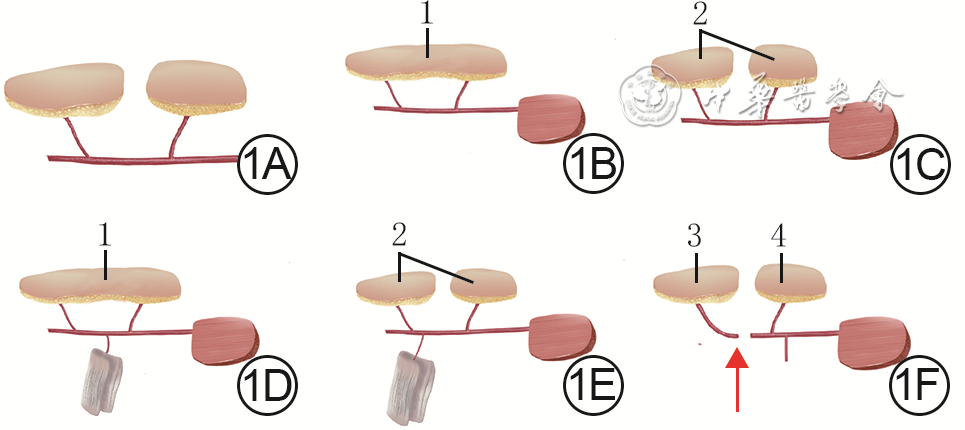
图 1 游离股前外侧嵌合皮瓣遵义分型示意图。1A.Ⅰ型嵌合皮瓣,由1种类型的组织构成;1B.Ⅱa型嵌合皮瓣,由2种类型的组织构成,皮肤未分叶;1C.Ⅱb型嵌合皮瓣,由2种类型的组织构成,且皮肤行分叶;1D.Ⅲa型嵌合皮瓣,由3种及以上类型的组织构成,皮肤未分叶;1E.Ⅲb型嵌合皮瓣,由3种及以上类型的组织构成,且皮肤行分叶;1F.Ⅳ型嵌合皮瓣,组织成分不限,为根据创面修复的特定需求,通过显微外科技术吻合血管人为构建的嵌合皮瓣
注:1表示皮肤未进行分叶处理,2表示皮肤进行分叶处理,3表示从额外供区切取的皮瓣,4表示从股前外侧区域切取的皮瓣;箭头指示血管吻合处

图 2 采用左侧游离Ⅰ型股前外侧嵌合皮瓣修复例1患者右手皮肤缺损的效果。2A.Ⅱ期术前,可见右手小指、中指、环指掌骨以远骨缺损、肌腱外露伴指背广泛皮肤缺损;2B.Ⅱ期术前,可见右手示指中节指骨缺损;2C.Ⅱ期术前,左侧股前外侧嵌合皮瓣设计;2D.Ⅱ期术中,切取由皮肤组成的Ⅰ型游离股前外侧嵌合皮瓣;2E、2F.分别为Ⅱ期术后2个月随访右手背侧、掌侧,皮瓣外形不臃肿

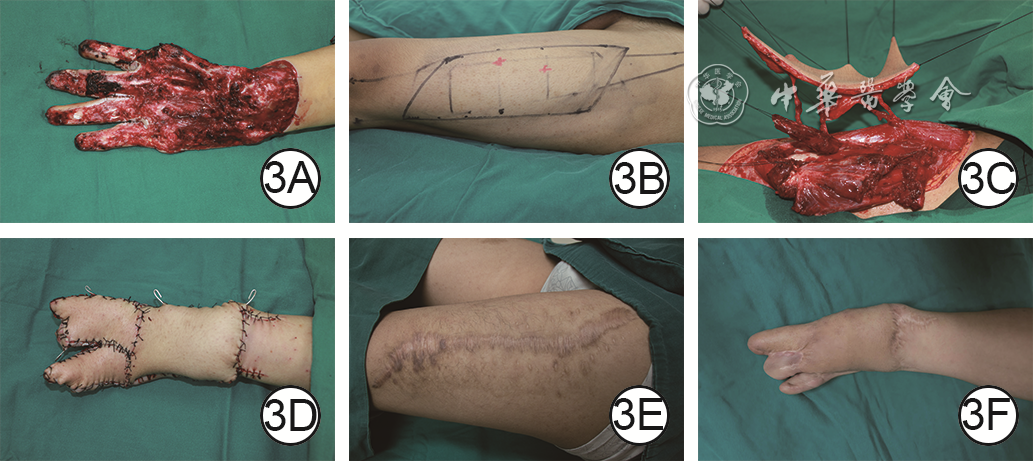
图 3 采用左侧Ⅲb型股前外侧嵌合皮瓣修复例2患者右手指、手掌、腕部皮肤缺损及消除死腔并修复腕关节囊缺损的效果。3A.Ⅱ期术前,右手掌侧机器绞伤所致组织缺损;3B.Ⅱ期术中,左侧股前外侧嵌合皮瓣设计;3C.Ⅱ期术中,切取由肌瓣、阔筋膜瓣、皮肤组成的Ⅲb型股前外侧嵌合皮瓣;3D.Ⅱ期术后即刻,皮瓣血运良好;3E.Ⅱ期术后2年随访,供区遗留瘢痕;3F.Ⅱ期术后2年随访,皮瓣外形不臃肿
Table 1. 游离股前外侧嵌合皮瓣的遵义分型
皮瓣类型 描述 适应证 Ⅰ型 由1种类型的组织构成,如双叶、三叶皮瓣 仅需要修复单纯皮肤缺损 Ⅱ型 Ⅱa型 由2种类型的组织构成,比如皮肤+肌瓣、皮肤+皮神经、皮肤+阔筋膜瓣、皮肤+骨瓣 在修复皮肤缺损的同时需要重建1种其他类型的组织的功能 Ⅱb型 在Ⅱa型的基础上,将皮肤进行分叶,化皮肤长度为宽度,更好地匹配创面 同Ⅱa型,创面形状不规则,需要将皮肤分叶以匹配创面 Ⅲ型 Ⅲa型 由3种及以上类型的组织构成,包含皮肤、神经、肌瓣、阔筋膜瓣、骨瓣 在修复皮肤缺损的同时需要重建2种及以上其他类型的组织的功能 Ⅲb型 在Ⅲa型的基础上,将皮肤进行分叶,化皮肤长度为宽度,更好匹配皮肤创面 同Ⅲa型,创面形状不规则,需要将皮肤分叶匹配创面 Ⅳ型 组织成分不限,根据创面修复的特定需求,通过显微外科技术吻合血管人为构建的嵌合皮瓣 大面积皮肤缺损、特殊组织或部位缺损,单个股前外侧区域无法满足修复需求,需要切取额外供区的组织(如对侧股前外侧皮瓣、空肠瓣、足底内侧皮瓣、腓骨瓣等)  下载: 导出CSV
-
 张演基5.6.mp4

-

 下载:
下载:


计量
- 文章访问数: 1856
- HTML全文浏览量: 441
- PDF下载量: 30
- 被引次数: 0
