





Analysis of the relationship between albumin balance status during the shock phase and MODS in patients with severe burns and the risk factors for the occurrence of negative albumin balance
-
摘要:
目的 分析严重烧伤患者休克期白蛋白平衡状态与多器官功能障碍综合征(MODS)的关系及发生白蛋白负平衡的危险因素。 方法 该研究为回顾性病例系列研究。2023年1月1日—2024年12月31日,陆军军医大学(第三军医大学)第一附属医院收治89例符合入选标准的严重烧伤患者,其中男73例、女16例,年龄(48±14)岁。采集患者入院时白蛋白测量值,基于Nadler公式估算血容量与血浆容量并引入外源性与内源性白蛋白代谢半衰期进行衰减校正,计算伤后48 h白蛋白平衡值,统计白蛋白负平衡发生情况。对患者入院时白蛋白测量值与伤后48 h白蛋白平衡值行相关分析。将伤后48 h白蛋白平衡值≤0 g/L的患者纳入负平衡组(14例),>0 g/L的患者纳入正平衡组(75例)。比较2组患者烧伤总面积、Ⅲ度烧伤面积,伤后48 h中性粒细胞百分比与白蛋白比值(NPAR)、系统炎症综合指数(AISI)、全身炎症反应指数(SIRI)、全身免疫炎症指数(SII)、中性粒细胞与淋巴细胞比值(NLR)、单核细胞与淋巴细胞比值(MLR)、改良序贯器官衰竭评估(SOFA)评分及MODS发生情况。筛选影响严重烧伤患者伤后48 h发生白蛋白负平衡的独立危险因素。 结果 患者入院时白蛋白测量值为(28±7)g/L,伤后48 h白蛋白平衡值为9.01(3.06,19.62)g/L,15.73%(14/89)的患者发生白蛋白负平衡。患者入院时白蛋白测量值与伤后48 h白蛋白平衡值呈显著正相关(rs=0.349,P<0.05)。负平衡组患者烧伤总面积、Ⅲ度烧伤面积均明显大于正平衡组(Z值分别为-3.736、-4.096,P<0.05),伤后48 h AISI、SIRI、SII、NPAR、MLR、改良SOFA评分、MODS发生比例均明显高于正平衡组(Z值分别为-2.310、-2.186、-2.130、-3.629、-2.108、-2.597,χ2=11.168,P<0.05)。单因素logistic回归分析结果显示,烧伤总面积和Ⅲ度烧伤面积以及伤后48 h NPAR、AISI、SIRI、SII、NLR、MLR、改良SOFA评分均为严重烧伤患者伤后48 h发生白蛋白负平衡的危险因素(OR分别为1.061、1.053、3.181、2.350、2.483、2.014、2.026、2.316、1.283,95%CI分别为1.028~1.094、1.025~1.081、1.635~6.189、1.193~4.631、1.250~4.932、1.061~3.821、1.025~4.008、1.167~4.597、1.065~1.546,P<0.05)。多因素logistic回归分析结果显示,Ⅲ度烧伤面积和伤后48 h SII均为严重烧伤患者伤后48 h发生白蛋白负平衡的独立危险因素(OR分别为1.055、2.347,95%CI分别为1.026~1.086、1.129~4.880,P<0.05)。 结论 严重烧伤患者休克期白蛋白负平衡与MODS的发生可能相关,Ⅲ度烧伤面积和伤后48 h SII是患者发生白蛋白负平衡的独立危险因素。 Abstract:Objective To analyse the relationship between albumin balance status during the shock phase and multiple organ dysfunction syndrome (MODS) in patients with severe burns and the risk factors for the occurrence of negative albumin balance. Methods This study was a retrospective case series study. From January 1st, 2023 to December 31st, 2024, 89 patients with severe burns who met the inclusion criteria were admitted to the First Affiliated Hospital of Army Medical University (Third Military Medical University), including 73 males and 16 females, aged (48±14) years. The albumin level at admission was collected, and blood volume and plasma volume were estimated based on the Nadler formula, with attenuation correction using the metabolic half-lives of exogenous and endogenous albumin, the albumin balance value at 48 h post-injury was calculated. Patients with an albumin balance value of ≤0 g/L at 48 h post-injury were included in negative balance group (n=14), while those with an albumin value of >0 g/L were included in positive balance group (n=75). The two groups were compared in terms of burn severity indicators such as total burn area and full-thickness burn area; inflammatory indicators at 48 h post-injury such as the neutrophil percentage-to-albumin ratio (NPAR), aggregate index of systemic inflammation (AISI), systemic inflammation response index (SIRI), systemic immune-inflammation index (SII), neutrophil-to-lymphocyte ratio (NLR), and monocyte-to-lymphocyte ratio (MLR); and organ injury indicators at 48 h post-injury such as the modified sequential organ failure assessment (SOFA) score and the incidence of MODS. The independent risk factors for the occurrence of negative albumin balance at 48 h post-injury in patients with severe burns were screened. Results In the 89 patients, the albumin level at admission was (28±7) g/L and the albumin balance value at 48 h post-injury was 9.01 (3.06, 19.62) g/L, with 15.73% (14/89) of the patients developing negative albumin balance. The albumin level at admission was significantly positively correlated with the albumin balance value at 48 h post-injury (rs=0.349, P<0.05). There were statistically significant differences between patients in negative balance group and positive balance group in terms of total burn area, full-thickness burn area, and AISI, SIRI, SII, NPAR, MLR, modified SOFA score and percentage of patients with MODS at 48 h post-injury (with Z values of -3.736, -4.096, -2.310, -2.186, -2.130, -3.629, -2.108, and -2.597, χ2=11.168, respectively, P<0.05). Univariate logistic regression analysis results showed that total burn area, full-thickness burn area, and NPAR, AISI, SIRI, SII, NLR, MLR, and modified SOFA score at 48 h post-injury were the risk factors for the occurrence of negative albumin balance at 48 h post-injury in patients with severe burns (with ORs of 1.061, 1.053, 1.116, 1.003, 1.240, 2.073, 1.082, 3.810 and 1.283, respectively, 95% CIs of 1.028-1.094, 1.025-1.081, 1.045-1.191, 1.001-1.004, 1.093-1.407, 1.227-3.501, 1.020-1.147, 1.627-8.923, and 1.065-1.546, respectively, P<0.05). Multivariate logistic regression analysis results showed that full-thickness burn area and SII at 48 h post-injury were the independent risk factors for the occurrence of negative albumin balance at 48 h post-injury in patients with severe burns (with ORs of 1.056 and 2.321, respectively, 95% CIs of 1.015-1.099 and 1.185-4.549, respectively, P<0.05). Conclusions Negative albumin balance during the shock phase was closely associated with the incidence of MODS in patients with severe burns, with full-thickness burn area and SII at 48 h post-injury were the independent risk factors for the occurrence of negative albumin balance. -
Key words:
- Burns /
- Hypoalbuminemia /
- Metabolism /
- Multiple organ failure /
- Prognosis /
- Risk factors
-
参考文献
(40) [1] JeschkeMG,van BaarME,ChoudhryMA,et al.Burn injury[J].Nat Rev Dis Primers,2020,6(1):11.DOI: 10.1038/s41572-020-0145-5. [2] 中国老年医学学会烧创伤分会.烧伤休克防治全国专家共识(2020版)[J].中华烧伤杂志,2020,36(9):786-792.DOI: 10.3760/cma.j.cn501120-20200623-00323. [3] CartottoR, JohnsonLS, SavetamalA, et al. American Burn Association Clinical Practice Guidelines on burn shock resuscitation[J]. J Burn Care Res,2024,45(3):565-589.DOI: 10.1093/jbcr/irad125. [4] HaberalM, Sakallioglu AbaliAE, KarakayaliH. Fluid management in major burn injuries[J]. Indian J Plast Surg,2010,43(Suppl):S29-S36.DOI: 10.4103/0970-0358.70715. [5] DemlingRH.The incidence and impact of pre-existing protein energy malnutrition on outcome in the elderly burn patient population[J].J Burn Care Rehabil,2005,26(1):94-100.DOI: 10.1097/01.bcr.0000150302.71007.80. [6] LehnhardtM,JafariHJ,DrueckeD,et al.A qualitative and quantitative analysis of protein loss in human burn wounds[J].Burns,2005,31(2):159-167.DOI: 10.1016/j.burns.2004.08.015. [7] SoetersPB, WolfeRR, ShenkinA. Hypoalbuminemia: pathogenesis and clinical significance[J]. JPEN J Parenter Enteral Nutr,2019,43(2):181-193.DOI: 10.1002/jpen.1451. [8] ChenYF, MaH, PerngCK, et al. Albumin supplementation may have limited effects on prolonged hypoalbuminemia in major burn patients: an outcome and prognostic factor analysis[J]. J Chin Med Assoc,2020,83(2):206-210.DOI: 10.1097/JCMA.0000000000000245. [9] CooperAB,CohnSM,ZhangHS,et al.Five percent albumin for adult burn shock resuscitation: lack of effect on daily multiple organ dysfunction score[J].Transfusion,2006,46(1):80-89.DOI: 10.1111/j.1537-2995.2005.00667.x. [10] LambdenS,LaterrePF,LevyMM,et al.The SOFA score-development, utility and challenges of accurate assessment in clinical trials[J].Crit Care,2019,23(1):374.DOI: 10.1186/s13054-019-2663-7. [11] NavickisRJ, GreenhalghDG, WilkesMM. Albumin in burn shock resuscitation: a meta-analysis of controlled clinical studies[J]. J Burn Care Res,2016,37(3):e268-e278.DOI: 10.1097/BCR.0000000000000201. [12] ZdolsekM,HahnRG,SjöbergF,et al.Plasma volume expansion and capillary leakage of 20% albumin in burned patients and volunteers[J].Crit Care,2020,24(1):191.DOI: 10.1186/s13054-020-02855-0. [13] HasselgrenE, ZdolsekM, ZdolsekJH, et al. Long intravascular persistence of 20% albumin in postoperative patients[J]. Anesth Analg,2019,129(5):1232-1239.DOI: 10.1213/ANE.0000000000004047. [14] SharmaHK, PageSS. Protein deficiency and related metabolic disturbances and its effects on drug metabolism in patients with burns[J]. Indian J Burns,2024,32(1):1-6.DOI: 10.4103/ijb.ijb_1_24. [15] SaraviB,GoebelU,HassenzahlLO,et al.Capillary leak and endothelial permeability in critically ill patients: a current overview[J].Intensive Care Med Exp,2023,11(1):96.DOI: 10.1186/s40635-023-00582-8. [16] OhWS, ChonSB. Calculation of the residual blood volume after acute, non-ongoing hemorrhage using serial hematocrit measurements and the volume of isotonic fluid infused: theoretical hypothesis generating study[J]. J Korean Med Sci,2016,31(5):814-816.DOI: 10.3346/jkms.2016.31.5.814. [17] LevittDG,LevittMD.Human serum albumin homeostasis: a new look at the roles of synthesis, catabolism, renal and gastrointestinal excretion, and the clinical value of serum albumin measurements[J].Int J Gen Med,2016,9:229-255.DOI: 10.2147/IJGM.S102819. [18] 吴军,罗高兴. 烧伤免疫研究进展[J]. 中华烧伤杂志,2004,20(6):321-323.DOI: 10.3760/cma.j.issn.1009-2587.2004.06.101. [19] VincentJL,DuboisMJ,NavickisRJ,et al.Hypoalbuminemia in acute illness: is there a rationale for intervention? A meta-analysis of cohort studies and controlled trials[J].Ann Surg,2003,237(3):319-334.DOI: 10.1097/01.SLA.0000055547.93484.87. [20] YeTTS, VishnuK S, DahilA, et al. Serum albumin on admission: a prognostic marker of morbidity and mortality in burns? A systematic review and meta-analysis[J]. J Burn Care Res,2026,47(5):1530-1542.DOI: 10.1093/jbcr/irag092. [21] BandeiraNG, BarrosoMVVS, MatosMAA, et al. Serum albumin concentration on admission as a predictor of morbidity and mortality in patients with burn injuries[J]. J Burn Care Res,2021,42(5):991-997.DOI: 10.1093/jbcr/irab004. [22] NadlerSB,HidalgoJH,BlochT.Prediction of blood volume in normal human adults[J].Surgery,1962,51(2):224-232. [23] WangB,ChenG,CaoY,et al.Correlation of lactate/albumin ratio level to organ failure and mortality in severe sepsis and septic shock[J].J Crit Care,2015,30(2):271-275.DOI: 10.1016/j.jcrc.2014.10.030. [24] DeitchEA.Intestinal permeability is increased in burn patients shortly after injury[J].Surgery,1990,107(4):411-416. [25] SingerM, DeutschmanCS, SeymourCW, et al. The third international consensus definitions for sepsis and septic shock (Sepsis-3)[J]. JAMA,2016,315(8):801-810.DOI: 10.1001/jama.2016.0287. [26] WeissSJ.Tissue destruction by neutrophils[J].N Engl J Med,1989,320(6):365-376.DOI: 10.1056/NEJM198902093200606. [27] FerreiraFL,BotaDP,BrossA,et al.Serial evaluation of the SOFA score to predict outcome in critically ill patients[J].JAMA,2001,286(14):1754-1758.DOI: 10.1001/jama.286.14.1754. [28] LiF,HeQ,PengH,et al.The systemic inflammation indexes after admission predict in-hospital mortality in patients with extensive burns[J].Burns,2024,50(4):980-990.DOI: 10.1016/j.burns.2024.01.020. [29] UrbanowiczT, MichalakM, Olasińska-WiśniewskaA, et al. Neutrophil counts, neutrophil-to-lymphocyte ratio, and systemic inflammatory response index (SIRI) predict mortality after off-pump coronary artery bypass surgery[J]. Cells,2022,11(7):1124.DOI: 10.3390/cells11071124. [30] HuB,YangXR,XuY,et al.Systemic immune-inflammation index predicts prognosis of patients after curative resection for hepatocellular carcinoma[J].Clin Cancer Res,2014,20(23):6212-6222.DOI: 10.1158/1078-0432.CCR-14-0442. [31] QiQ,ZhuangL,ShenY,et al.A novel systemic inflammation response index (SIRI) for predicting the survival of patients with pancreatic cancer after chemotherapy[J].Cancer,2016,122(14):2158-2167.DOI: 10.1002/cncr.30057. [32] XiaY, XiaC, WuL, et al. Systemic immune inflammation index (SII), system inflammation response index (SIRI) and risk of all-cause and cardiovascular mortality: a 20-year follow-up cohort study of 42,875 US adults[J]. J Clin Med,2023,12(3):1128.DOI: 10.3390/jcm12031128. [33] JeschkeMG,MlcakRP,FinnertyCC,et al.Burn size determines the inflammatory and hypermetabolic response[J].Crit Care,2007,11(4):R90.DOI: 10.1186/cc6102. [34] GabayC,KushnerI.Acute-phase proteins and other systemic responses to inflammation[J].N Engl J Med,1999,340(6):448-454.DOI: 10.1056/NEJM199902113400607. [35] FinnertyCC,HerndonDN,PrzkoraR,et al.Cytokine expression profile over time in severely burned pediatric patients[J].Shock,2006,26(1):13-19.DOI: 10.1097/01.shk.0000223120.26394.7d. [36] XiaoW,MindrinosMN,SeokJ,et al.A genomic storm in critically injured humans[J].J Exp Med,2011,208(13):2581-2590.DOI: 10.1084/jem.20111354. [37] MartiniWZ,WolfSE,ChinkesDL,et al.Enhanced albumin synthesis in severely burned adults[J].Shock,2010,34(4):364-368.DOI: 10.1097/SHK.0b013e3181d8844b. [38] CartottoR, CallumJ. A review on the use of plasma during acute burn resuscitation[J]. J Burn Care Res,2020,41(2):433-440.DOI: 10.1093/jbcr/irz184. [39] SaffleJI.The phenomenon of "fluid creep" in acute burn resuscitation[J].J Burn Care Res,2007,28(3):382-395.DOI: 10.1097/BCR.0B013E318053D3A1. [40] XuZ, ZhangK, LiuD, et al. Predicting mortality and risk factors of sepsis related ARDS using machine learning models[J]. Sci Rep,2025,15(1):13509.DOI: 10.1038/s41598-025-96501-w. -

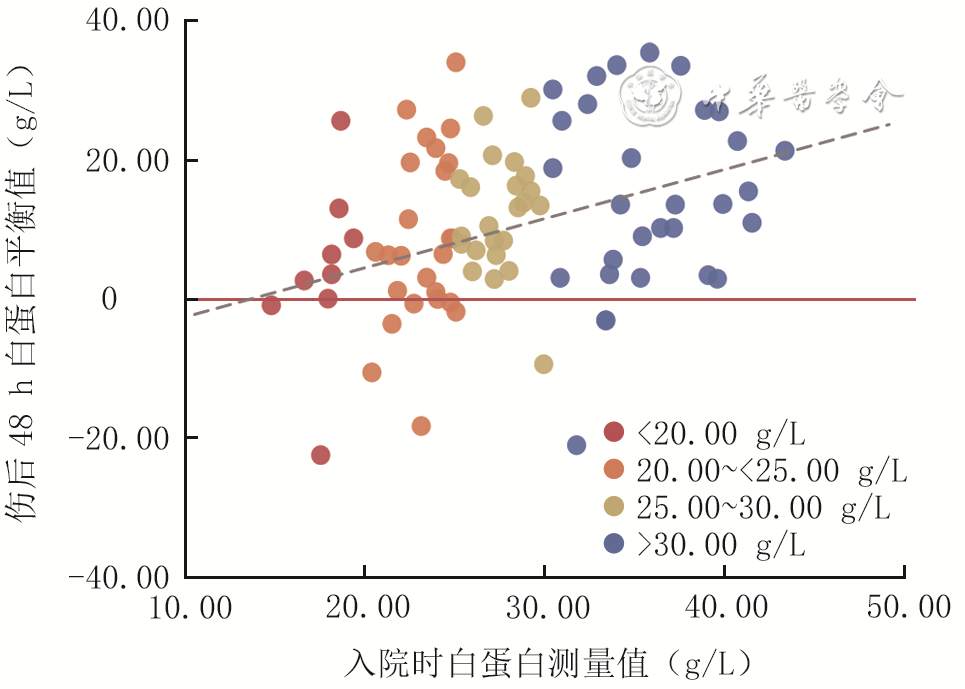
图 1 89例严重烧伤患者入院时白蛋白测量值不同分层下伤后48 h白蛋白平衡值的分布及二者的相关性
注:按入院时白蛋白测量值将患者分为4层(<20.00、20.00~<25.00、25.00~30.00、>30.00 g/L),图中红色实线示伤后48 h白蛋白平衡值=0;2例患者数据超出坐标轴范围未予显示(1例入院时白蛋白测量值51.60 g/L、1例伤后48 h白蛋白平衡值-63.85 g/L);入院时白蛋白测量值与伤后48 h白蛋白平衡值呈显著正相关,rs=0.349,P<0.001
Table 1. 2组严重烧伤患者临床和实验室检测指标比较
组别 例数 性别(例) 年龄(岁, 伤后入院时间[h,M(Q1,Q3)] 烧伤总面积[%TBSA,M(Q1,Q3)] Ⅲ度烧伤面积[%TBSA,M(Q1,Q3)] 合并吸入性损伤(例) 基础性疾病(例) 男 女 正平衡组 75 63 12 48±14 6.00(4.00,10.50) 40.00(33.50,53.00) 15.00(5.00,26.00) 47 19 负平衡组 14 10 4 50±19 7.50(6.25,9.00) 71.50(60.50,88.75) 42.00(35.25,79.25) 12 6 统计量值 — t=-0.452 Z=-0.963 Z=-3.736 Z=-4.096 — — P值 0.269 0.652 0.335 <0.001 <0.001 0.127 0.204 注:将伤后48 h白蛋白平衡值>0 g/L的患者纳入正平衡组,≤0 g/L的患者纳入负平衡组;“—”表示无此项;TBSA为体表总面积,AISI为系统炎症综合指数,SIRI为全身炎症反应指数,SII为全身免疫炎症指数,NPAR为中性粒细胞百分比与白蛋白比值,NLR为中性粒细胞与淋巴细胞比值,MLR为单核细胞与淋巴细胞比值,SOFA为序贯器官衰竭评估,MODS为多器官功能障碍综合征  下载: 导出CSV
Table 2. 89例严重烧伤患者伤后48 h发生白蛋白负平衡影响因素的单因素logistic回归分析结果
自变量 OR 95%CI P值 性别(以男性为参照) 2.100 0.565~7.811 0.268 年龄(岁) 1.009 0.970~1.050 0.648 伤后入院时间(h) 0.992 0.926~1.063 0.816 烧伤总面积(%TBSA) 1.061 1.028~1.094 <0.001 Ⅲ度烧伤面积(%TBSA) 1.053 1.025~1.081 <0.001 合并吸入性损伤(以无吸入性损伤为参照) 3.574 0.745~17.153 0.111 基础性疾病(以无基础性疾病为参照) 2.211 0.680~7.190 0.187 休克期补液系数(mL·kg-1·%TBSA-1) 0.370 0.074~1.851 0.226 休克期电解质系数(mL·kg-1·%TBSA-1) 0.315 0.046~2.157 0.239 休克期胶体系数(mL·kg-1·%TBSA-1) 0.570 0.031~10.606 0.706 休克期尿量(mL·kg-1·h-1) 0.160 0.014~1.892 0.146 伤后48 h NPAR(ln值) 3.181 1.635~6.189 <0.001 伤后48 h AISI(ln值) 2.350 1.193~4.631 0.014 伤后48 h SIRI(ln值) 2.483 1.250~4.932 0.009 伤后48 h SII(ln值) 2.014 1.061~3.821 0.032 伤后48 h NLR(ln值) 2.026 1.025~4.008 0.042 伤后48 h MLR(ln值) 2.316 1.167~4.597 0.016 伤后48 h改良SOFA评分(分) 1.283 1.065~1.546 0.009 注:TBSA为体表总面积,NPAR为中性粒细胞百分比与白蛋白比值,AISI为系统炎症综合指数,SIRI为全身炎症反应指数,SII为全身免疫炎症指数,NLR为中性粒细胞与淋巴细胞比值,MLR为单核细胞与淋巴细胞比值,SOFA为序贯器官衰竭评估
下载: 导出CSV
-

 下载:
下载:


图(2) / 表(2)
计量
- 文章访问数: 2
- HTML全文浏览量: 2
- PDF下载量: 0
- 被引次数: 0
