





Intelligent intensive care unit construction and severe burn management: integration and innovation
-
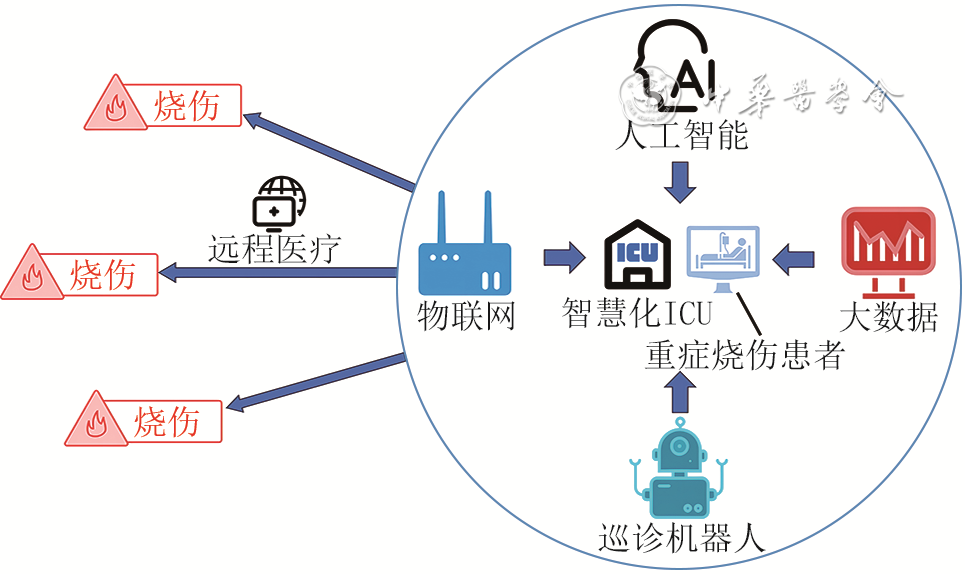
摘要: 智慧化重症监护病房(ICU)的发展促进了重症烧伤患者的优化救治。智慧化ICU基于物联网技术的设备互联实现了数据自动采集与共享,整合了烧伤多模态数据并进行病情预测与评估,推动了远程监护与治疗。面对重症烧伤患者病情复杂多样、模型可解释性和数据安全不足等挑战,在未来的智慧化烧伤ICU建设中,仍需在软硬件基础设施、多模态信息整合、智能预测建模、虚拟现实辅助诊断与治疗、远程医疗联动、临床指南更新以及多学科融合等方面持续探索与创新。Abstract: The development of intelligent intensive care unit (ICU) has promoted the optimal treatment of severely burned patients. Intelligent ICUs, based on the Internet of Things technology, enable automatic data acquisition and sharing through device connection, integrate multimodal burn data and carry out prediction and evaluation of diseases, and promote remote monitoring and treatment. Faced with challenges such as the complexity and diversity of severe burn patients' conditions, insufficient model interpretability, and inadequate data security, the future construction of intelligent burn ICUs will still require continuous exploration and innovation in areas including software and hardware infrastructure, multimodal information integration, intelligent predictive modeling, virtual reality-assisted diagnosis and treatment, telemedicine linkage, clinical guideline updates, and multi-disciplinary integration.
-
Key words:
- Burns /
- Intensive care units /
- Artificial intelligence /
- Internet of Things /
- Telemedicine /
- Virtual reality
-
参考文献
(42) [1] TrojanS,SteinF,LeferingR,et al.Survey about target temperature and thermal management in intensive care for severe thermal trauma in burn centres of Germany, Austria and Switzerland[J].Burns,2025,51(1):107308.DOI: 10.1016/j.burns.2024.107308. [2] KileyJL,GreenhalghDG.Infections in burn patients[J].Surg Clin North Am,2023,103(3):427-437.DOI: 10.1016/j.suc.2023.02.005. [3] Radzikowska-BüchnerE,ŁopuszyńskaI,FliegerW,et al.An overview of recent developments in the management of burn injuries[J].Int J Mol Sci,2023,24(22):16357.DOI: 10.3390/ijms242216357. [4] MaoZ,LiuC,LiQ,et al.Intelligent intensive care unit: current and future trends[J].Intensive Care Res,2023,3:182-188.DOI: 10.1007/s44231-023-00036-5. [5] KhanMS,ArshadMS,GreeneSJ,et al.Artificial intelligence and heart failure: a state-of-the-art review[J].Eur J Heart Fail,2023,25(9):1507-1525.DOI: 10.1002/ejhf.2994. [6] HuangB,HuangH,ZhangS,et al.Artificial intelligence in pancreatic cancer[J].Theranostics,2022,12(16):6931-6954.DOI: 10.7150/thno.77949. [7] BeunzaJJ,LafuenteJL,GonzálezS,et al.Artificial intelligence and the Internet of Medical Things in the ICU: time for implementation[J].Med Intensiva (Engl Ed),2024,48(1):56-58.DOI: 10.1016/j.medine.2023.10.012. [8] XuN,LiuC,FengY,et al.Influence of the Internet of Things management system on hand hygiene compliance in an emergency intensive care unit[J].J Hosp Infect,2021,109:101-106.DOI: 10.1016/j.jhin.2020.12.009. [9] AkellaP,VoigtLP,ChawlaS.To wean or not to wean: a practical patient focused guide to ventilator weaning[J].J Intensive Care Med,2022,37(11):1417-1425.DOI: 10.1177/08850666221095436. [10] SchaubroeckH,RossbergM,ThieleH,et al.ICU management of cardiogenic shock before mechanical support[J].Curr Opin Crit Care,2024,30(4):362-370.DOI: 10.1097/MCC.0000000000001182. [11] ArnalJM,KatayamaS,HowardC.Closed-loop ventilation[J].Curr Opin Crit Care,2023,29(1):19-25.DOI: 10.1097/MCC.0000000000001012. [12] BaiY,GuB,TangC.Enhancing real-time patient monitoring in intensive care units with deep learning and the Internet of Things[J/OL].Big Data,2025(2025-01-17)[2025-07-15]. https://pubmed.ncbi.nlm.nih.gov/39819048/.DOI:10.1089/big.2024.0113.[published online ahead of print]. [13] YesminT,CarterMW,GladmanAS.Internet of Things in healthcare for patient safety: an empirical study[J].BMC Health Serv Res,2022,22(1):278.DOI: 10.1186/s12913-022-07620-3. [14] Al-KahtaniMS,KhanF,TaekeunW.Application of Internet of Things and sensors in healthcare[J].Sensors (Basel),2022,22(15):5738.DOI: 10.3390/s22155738. [15] KongHJ,AnS,LeeS,et al.Usage of the Internet of Things in medical institutions and its implications[J].Healthc Inform Res,2022,28(4):287-296.DOI: 10.4258/hir.2022.28.4.287. [16] 齐霜,毛智,胡新,等.基于专科信息系统建立的重症医学数据库:大型三甲医院重症医学数据库的模式[J].中华危重病急救医学,2020,32(6):743-749.DOI: 10.3760/cma.j.cn121430-20200520-00393. [17] Gwyn-JonesA,AfolabiT,BonneyS,et al.Major burns in adults: a practice review[J].Emerg Med J,2024,41(10):630-634.DOI: 10.1136/emermed-2024-214046. [18] HarutaA,MandellSP.Assessment and management of acute burn injuries[J].Phys Med Rehabil Clin N Am,2023,34(4):701-716.DOI: 10.1016/j.pmr.2023.06.019. [19] FaourS,FarahatM,AijazA,et al.Fibrosis in burns: an overview of mechanisms and therapies[J].Am J Physiol Cell Physiol,2023,325(6):C1545-C1557.DOI: 10.1152/ajpcell.00254.2023. [20] HuangP,ZhuL,WuQ,et al.Safety influencing factors and management countermeasures of patients transferred from ICU in transition period based on intelligent processor three-dimensional quality model[J].J Healthc Eng,2022,2022:1455830.DOI: 10.1155/2022/1455830. [21] WangD,LiJ,SunY,et al.A machine learning model for accurate prediction of sepsis in ICU patients[J].Front Public Health,2021,9:754348.DOI: 10.3389/fpubh.2021.754348. [22] JacobsonMJ,MasryME,ArrublaDC,et al.Autonomous multi-modality burn wound characterization using artificial intelligence[J].Mil Med,2023,188(Suppl 6):674-681.DOI: 10.1093/milmed/usad301. [23] RashidiHH,SenS,PalmieriTL,et al.Early recognition of burn- and trauma-related acute kidney injury: a pilot comparison of machine learning techniques[J].Sci Rep,2020,10(1):205.DOI: 10.1038/s41598-019-57083-6. [24] SchmidtSV,DryschM,ReinkemeierF,et al.Improvement of predictive scores in burn medicine through different machine learning approaches[J].Healthcare (Basel),2023,11(17):2437.DOI: 10.3390/healthcare11172437. [25] EdwardsSR,ChamounG,HecoxEE,et al.Barriers to remote burn care delivery: an analysis of burn center proximity and access to critical telehealth infrastructure[J].Ann Plast Surg,2024,92(6S Suppl 4):S391-S396.DOI: 10.1097/SAP.0000000000003960. [26] ShahdadiH,RezayiS,ShahrahmaniF,et al.Photographic evaluation of burn depth via telemedicine: insights from iranian surgeons[J].Telemed Rep,2023,4(1):266-270.DOI: 10.1089/tmr.2023.0048. [27] BasaranA,OzluO,DasK.Telemedicine in burn patients: reliability and patient preference[J].Burns,2021,47(8):1873-1877.DOI: 10.1016/j.burns.2020.11.015. [28] Monte SoldadoA,López-MasrramonB,Aguilera-SáezJ,et al.Implementation and evaluation of telemedicine in burn care: study of clinical safety and technical feasibility in a single burn center[J].Burns,2020,46(7):1668-1673.DOI: 10.1016/j.burns.2020.04.027. [29] ZhouC,HuJ,ChenN.Remote care assistance in emergency department based on smart medical[J].J Healthc Eng,2021,2021:9971960.DOI: 10.1155/2021/9971960. [30] JiangJ,ZhangJ,SunJ,et al.User's image perception improved strategy and application of augmented reality systems in smart medical care: a review[J].Int J Med Robot,2023,19(3):e2497.DOI: 10.1002/rcs.2497. [31] PrasitlumkumN,CheungpasitpornW,ChokesuwattanaskulA,et al.Diagnostic accuracy of smart gadgets/wearable devices in detecting atrial fibrillation: a systematic review and meta-analysis[J].Arch Cardiovasc Dis,2021,114(1):4-16.DOI: 10.1016/j.acvd.2020.05.015. [32] KileyJL,ChungKK,BlythDM.Viral infections in burns[J].Surg Infect (Larchmt),2021,22(1):88-94.DOI: 10.1089/sur.2020.130. [33] RaimundoR,RosárioA.The impact of artificial intelligence on data system security: a literature review[J].Sensors (Basel),2021,21(21):7029.DOI: 10.3390/s21217029. [34] ParkYR,EomJB.Multi-wavelength imaging photoplethysmography for non-invasive and non-contact assessment of burn severity[J].Sci Rep,2025,15(1):16586.DOI: 10.1038/s41598-025-01707-7. [35] ParkJH,ChoY,ShinD,et al.Prediction of mortality after burn surgery in critically ill burn patients using machine learning models[J].J Pers Med,2022,12(8):1293.DOI: 10.3390/jpm12081293. [36] LiH,ZhenN,LinS,et al.Deployable machine learning-based decision support system for tracheostomy in acute burn patients[J/OL].Burns Trauma,2025,13:tkaf010[2025-07-15].https://pubmed.ncbi.nlm.nih.gov/40365530/.DOI: 10.1093/burnst/tkaf010. [37] XieL,XuA,CaiD,et al.Development of a predictive model for deep vein thrombosis in burn patients based on the Caprini Risk Assessment Scale[J].Am J Transl Res,2025,17(1):538-549.DOI: 10.62347/EBEW2103. [38] 王华,赵朋,孙丹,等.烧伤患者医院感染的流行病学特点及风险预测模型的构建与评价[J].中华烧伤与创面修复杂志,2022,38(12):1170-1178.DOI: 10.3760/cma.j.cn501225-20220214-00025. [39] 沈拓, 马琪敏, 褚志刚, 等. 成年严重烧伤患者早期凝血特征的多中心回顾分析及预后的危险因素分析[J]. 中华烧伤与创面修复杂志, 2025, 41(9): 857-866. DOI: 10.3760/cma.j.cn501225-20250530-00250. [40] RamageM,DavisSP.Virtual reality as an intervention for adult burn patients: an integrative review[J].J Res Nurs,2025:17449871251317922.DOI: 10.1177/17449871251317922. [41] CecconiM,GrecoM,ShickelB,et al.Implementing artificial intelligence in critical care medicine: a consensus of 22[J].Crit Care,2025,29(1):290.DOI: 10.1186/s13054-025-05532-2. [42] WangZ.An intelligent collection system of big data in medical and health education based on the Internet of Things[J].J Healthc Eng,2022,2022:3735102.DOI: 10.1155/2022/3735102. -

 下载:
下载:


图(2)
计量
- 文章访问数: 4897
- HTML全文浏览量: 846
- PDF下载量: 27
- 被引次数: 0
