






Latent profile analysis of the relationship between immune subtypes in sepsis patients and response to glucocorticoid treatment and prognosis
-
摘要:
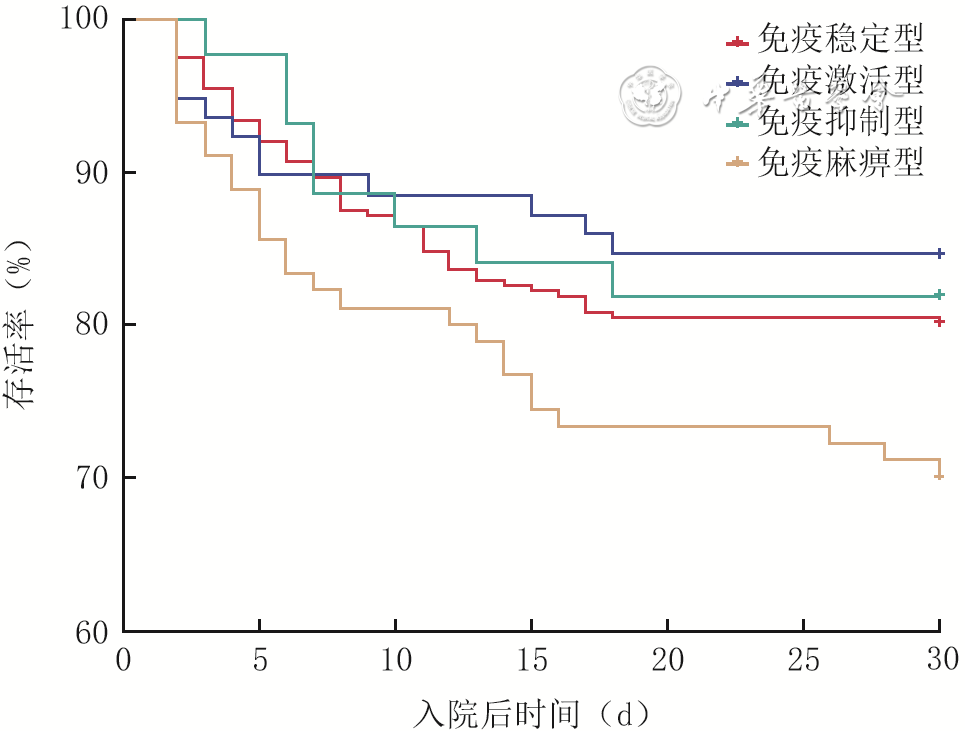
目的 探究脓毒症患者免疫亚型与糖皮质激素(GC)治疗反应及预后的关系,为烧创伤脓毒症患者的免疫分型与治疗提供参考。 方法 该研究为回顾性队列研究。2021年1月1日—2024年6月20日,温州医科大学附属第一医院急诊重症监护病房(EICU)收治499例符合入选标准的脓毒症患者,其中男304例、女195例,年龄67.0(55.0,75.0)岁。将患者按入院后30 d内死亡(以下简称30 d死亡)情况分为存活组(395例)与死亡组(104例),比较2组患者临床特征,包括年龄、体重指数等基本资料,慢性肺脏、肾脏、肝脏疾病等合并症,入院后24 h内序贯器官衰竭评估(SOFA)评分、急性生理学和慢性健康状况评价Ⅱ(APACHEⅡ)评分以及机械通气、血液透析情况,入院后48 h内静脉输注GC即早期GC治疗情况及住院时长。基于所有患者入院后48 h内11项免疫指标,使用潜在剖面分析(LPA)识别患者的免疫亚型。比较不同免疫亚型患者的临床特征,评估免疫亚型对患者30 d死亡风险的影响、早期GC治疗对不同免疫亚型患者30 d死亡风险的影响。 结果 存活组和死亡组患者年龄、体重指数,入院后24 h内SOFA评分、APACHEⅡ评分,住院时长,合并慢性肺脏、肾脏、肝脏疾病情况,入院后24 h内机械通气、血液透析情况,早期GC治疗情况比较,差异均有统计学意义(U值分别为15 316.00、24 534.00、16 981.50、12 242.00、40 685.00,χ2值分别为7.66、9.47、5.17、35.70、20.76、6.57,P<0.05)。LPA在499例患者中确定4种免疫亚型,其中免疫稳定型患者287例、免疫激活型患者78例、免疫抑制型患者44例、免疫麻痹型患者90例。4种免疫亚型患者入院后24 h内SOFA评分、APACHEⅡ评分,合并慢性肾脏疾病情况,入院后24 h内机械通气、血液透析情况,早期GC治疗情况比较,差异均有统计学意义(H值分别为46.82、22.55,χ2值分别为12.56、17.77、13.81、14.84,P<0.05)。在免疫麻痹型患者中,行早期GC治疗者30 d死亡比例显著高于未行早期GC治疗者(χ2=5.95,P<0.05)。调整年龄、性别、体重指数、合并症、SOFA评分、APACHEⅡ评分后,免疫稳定型患者30 d死亡风险显著低于免疫麻痹型患者(HR=0.53,95%CI为0.33~0.86,P<0.05),免疫麻痹型患者行早期GC治疗对其30 d死亡风险增加具有显著影响(HR=2.92,95%CI为1.16~7.32,P<0.05)。 结论 脓毒症患者存在4种免疫亚型,不同亚型患者具有独特的临床特征、预后及对GC治疗的反应性差异,早期GC治疗对免疫麻痹型患者死亡风险增加具有显著影响。 Abstract:Objective To explore the relationship between immune subtypes in sepsis patients and their response to glucocorticoid (GC) treatment and prognosis, so as to provide a reference for immune typing and treatment of burn and trauma patients with sepsis. Methods The study was a retrospective cohort study. From January 1, 2021 to June 20, 2024, 499 sepsis patients were admitted to the emergency intensive care unit (EICU) of the First Affiliated Hospital of Wenzhou Medical University, including 304 males and 195 females, aged 67.0 (55.0, 75.0) years. The patients were divided into survival group (n=395) and death group (n=104) according to the death within 30 days after admission (hereinafter referred to as 30-day death). The clinical characteristics of two groups of patients were compared, including age, body mass index, and other basic data, chronic lung, kidney, and liver diseases and other complications, sequential organ failure assessment (SOFA) score, acute physiology and chronic health evaluation Ⅱ (APACHE Ⅱ) score, mechanical ventilation, and hemodialysis within 24 hours after admission, and the intravenous administration of GC within 48 hours of hospitalization, i.e., early GC treatment, and length of hospital stay. Based on the 11 immune indicators of all patients within 48 hours after admission, latent profile analysis (LPA) was used to identify the immune subtypes of patients. The clinical characteristics of patients with different immune subtypes were compared. The impact of immune subtypes on the 30-day death risk of patients and the impact of early GC treatment on the 30-day death risk of patients with different immune subtypes were evaluated. Results There were statistically significant differences in age, body mass index, SOFA score and APACHE Ⅱ score within 24 hours after admission, length of hospital stay, complications of chronic lung, kidney, and liver diseases, mechanical ventilation and hemodialysis within 24 hours after admission, and early GC treatment between patients in survival group and death group (with U values of 15 316.00, 24 534.00, 16 981.50, 12 242.00, and 40 685.00, respectively, χ2 values of 7.66, 9.47, 5.17, 35.70, 20.76, and 6.57, respectively, P<0.05). LPA identified 4 immune subtypes in 499 patients, including 287 patients with immune stable type, 78 patients with immune activated type, 44 patients with immune suppressed type, and 90 patients with immune paralyzed type. There were statistically significant differences in SOFA score and APACHE Ⅱ score within 24 hours after admission, complication of chronic kidney disease, mechanical ventilation and hemodialysis within 24 hours after admission, and early GC treatment among the four immune subtypes of patients (with H values of 46.82 and 22.55, respectively, χ2 values of 12.56, 17.77, 13.81, and 14.84, respectively, P<0.05). Among patients with immune paralyzed type, the 30-day death ratio of patients with early GC treatment was significantly higher than that of patients without early GC treatment (χ2=5.95, P<0.05). After adjusting for age, gender, body mass index, complications, SOFA score, and APACHE Ⅱ score, the 30-day death risk of patients with immune stable type was significantly lower than that of patients with immune paralyzed type (HR=0.53, with 95% CI of 0.33-0.86, P<0.05), and early GC treatment for patients with immune paralyzed type had a significant impact on the increased 30-day death risk (HR=2.92, with 95% CI of 1.16-7.32, P<0.05). Conclusions There are 4 immune subtypes in sepsis patients. Patients with different subtypes exhibit unique clinical features, prognoses, and varying responses to early GC treatment. Early GC treatment has a significant impact on the increased risk of death in patients with immune paralyzed type. -
Key words:
- Sepsis /
- Immunophenotyping /
- Glucocorticoids /
- Prognosis /
- Clinical characteristics /
- Latent profile analysis
-
参考文献
(37) [1] SingerM,DeutschmanCS,SeymourCW,et al.The third international consensus definitions for sepsis and septic shock (Sepsis-3)[J].JAMA,2016,315(8):801-810.DOI: 10.1001/jama.2016.0287. [2] LiY,ZhangH,ChenC,et al.Biomimetic immunosuppressive exosomes that inhibit cytokine storms contribute to the alleviation of sepsis[J].Adv Mater,2022,34(19):e2108476.DOI: 10.1002/adma.202108476. [3] 姚咏明,张卉.改善脓毒症患者长期预后的康复治疗对策[J].中华烧伤与创面修复杂志,2022,38(3):201-206.DOI: 10.3760/cma.j.cn501120-20211004-00344. [4] Fleischmann-StruzekC,RuddK.Challenges of assessing the burden of sepsis[J].Med Klin Intensivmed Notfmed,2023,118(Suppl 2):S68-S74.DOI: 10.1007/s00063-023-01088-7. [5] SeymourCW,GomezH,ChangCH,et al.Precision medicine for all? Challenges and opportunities for a precision medicine approach to critical illness[J].Crit Care,2017,21(1):257.DOI: 10.1186/s13054-017-1836-5. [6] WangW,LiuCF.Sepsis heterogeneity[J].World J Pediatr,2023,19(10):919-927.DOI: 10.1007/s12519-023-00689-8. [7] WiersingaWJ,van der PollT.Immunopathophysiology of human sepsis[J].EBioMedicine,2022,86:104363.DOI: 10.1016/j.ebiom.2022.104363. [8] ZhangZ,AbardaA,ContractorAA,et al.Exploring heterogeneity in clinical trials with latent class analysis[J].Ann Transl Med,2018,6(7):119.DOI: 10.21037/atm.2018.01.24. [9] KempkerJA,MartinGS.The changing epidemiology and definitions of sepsis[J].Clin Chest Med,2016,37(2):165-179.DOI: 10.1016/j.ccm.2016.01.002. [10] 马帅,郭树彬.脓毒症免疫麻痹与细胞免疫调理治疗研究进展[J].中华急诊医学杂志,2016,25(7):969-973.DOI: 10.3760/cma.j.issn.1671-0282.2016.07.027. [11] 裴飞,吴健锋.脓毒症免疫调理治疗研究进展[J].中华医学信息导报,2021,36(21):19.DOI: 10.3760/cma.j.issn.1000-8039.2021.21.127. [12] 姚咏明,栾樱译.严重烧创伤感染及其并发症的免疫新认识[J].中华烧伤杂志,2021,37(6):519-523.DOI: 10.3760/cma.j.cn501120-20210118-00025. [13] WuY,WangL,LiY,et al.Immunotherapy in the context of sepsis-induced immunological dysregulation[J].Front Immunol,2024,15:1391395.DOI: 10.3389/fimmu.2024.1391395. [14] 胡荣华,郑颜磊,程飞,等.脓毒症精准免疫治疗的新进展[J].中国中西医结合急救杂志,2019,26(4):504-506.DOI: 10.3969/j.issn.1008-9691.2019.04.036. [15] 权震,温良鹤,郑俊波,等.脓毒症免疫抑制机制及治疗策略[J].中国急救医学,2024,44(1):25-29.DOI: 10.3969/j.issn.1002-1949.2024.01.005. [16] 彭海伦,赵月丽,徐崇孝,等. 成人脓毒症分型研究进展[J]. 解放军医学杂志,2023,48(9):1107-1112. DOI: 10.11855/j.issn.0577-7402.1426.2022.0915. [17] 姚咏明,张卉,董宁.脓毒症分型:精准治疗之基石[J].中华烧伤与创面修复杂志,2024,40(10):915-919.DOI: 10.3760/cma.j.cn501225-20240529-00203. [18] CaoM,WangG,XieJ.Immune dysregulation in sepsis: experiences, lessons and perspectives[J].Cell Death Discov,2023,9(1):465.DOI: 10.1038/s41420-023-01766-7. [19] LiuZ,TingY,LiM,et al.From immune dysregulation to organ dysfunction: understanding the enigma of Sepsis[J].Front Microbiol,2024,15:1415274.DOI: 10.3389/fmicb.2024.1415274. [20] 魏启美,修光辉.人工智能在脓毒症早期诊断及预测中应用的研究进展[J].中华危重病急救医学,2022,34(11):1218-1221.DOI: 10.3760/cma.j.cn121430-20220628-00611. [21] SpurkD,HirschiA,WangM,et al.Latent profile analysis: a review and “how to” guide of its application within vocational behavior research[J].J Vocat Behav,2020,120:103445. DOI: 10.1016/j.jvb.2020.103445. [22] RhodesA,EvansLE,AlhazzaniW,et al.Surviving Sepsis Campaign: international guidelines for management of sepsis and septic shock: 2016[J].Intensive Care Med,2017,43(3):304-377.DOI: 10.1007/s00134-017-4683-6. [23] FraleyC,RafteryAE.How many clusters? Which clustering method? Answers via model-based cluster analysis[J].Comput J,1998,41(8):578-588.DOI: 10.1093/comjnl/41.8.578. [24] TsukamotoH,FujiedaK,SenjuS,et al.Immune-suppressive effects of interleukin-6 on T-cell-mediated anti-tumor immunity[J].Cancer Sci,2018,109(3):523-530.DOI: 10.1111/cas.13433. [25] SeymourCW,KennedyJN,WangS,et al.Derivation, validation, and potential treatment implications of novel clinical phenotypes for sepsis[J].JAMA,2019,321(20):2003-2017.DOI: 10.1001/jama.2019.5791. [26] SongJ,ParkDW,MoonS,et al.Diagnostic and prognostic value of interleukin-6, pentraxin 3, and procalcitonin levels among sepsis and septic shock patients: a prospective controlled study according to the Sepsis-3 definitions[J].BMC Infect Dis,2019,19(1):968.DOI: 10.1186/s12879-019-4618-7. [27] 马跃,傅斌清,魏海明.脓毒症的过度炎症反应与免疫抑制[J].中华微生物学和免疫学杂志,2025,45(3):190-197.DOI: 10.3760/cma.j.cn112309-20250122-00025. [28] ZhangX,ZhangY,YuanS,et al.The potential immunological mechanisms of sepsis[J].Front Immunol,2024,15:1434688.DOI: 10.3389/fimmu.2024.1434688. [29] BarriosEL,MazerMB,McGonagillPW,et al.Adverse outcomes and an immunosuppressed endotype in septic patients with reduced IFN-γ ELISpot[J].JCI Insight,2024,9(2):e175785.DOI: 10.1172/jci.insight.175785. [30] PitreT,DroverK,ChaudhuriD,et al.Corticosteroids in sepsis and septic shock: a systematic review, pairwise, and dose-response meta-analysis[J].Crit Care Explor,2024,6(1):e1000.DOI: 10.1097/CCE.0000000000001000. [31] 孙玉景,吴建华,任建国,等.糖皮质激素在脓毒症治疗中研究进展[J].中国老年学杂志,2022,42(17):4365-4369.DOI: 10.3969/j.issn.1005-9202.2022.17.058. [32] HemingN,SivanandamoorthyS,MengP,et al.Immune effects of corticosteroids in sepsis[J].Front Immunol,2018,9:1736.DOI: 10.3389/fimmu.2018.01736. [33] KobbeP,BläsiusFM,LichteP,et al.Neuroendocrine modulation of the immune response after trauma and sepsis: does it influence outcome?[J].J Clin Med,2020,9(7):2287.DOI: 10.3390/jcm9072287. [34] YangZ,GaoY,ZhaoL,et al.Molecular mechanisms of Sepsis attacking the immune system and solid organs[J].Front Med (Lausanne),2024,11:1429370.DOI: 10.3389/fmed.2024.1429370. [35] KudoD,GotoT,UchimidoR,et al.Coagulation phenotypes in sepsis and effects of recombinant human thrombomodulin: an analysis of three multicentre observational studies[J].Crit Care,2021,25(1):114.DOI: 10.1186/s13054-021-03541-5. [36] 宋景春,丁仁彧,吕奔,等. 脓毒症性凝血病诊疗中国专家共识(2024版)[J]. 解放军医学杂志,2024,49(11):1221-1236. DOI: 10.11855/j.issn.0577-7402.1189.2024.0918. [37] PeiF,YaoRQ,RenC,et al.Expert consensus on the monitoring and treatment of sepsis-induced immunosuppression[J].Mil Med Res,2022,9(1):74.DOI: 10.1186/s40779-022-00430-y. -
Table 1. 2组脓毒症患者临床特征比较
组别 例数 性别(例) 年龄[岁,M(Q1,Q3)] 体重指数[kg/m2,M(Q1,Q3)] SOFA评分[分,M(Q1,Q3)] APACHEⅡ评分[分,M(Q1,Q3)] 合并高血压(例) 合并慢性心脏疾病(例) 合并慢性肺脏疾病(例) 男 女 是 否 是 否 是 否 存活组 395 239 156 65.0(53.0,75.0) 22.9(20.2,25.4) 8.0(6.0,10.0) 11.0(8.0,14.0) 185 210 132 263 22 373 死亡组 104 65 39 71.0(64.0,79.0) 21.5(18.4,24.0) 10.0(6.0,13.0) 14.0(11.8,20.0) 59 45 44 60 14 90 统计量值 χ2=0.14 U=15 316.00 U=24 534.00 U=16 981.50 U=12 242.00 χ2=3.23 χ2=2.85 χ2=7.66 P值 0.711 <0.001 0.002 0.006 <0.001 0.072 0.091 0.006 注:SOFA为序贯器官衰竭评估,APACHEⅡ为急性生理学和慢性健康状况评价Ⅱ;SOFA评分、APACHEⅡ评分、机械通气、血液透析均为入院后24 h内统计数据,静脉输注糖皮质激素为入院后48 h内统计数据  下载: 导出CSV
Table 2. 基于潜在剖面分析识别499例脓毒症患者免疫亚型的各模型拟合效果比较
类别数(个) EII VII EEI VEI EVI VVI EEE EEV VEV VVV 1 -17 062.02 -17 062.02 -17 133.30 -17 133.30 -17 133.30 -17 133.30 -13 882.27 -13 882.27 -13 882.27 -13 882.27 2 -16 582.70 -13 193.54 -16 445.13 -11 332.44 -12 007.61 -9 645.72 -13 645.68 -9 963.58 -7 443.56 -6 747.37 3 -16 299.05 -12 128.05 -15 708.60 -9 743.90 -10 438.04 -8 074.80 -13 465.01 -8 619.15 -5 741.18 -6 012.38 4 -15 998.82 -11 024.25 -15 683.88 -9 443.52 -9 348.04 -7 279.47 -13 392.96 -8 028.87 -5 317.94 -5 432.53 5 -16 000.76 -10 582.50 -15 184.75 -8 983.82 -9 523.16 -6 854.21 -12 807.12 -8 623.97 -5 632.24 -5 782.07 6 -15 563.51 -10 456.72 -15 155.73 -8 921.35 -8 357.95 -6 619.20 -12 426.24 -7 951.09 -5 689.81 -5 787.71 注:EII为等体积球形模型,VII为变体积球形模型,EEI为等体积等形状对角模型,VEI为变体积等形状对角模型,EVI为等体积变形状对角模型,VVI为变体积变形状对角模型,EEE为等体积等形状等方向椭圆模型,EEV为等体积等形状变方向椭圆模型,VEV为变体积等形状变方向椭圆模型,VVV为变体积变形状变方向椭圆模型;表中数据为贝叶斯信息准则值
下载: 导出CSV
Table 3. 4种免疫亚型脓毒症患者入院后48 h内免疫指标比较[M(Q1,Q3)]
免疫亚型 例数 IL-2(pg/mL) IL-4(pg/mL) IL-6(pg/mL) IL-10(pg/mL) TNF-α(pg/mL) γ干扰素(pg/mL) 免疫稳定型 287 0.4(0.1,1.2) 0.1(0.1,0.8) 120.7(47.3,356.8) 14.0(5.4,36.0) 0.4(0.0,1.6) 0.9(0.1,2.5) 免疫激活型 78 0.7(0.1,2.1) 0.3(0.1,1.2) 124.1(30.5,763.9) 21.2(7.6,108.8)a 1.9(0.1,7.1)a 3.7(0.9,37.6)a 免疫抑制型 44 1.7(0.6,6.5)ab 0.4(0.1,1.6) 7 666.7(500.9,13 620.9)ab 369.3(57.4,3 026.4)ab 3.8(0.8,15.9)a 15.8(2.9,142.8)ab 免疫麻痹型 90 1.0(0.1,1.9)a 0.1(0.1,0.7) 5 257.1(1 960.1,11 236.3)ab 262.6(63.9,523.4)ab 0.9(0.1,2.0)c 1.9(0.6,4.6)ac H值 32.66 5.38 186.18 181.32 50.63 91.14 P值 <0.001 0.146 <0.001 <0.001 <0.001 <0.001 注:IL为白细胞介素,TNF-α为肿瘤坏死因子-α;与免疫稳定型比较,aP<0.05;与免疫激活型比较,bP<0.05;与免疫抑制型比较,cP<0.05
下载: 导出CSV
Table 4. 4种免疫亚型脓毒症患者的临床特征比较
免疫亚型 例数 性别(例) 年龄[岁,M(Q1,Q3)] 体重指数[kg/m2,M(Q1,Q3)] SOFA评分[分,M(Q1,Q3)] APACHEⅡ评分[分,M(Q1,Q3)] 合并高血压(例) 合并慢性心脏疾病(例) 合并慢性肺脏疾病(例) 男 女 是 否 是 否 是 否 免疫稳定型 287 167 120 68.0(57.0,76.0) 22.8(20.0,25.0) 7.0(5.0,10.0) 12.0(8.0,15.0) 145 142 111 176 22 265 免疫激活型 78 45 33 63.5(51.2,73.8) 22.7(20.6,25.5) 8.0(6.0,10.0) 10.0(8.0,13.8) 34 44 22 56 2 76 免疫抑制型 44 29 15 67.0(52.8,74.0) 22.0(20.4,25.3) 10.0(8.8,12.2)ab 13.5(10.0,17.2)ab 22 22 10 34 5 39 免疫麻痹型 90 63 27 66.0(54.0,74.8) 21.9(18.7,25.0) 10.0(7.0,13.0)ab 13.0(11.0,16.0)ab 43 47 33 57 7 83 统计量值 χ2=4.82 H=5.85 H=2.54 H=46.82 H=22.55 χ2=1.25 χ2=6.27 χ2=3.78 P值 0.186 0.119 0.501 <0.001 <0.001 0.741 0.099 0.286 注:SOFA为序贯器官衰竭评估,APACHEⅡ为急性生理学和慢性健康状况评价Ⅱ;SOFA评分、APACHEⅡ评分、机械通气、血液透析均为入院后24 h内统计数据,静脉输注糖皮质激素为入院后48 h内统计数据;与免疫稳定型比较,aP<0.05;与免疫激活型比较,bP<0.05
下载: 导出CSV
Table 5. 4种免疫亚型脓毒症患者入院后24 h内生命体征和实验室指标比较[M(Q1,Q3)]
免疫亚型 例数 呼吸频率(次/min) 动脉血氧分压(mmHg) 动脉血二氧化碳分压(mmHg) 丙氨酸氨基转移酶(U/L) 天冬氨酸氨基转移酶(U/L) 总胆红素(μmol/L) 肌酐(μmol/L) 免疫稳定型 287 22.0(18.0,26.0) 105.0(85.4,126.0) 31.7(28.0,35.4) 30.0(16.5,59.0) 40.0(27.5,86.5) 17.0(11.0,29.5) 137.0(83.0,277.0) 免疫激活型 78 22.5(19.0,25.0) 92.4(77.2,109.8)a 31.7(26.8,35.0) 43.0(22.2,78.8) 69.5(38.0,130.2)a 18.0(12.0,28.8) 117.5(84.8,187.2) 免疫抑制型 44 23.0(19.8,26.2) 97.8(80.3,116.5) 32.2(26.1,34.8) 46.0(27.2,89.0)a 73.5(43.2,151.0)a 21.5(14.8,41.8) 190.0(125.5,296.5)b 免疫麻痹型 90 25.5(21.0,28.8)ab 95.4(81.5,116.8) 29.1(25.3,32.6)a 39.5(18.2,91.2) 69.5(35.2,150.0)a 23.0(14.0,51.0)a 168.0(117.0,245.2)b H值 15.30 9.88 15.29 11.99 20.58 12.67 10.48 P值 0.002 0.020 0.002 0.007 <0.001 0.005 0.015 注:1 mmHg=0.133 kPa;与免疫稳定型比较,aP<0.05;与免疫激活型比较,bP<0.05
下载: 导出CSV
Table 6. 免疫亚型对脓毒症患者入院后30 d内死亡风险影响的Cox比例风险回归模型分析结果
免疫亚型 例数 模型1 模型2 模型3 HR 95%CI P值 HR 95%CI P值 HR 95%CI P值 免疫稳定型 287 0.62 0.39~0.98 0.043 0.60 0.38~0.95 0.029 0.53 0.33~0.86 0.010 免疫激活型 78 0.48 0.24~0.94 0.033 0.54 0.27~1.07 0.076 0.50 0.25~1.00 0.050 免疫抑制型 44 0.56 0.25~1.23 0.146 0.51 0.23~1.17 0.112 0.47 0.20~1.09 0.079 免疫麻痹型 90 1.00 — — 1.00 — — 1.00 — — 注:以免疫麻痹型为参照;模型1未调整混杂因素,模型2调整了年龄、性别、体重指数,模型3调整了年龄、性别、体重指数、合并症、序贯器官衰竭评估评分、急性生理学和慢性健康状况评价Ⅱ评分;“—”表示无此项
下载: 导出CSV
Table 7. 入院后48 h内静脉输注糖皮质激素对各免疫亚型脓毒症患者入院后30 d内死亡风险影响的Cox比例风险回归模型分析结果
免疫亚型 例数 模型1 模型2 模型3 HR 95%CI P值 HR 95%CI P值 HR 95%CI P值 免疫稳定型 287 1.36 0.73~2.53 0.328 1.27 0.68~2.37 0.449 1.07 0.56~2.04 0.840 免疫激活型 78 2.22 0.67~7.37 0.193 3.14 0.83~11.88 0.092 3.50 0.72~17.17 0.122 免疫抑制型 44 0.88 0.21~3.67 0.857 1.02 0.24~4.35 0.979 0.04 0.01~0.17 0.001 免疫麻痹型 90 2.49 1.17~5.31 0.018 3.06 1.40~6.66 0.005 2.92 1.16~7.32 0.022 注:模型1未调整混杂因素,模型2调整了年龄、性别、体重指数,模型3调整了年龄、性别、体重指数、合并症、序贯器官衰竭评估评分、急性生理学和慢性健康状况评价Ⅱ评分
下载: 导出CSV
-
 洪德江.mp4

-

 下载:
下载:


图(2) / 表(7)
计量
- 文章访问数: 3919
- HTML全文浏览量: 1292
- PDF下载量: 23
- 被引次数: 0
