





Current status of post-traumatic growth among university students and its mediation pathway with post-traumatic stress symptoms
-
摘要:
目的 调查大学生创伤后成长(PTG)现状,探讨其与创伤后应激症状(PTSS)之间的中介路径。 方法 该研究为多中心横断面调查。2024年12月—2025年1月,采用便利抽样法,选取重庆市2所综合大学、1所医科大学中符合入选标准的18岁以上近1年经历生活应激事件的718名在校大学生,作为研究对象。采用自编人口学问卷调查大学生性别、年龄、年级、家庭结构等人口学资料;采用青少年生活事件量表调查大学生生活应激事件经历及是否受这些事件影响;采用创伤后应激障碍自评量表平民版、中文版PTG评定量表、简版心理弹性量表及中文版PERMA幸福指数量表,分别评估大学生PTSS、PTG、心理弹性和幸福感水平。将大学生按人口学资料和是否受生活应激事件影响分类,比较其PTG总评分;分析大学生PTG、PTSS、心理弹性及幸福感之间的相关性;筛选大学生PTG的独立影响因素;通过构建结构方程模型,分析幸福感和心理弹性在PTSS与PTG转化间的中介效应。 结果 共发放问卷718份,回收有效问卷647份,有效回收率为90.1%。大学生中,男584人、女63人,年龄18~27岁,年级为大一年级者84人、大二年级者178人、大三年级者196人、大四年级者189人,家庭结构为双亲家庭者582人、单亲家庭者65人,受生活应激事件影响者102人、未受生活应激事件影响者545人。大学生经历的生活应激事件包括躯体创伤、患急重病、人际关系紧张、学习压力大等27项。大学生PTSS、PTG、心理弹性和幸福感总评分分别为18.00(17.00,27.00)、64.00(41.00,80.00)、30.00(21.00,39.00)、118.00(90.00,135.00)分。不同年龄、家庭结构、生活应激事件影响大学生PTG总评分比较,差异均有统计学意义(Z值分别为-3.426、-2.285、-3.693,P<0.05)。大学生PTG总评分及其各维度评分与心理弹性总评分、幸福感总评分及其各维度评分均呈显著正相关(r值为0.377~0.653,P<0.05)。年龄、家庭结构、是否受应激事件影响、幸福感和心理弹性均是大学生PTG的独立影响因素(β值分别为-0.144、0.109、-0.151、0.181、0.603,P<0.05)。构建的模型为多重中介模型,在PTSS与PTG转化间,幸福感的单独中介效应及幸福感与心理弹性的链式中介效应均具有统计学意义(β值分别为-0.140、-0.287,95%CI分别为-0.224~-0.075、-0.381~-0.214,P<0.05),幸福感与心理弹性的链式中介效应显著高于幸福感的单独中介效应(β=0.146,95%CI为0.027~0.275,P<0.05)。 结论 大学生PTG呈中等水平,幸福感和心理弹性在大学生PTSS与PTG转化间发挥链式中介作用。 Abstract:Objective To investigate the current status of post-traumatic growth (PTG) among university students, and to explore its mediation pathway with post-traumatic stress symptoms (PTSS). Methods This study was a multicenter cross-sectional survey. From December 2024 to January 2025, using convenience sampling, 718 university students aged >18 years who met the inclusion criteria and had experienced stressful life events in the past year were selected from two comprehensive universities and one medical university in Chongqing as the study participants. A self-designed demographic questionnaire was used to collect demographic information of the university students, including gender, age, grade level, and family structure, etc. The adolescent self-rating life events checklist was used to assess university students' experiences of stressful life events and whether they were affected by these events. The post-traumatic stress disorder checklist-civilian version, the Chinese-Posttraumatic Growth Inventory, the 10-item Connor-Davidson resilience scale, and the Chinese PERMA-Profiler were used to assess university students' levels of PTSS, PTG, psychological resilience, and well-being, respectively. University students were classified according to demographic information and whether they were affected by stressful life events, and their total PTG scores were compared. Analysis of the correlation among PTG, PTSS, psychological resilience, and well-being in university students was carried out. Independent influencing factors for PTG among university students were identified. A structural equation model was constructed to analyze the mediating effects of well-being and psychological resilience on the transformation between PTSS and PTG. Results Totally 718 questionnaires were distributed, and 647 valid questionnaires were returned, with a valid response rate of 90.1%. Among the university students, there were 584 males and 63 females, aged 18 to 27 years. There were 84 first-year students, 178 second-year students, 196 third-year students, and 189 fourth-year students. Among them, 582 students were from two-parent families, and 65 students were from single-parent families. Totally 102 students were affected by stressful life events, while 545 students were not affected by stressful life events. The stressful life events experienced by university students included 27 items, such as physical trauma, acute or serious illness, interpersonal tension, and academic pressure. The total scores of PTSS, PTG, psychological resilience, and well-being among university students were 18.00 (17.00, 27.00), 64.00 (41.00, 80.00), 30.00 (21.00, 39.00), and 118.00 (90.00, 135.00), respectively. Comparisons of total PTG scores among university students showed statistically significant differences by different age, family structure, and exposure to stressful life events (with Z values of -3.426, -2.285, and -3.693, respectively, P<0.05). The total PTG score and its subdimension scores of university students were significantly positively correlated with the total psychological resilience score, the total well-being score and its subdimension scores (with r values of 0.377 to 0.653, P<0.05). Age, family structure, whether being affected by stressful life events, well-being, and psychological resilience were independent influencing factors for PTG among university students (with β values of -0.144, 0.109, -0.151, 0.181, and 0.603, respectively, P<0.05). The constructed model was a multiple mediation model. Between PTSS and PTG transformation, both the independent mediating effect of well-being and the chain-mediating effects of well-being and psychological resilience were statistically significant (with β values of -0.140 and -0.287, respectively, 95% CI of -0.224 to -0.075 and -0.381 to -0.214, respectively, P<0.05), and the chain-mediating effect of well-being and psychological resilience was significantly higher than the independent mediating effect of well-being (β=0.146, with a 95% CI of 0.027 to 0.275, P<0.05). Conclusions PTG among university students is at a moderate level. Well-being and psychological resilience play a chain-mediating role in the transformation between PTSS and PTG among university students. -
参考文献
(40) [1] 卢学兰,刘应平,刘一伟,等.学龄前儿童烧伤后心理应激障碍发生情况的横断面调查及影响因素分析[J].中华烧伤与创面修复杂志,2024,40(4):373-379.DOI: 10.3760/cma.j.cn501225-20230731-00028. [2] 周惠至,杨舒然,韩冬,等.家庭动力学特征和负性生活事件与青少年抑郁症状的相关性分析[J].解放军医学杂志,2024,49(12):1360-1365.DOI: 10.11855/j.issn.0577-7402.1160.2024.0514. [3] MochelK,BronteJ,KasabaM,et al.The impact of psychological stress on wound healing: implications for neocollagenesis and scar treatment efficacy[J].Clin Cosmet Investig Dermatol,2025,18:1625-1637.DOI: 10.2147/CCID.S528730. [4] MakyeyevaL,BelenichevI,AliyevaO,et al.Impact of chronic social stress on molecular markers of skin regeneration during experimental excisional wounding[J].Front Immunol,2025,16:1656214.DOI: 10.3389/fimmu.2025.1656214. [5] TedeschiRG,CalhounLG.The Posttraumatic Growth Inventory: measuring the positive legacy of trauma[J].J Trauma Stress,1996,9(3):455-471.DOI: 10.1007/BF02103658. [6] ZhouX,ZhenR.A three-phase process model of posttraumatic stress disorder and growth: understanding the mechanisms underlying posttraumatic reactions[J].Psychol Trauma,2024,16(6):1033-1043.DOI: 10.1037/tra0001666. [7] HobfollSE.Social and psychological resources and adaptation[J].Rev Gen Psychol,2002,6(4):307-324.DOI: 10.1037/1089-2680.6.4.307. [8] 祖勉,张音.美军创伤后应激障碍研究进展分析[J].军事医学,2023,47(11):810-816.DOI: 10.7644/j.issn.1674-9960.2023.11.003. [9] 王海梅,蔡艳丽,李燕,等.PERMA模式下心理干预在烧伤瘢痕修复术中的应用[J].中国美容医学,2021,30(10):167-170.DOI: 10.15909/j.cnki.cn61-1347/r.004708. [10] FortunaJ.The road to resilience traveling the path less followed to realize what is possible[J].Open J Occup Ther,2019,7(1):15. DOI: 10.15453/2168-6408.1593. [11] 车兴隆.团体心理辅导对调节和干预大学生心理健康的积极作用及影响机制[J].北华大学学报(社会科学版),2023,24(6):115-125.DOI: 10.19669/j.issn.1009-5101.2023.06.015. [12] 吴九君.积极心理干预对大学生睡眠质量、正性情感、抗逆力、心理和谐、总体幸福感的提升效果[J].中国健康心理学杂志,2024,32(8):1268-1274.DOI: 10.13342/j.cnki.cjhp.2024.08.028. [13] 张伊,黄琪,安媛媛.青少年正念对创伤后应激障碍和创伤后成长的影响[J].中国临床心理学杂志,2019,27(1):172-176.DOI: 10.16128/j.cnki.1005-3611.2019.01.035. [14] 刘贤臣,刘连启,杨杰,等.青少年生活事件量表的编制与信度效度测试[J].山东精神医学,1997(1):15-19. [15] 杨晓云,杨宏爱,刘启贵,等.创伤后应激检查量表平民版的效度、信度及影响因素的研究[J].中国健康心理学杂志,2007,15(1):6-9.DOI: 10.3969/j.issn.1005-1252.2007.01.036. [16] 汪际.创伤后成长评定量表及其意外创伤者常模的研制[D/OL].上海:第二军医大学,2011[2026-03-09].https://d.wanfangdata.com.cn/thesis/Ch1UaGVzaXNOZXdTb2xyOVMyMDI2MDQxNTE0Mjg1MRIHRDE1MTQyORoIdzF5N2k2dnA%3D.DOI: 10.7666/d.d151429. [17] Campbell-SillsL,SteinMB.Psychometric analysis and refinement of the Connor-davidson Resilience Scale (CD-RISC): validation of a 10-item measure of resilience[J].J Trauma Stress,2007,20(6):1019-1028.DOI: 10.1002/jts.20271. [18] ConnorKM,DavidsonJR.Development of a new resilience scale: the Connor-Davidson Resilience Scale (CD-RISC)[J].Depress Anxiety,2003,18(2):76-82.DOI: 10.1002/da.10113. [19] 张鹏,许辰,刘洋,等.大学生知觉压力对生命意义感的影响:感恩和心理弹性的链式中介作用[J].联勤军事医学,2024,38(4):334-338.DOI: 10.13730/j.issn.2097-2148.2024.04.011. [20] 张丹梅,熊梅,李彦章.心理弹性量表简版在社区老年人中的信效度检验[J].中华行为医学与脑科学杂志,2018,27(10):942-946.DOI: 10.3760/cma.j.issn.1674-6554.2018.10.016. [21] 张淳淦,程淑华,谢善玉.基于Seligman幸福理论的大学生PERMA幸福感问卷编制及其信效度检验[J].内江师范学院学报,2023,38(2):22-27+54.DOI: 10.13603/j.cnki.51-1621/z.2023.02.004. [22] ButlerJ, KernML.The PERMA-Profiler:a brief multidimensional measure of flourishing[J]. Int J Wellbeing,2016,6(3):1-48.DOI: 10.5502/ijw.v6i3.526. [23] NieYZ,ZhangX,HongNW,et al.Psychometric validation of the PERMA-profiler for well-being in Chinese adults[J].Acta Psychol (Amst),2024,246:104248.DOI: 10.1016/j.actpsy.2024.104248. [24] 王晓艳,周霞.心理社会发展理论视角下大学生“自我”发展困境解析[J].北京化工大学学报(社会科学版),2020(2):103-108.DOI: 10.3969/j.issn.1671-6639.2020.02.015. [25] 杨晓云,王娥蕊,李娜.大学生创伤后应激障碍的发生特点及教育的启示[J].教育科学,2007,23(2):78-82.DOI: 10.3969/j.issn.1002-8064.2007.02.018. [26] 周慧,周舟.心理复原力及反刍性沉思在卵巢癌术后化疗病人压力知觉与创伤后成长间的链式中介作用[J].全科护理,2024,22(18):3491-3494.DOI: 10.12104/j.issn.1674-4748.2024.18.031. [27] SouthwickSM,BonannoGA,MastenAS,et al.Resilience definitions, theory, and challenges: interdisciplinary perspectives[J].Eur J Psychotraumatol,2014,5:1-14.DOI: 10.3402/ejpt.v5.25338. [28] ReimersM.Human resilience depends on distinctively human brain circuitry and development[J].Front Behav Neurosci,2024,18:1370551.DOI: 10.3389/fnbeh.2024.1370551. [29] 刘艾祎,王文超,伍新春.青少年的自我同情对创伤后应激障碍与创伤后成长的影响:感恩的中介作用[J].心理发展与教育,2022,38(6):859-868.DOI: 10.16187/j.cnki.issn1001-4918.2022.06.12. [30] 苗欣雨,张凡迪.创伤后成长目标下的大学生积极心理健康教育策略[J].沈阳大学学报(社会科学版),2024,26(5):93-100.DOI: 10.3969/j.issn.2095-5464.2024.05.012. [31] 余青云,王文超,伍新春.感恩与大学生创伤后成长的关系:社会支持和希望的中介作用[J].心理发展与教育,2022,38(5):703-710.DOI: 10.16187/j.cnki.issn1001-4918.2022.05.11. [32] 刘新义,周燕春,张昳丽,等.先天性小耳畸形患者焦虑抑郁现状及影响因素分析[J].组织工程与重建外科杂志,2025,21(1):68-72.DOI: 10.3969/j.issn.1673-0364.2025.01.012. [33] 温晓丽,邵艳霞,张芳利,等.ICU日记在ICU患者急性应激障碍中的干预效果研究[J].重庆医科大学学报,2023,48(10):1271-1276.DOI: 10.13406/j.cnki.cyxb.003359. [34] 杜林,张贞,朱琦,等.非手术治疗联合健康教育对面部瘢痕疙瘩患者心理健康的影响[J].组织工程与重建外科杂志,2025,21(6):538-542.DOI: 10.3969/j.issn.1673-0364.2025.06.004. [35] 刘志艳,刘丽爽,沈茜茜.颅脑创伤后促肾上腺皮质激素轴相关激素水平变化对预后的影响及预测效能[J].中华内分泌外科杂志(中英文),2024,18(2):257-261.DOI: 10.3760/cma.j.cn.115807-20231109-00141. [36] BasuS,GoswamiAG,DavidLE,et al.Psychological stress on wound healing: a silent player in a complex background[J].Int J Low Extrem Wounds,2024,23(3):365-371.DOI: 10.1177/15347346221077571. [37] WooK,GonzálezCVS,AmdieFZ,et al.Exploring the effect of wound related pain on psychological stress, inflammatory response, and wound healing[J].Int Wound J,2024,21(7):e14942.DOI: 10.1111/iwj.14942. [38] PombeiroI,MouraJ,PereiraMG,et al.Stress-reducing psychological interventions as adjuvant therapies for diabetic chronic wounds[J].Curr Diabetes Rev,2022,18(3):e060821195361.DOI: 10.2174/1573399817666210806112813. [39] DuvenageE.Post-traumatic stress damages skin cells involved in healing[J/OL].Nature Africa,2024(2024-07-30)[2026-03-09].https://www.nature.com/articles/d44148-024-00230-7.DOI: 10.1038/D44148-024-00230-7. [40] 李恒嫦,李杰辉,卢维,等.虚拟现实技术在创面修复中的应用现状与展望[J].中华烧伤与创面修复杂志,2022,38(5):486-490.DOI: 10.3760/cma.j.cn501120-20210805-00270. -

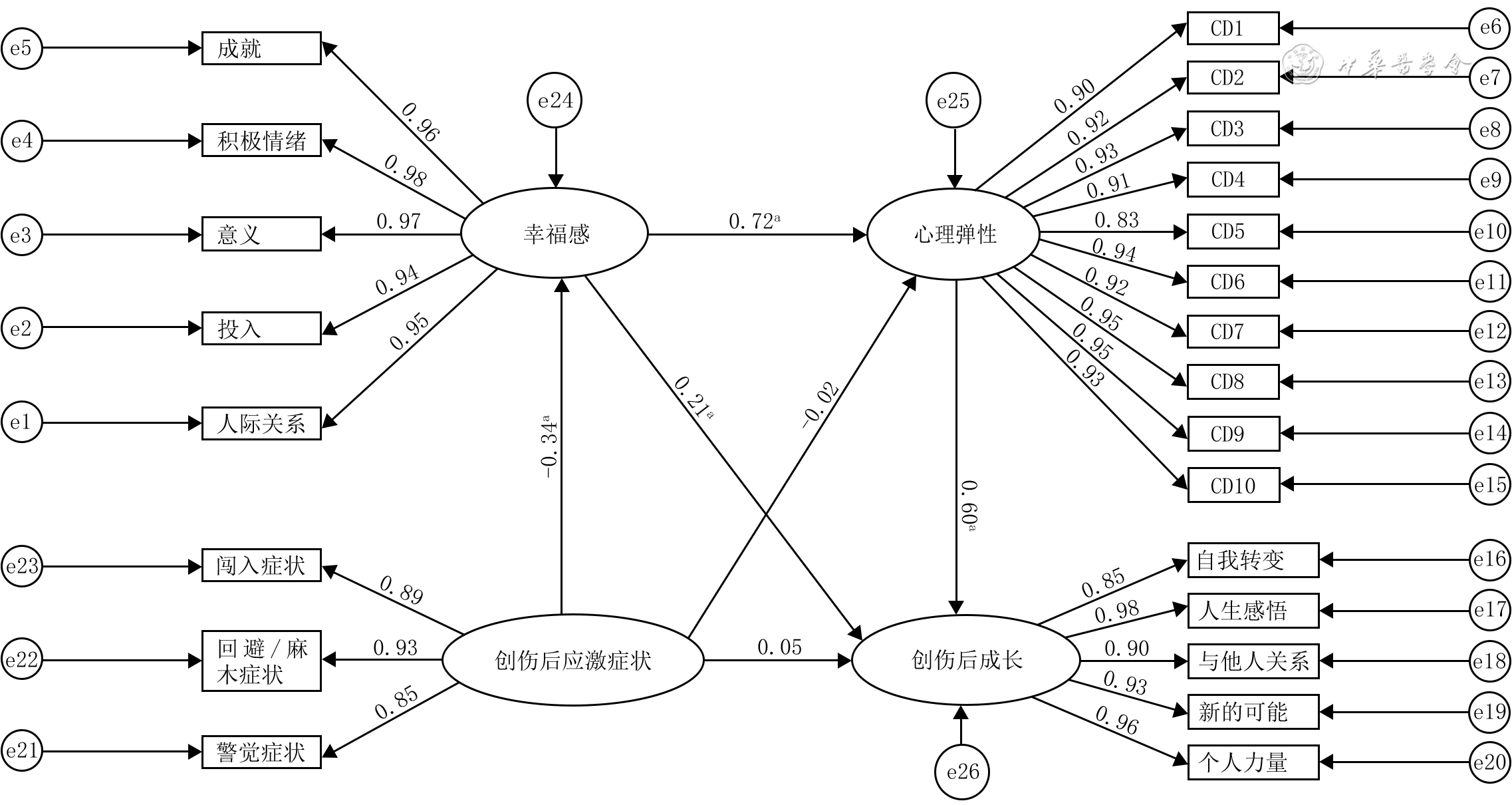
图 1 基于647名大学生创伤后应激症状、创伤后成长、幸福感和心理弹性构建的多重中介模型
注:图中椭圆形中为潜变量,矩形中为观测变量;潜变量指向观测变量的箭头上的数字为标准化因子载荷,表示观测变量对潜变量的解释力;潜变量之间的箭头上的数字为标准化路径系数,表示变量之间的直接影响强度;e为残差项,观测变量的e表示测量误差,潜变量的e表示模型未能解释的变异部分,e1~e26为残差编号;CD1~CD10为心理弹性的10个观测变量;aP<0.05表示标准化路径系数具有统计学意义
Table 1. 647名大学生在不同人口学资料和生活应激事件影响下创伤后成长总评分比较[分,M(Q1,Q3)]
项目与分类 人数 创伤后成长总评分 统计量值 P值 性别 男 584 68.00(41.25,80.00) Z=-1.706 0.088 女 63 59.00(40.00,69.00) 年龄(岁) ≤20 127 69.00(54.00,85.00) Z=-3.426 <0.001 >20 520 63.00(36.00,78.00) 年级 大一 84 66.50(28.25,76.00) H=7.793 0.050 大二 178 69.00(39.75,80.00) 大三 196 67.50(48.25,83.75) 大四 189 60.00(38.00,77.50) 民族 汉族 576 64.00(42.00,79.00) Z=-0.078 0.938 少数民族 71 63.50(37.75,81.50) 是否为独生子女 是 270 64.00(37.75,80.00) Z=-0.461 0.645 否 377 65.00(43.50,79.50) 受教育程度 大专 263 65.00(32.00,78.00) Z=-1.660 0.097 本科 384 63.50(43.00,80.00) 是否为学生干部 是 216 63.50(46.25,81.00) Z=-1.091 0.275 否 431 64.00(39.00,79.00) 家庭结构 双亲家庭 582 63.00(40.00,78.00) Z=-2.285 0.022 单亲家庭 65 74.00(48.50,90.50) 是否受生活应激 事件影响 是 102 53.00(32.75,67.25) Z=-3.693 <0.001 否 545 69.00(44.50,80.00) 注:生活应激事件统计近1年情况  下载: 导出CSV
Table 2. 是否受生活应激事件影响大学生的核心心理指标总评分比较[分,M(Q1,Q3)]
分类 人数 创伤后应激症状总评分 心理弹性总评分 幸福感总评分 受影响 102 39.00(28.00,45.50) 24.50(17.75,33.25) 94.50(75.00,121.00) 未受影响 545 17.00(17.00,21.00) 35.00(24.00,40.00) 122.00(98.00,143.00) Z值 -13.053 -5.555 -5.701 P值 <0.001 <0.001 <0.001 注:生活应激事件统计近1年情况
下载: 导出CSV
Table 3. 647名大学生创伤后成长、创伤后应激症状、心理弹性及幸福感之间的相关性分析结果
变量 PTG 自我转变 人生感悟 与他人关系 新的可能 个人力量 PTSS 闯入症状 回避/麻木症状 警觉症状 心理弹性 幸福感 成就 积极情绪 意义 人际关系 投入 PTG — — — — — — — — — — — — — — — — 自我转变 0.876a — — — — — — — — — — — — — — — 人生感悟 0.959a 0.793a — — — — — — — — — — — — — — 与他人关系 0.923a 0.774a 0.844a — — — — — — — — — — — — — 新的可能 0.928a 0.755a 0.859a 0.860a — — — — — — — — — — — — 个人力量 0.930a 0.743a 0.923a 0.833a 0.853a — — — — — — — — — — — PTSS -0.183a -0.041 -0.175a -0.185a -0.210a -0.182a — — — — — — — — — — 闯入症状 -0.196a -0.063 -0.195a -0.198a -0.202a -0.201a 0.872a — — — — — — — — — 回避/麻木 症状 -0.163a -0.039 -0.155a -0.166a -0.191a -0.160a 0.913a 0.809a — — — — — — — — 警觉症状 -0.240a -0.081a -0.237a -0.226a -0.254a -0.242a 0.864a 0.700a 0.723a — — — — — — — 心理弹性 0.647a 0.514a 0.648a 0.589a 0.608a 0.653a -0.300a -0.321a -0.283a -0.320a — — — — — — 幸福感 0.575a 0.438a 0.578a 0.553a 0.521a 0.548a -0.348a -0.341a -0.328a -0.342a 0.654a — — — — — 成就 0.571a 0.451a 0.567a 0.547a 0.521a 0.540a -0.352a -0.337a -0.328a -0.349a 0.649a 0.960a — — — — 积极情绪 0.562a 0.431a 0.571a 0.532a 0.509a 0.534a -0.348a -0.340a -0.330a -0.346a 0.636a 0.964a 0.911a — — — 意义 0.556a 0.428a 0.570a 0.525a 0.490a 0.544a -0.330a -0.336a -0.307a -0.329a 0.642a 0.963a 0.931a 0.920a — — 人际关系 0.516a 0.377a 0.516a 0.512a 0.481a 0.483a -0.327a -0.328a -0.311a -0.314a 0.606a 0.937a 0.862a 0.897a 0.886a — 投入 0.547a 0.424a 0.548a 0.524a 0.496a 0.524a -0.293a -0.276a -0.282a -0.287a 0.601a 0.929a 0.862a 0.876a 0.854a 0.845a 注:基于创伤后成长(PTG)、创伤后应激症状(PTSS)、幸福感总评分及其各维度评分及心理弹性总评分分析,PTG包括自我转变、人生感悟、与他人关系、新的可能、个人力量5个维度,PTSS包括闯入症状、回避/麻木症状、警觉症状3个维度,幸福感包括成就、积极情绪、意义、人际关系、投入5个维度;表中数据为r值,表示对应行变量与列变量之间的相关性,aP<0.05表示相关性具有统计学意义;空白表示该位置无须填写数据;“—”表示数据重复
下载: 导出CSV
Table 4. 647名大学生创伤后成长的影响因素分层回归分析结果
分层与自变量 B值 β值 P值 第1层 年龄(岁) 2.590 -0.144 <0.001 家庭结构 11.087 0.109 0.005 是否受生活应激事件影响 12.601 -0.151 <0.001 第2层 创伤后应激症状(分) 0.150 0.055 0.100 心理弹性(分) 1.496 0.603 <0.001 幸福感(分) 0.150 0.181 <0.001 注:生活应激事件统计近1年情况
下载: 导出CSV
Table 5. 647名大学生PTSS与PTG转化间的中介效应分析结果
中介路径 β值 95%CI 效应占比(%) P值 PTSS—幸福感—PTG -0.140 -0.224~-0.075 25.13 <0.001 PTSS—心理弹 性—PTG -0.026 -0.091~0.046 4.67 0.493 PTSS—幸福感—心理 弹性—PTG -0.287 -0.381~-0.214 51.53 <0.001 注:PTSS为创伤后应激症状,PTG为创伤后成长
下载: 导出CSV
-

 下载:
下载:

计量
- 文章访问数: 499
- HTML全文浏览量: 283
- PDF下载量: 35
- 被引次数: 0
