





Construction and validation of a multimodal risk prediction model for burn sepsis in infants and toddlers based on deep learning
-
摘要:
目的 构建并验证一种基于深度学习的多模态婴幼儿烧伤脓毒症风险预测模型(以下简称多模态预测模型)。 方法 该研究为回顾性队列研究。2015年1月—2025年12月,南京医科大学附属儿童医院烧伤整形外科收治1 709例符合入选标准的烧伤婴幼儿患者(以下简称患儿),烧伤总面积为1.0%~85.0%体表总面积。根据患儿的临床结局,将其分为脓毒症组[54例,其中男34例、女20例,年龄500.0(270.3,695.0)d]和非脓毒症组[1 655例,其中男998例、女657例,年龄515.0(365.0,790.0)d]。统计患儿入院24 h内的临床资料,并比较两组患儿烧伤总面积、Ⅲ度烧伤面积、合并吸入性损伤者比例、C反应蛋白(CRP)升高者比例、降钙素原升高者比例、凝血酶原时间(PT)、白蛋白水平、白细胞计数等。构建包含烧伤创面图像特征与配对的临床量表特征的多模态预测模型。将多模态预测模型与随机森林、XGBoost、TabTransformer、ResNet、Vision Transformer、Swin Transformer模型(6种对照模型)进行对比,评估其性能;采用五折交叉验证评估多模态预测模型的内部性能。采用基于梯度的特征重要性分析方法对多模态预测模型进行可解释性分析,量化临床特征的贡献。采用梯度加权类激活映射方法对多模态预测模型进行可视化分析。 结果 与非脓毒症组相比,脓毒症组患儿烧伤总面积、Ⅲ度烧伤面积均明显更大(Z值分别为8.266、7.945,P<0.05),合并吸入性损伤者比例、CRP升高者比例、降钙素原升高者比例和白细胞计数均明显升高(χ2值分别为4.914、7.803、8.859,Z=1.969,P<0.05),白蛋白水平明显下降(Z=-2.132,P<0.05),PT明显延长(Z=-4.247,P<0.05)。多模态预测模型在患儿烧伤脓毒症风险预测中的受试者操作特征曲线下面积为0.931±0.009,优于随机森林、XGBoost、TabTransformer、ResNet、Vision Transformer、Swin Transformer模型的0.861±0.031、0.862±0.025、0.876±0.019、0.897±0.015、0.900±0.015、0.916±0.012。同时,多模态预测模型在烧伤创面图像分割中的戴斯相似系数高于ResNet、Vision Transformer、Swin Transformer模型。五折交叉验证显示,相较于6种对照模型,多模态预测模型整体呈现更优的预测性能。基于梯度的特征重要性分析显示,PT的归一化重要性权重(1.000)最大,其次是舒张压(0.855)。多模态预测模型输出的创面区域与医师标注区域边界基本一致。 结论 构建的多模态预测模型可以准确评估患儿烧伤后脓毒症的发生风险,具有良好的区分度和临床实用性。 Abstract:Objective To construct and validate a multimodal risk prediction model (hereinafter referred to as the multimodal prediction model) for burn sepsis in infants and toddlers based on deep learning. Methods This retrospective cohort study included 1 709 burned infants and toddler patients (hereinafter referred to as pediatric patients) with total burn area ranged from 1.0%-85.0% total body surface area who were admitted to the Department of Burn and Plastic Surgery of Children's Hospital of Nanjing Medical University and met the eligibility criteria from January 2015 to December 2025. According to clinical outcomes, pediatric patients were divided into sepsis group (n=54, 34 males and 20 females, aged 500.0 (270.3, 695.0) days) and non-sepsis group (n=1 655, 998 males and 657 females, aged 515.0 (365.0, 790.0) days). Clinical data collected within 24 h after admission were analyzed and compared between the two groups of pediatric patients, including the total burn area, full-thickness burn area, the proportion of pediatric patients with concomitant inhalation injury, elevated C-reactive protein (CRP), and elevated procalcitonin, prothrombin time (PT), albumin level, and white blood cell count. A multimodal prediction model was constructed by integrating burn wound image features and paired clinical scale features. Its performance was compared with that of random forest, XGBoost, TabTransformer, ResNet, Vision Transformer, and Swin Transformer models (six control models), and its internal performance was evaluated using five-fold cross-validation. Gradient-based feature importance analysis was performed to interpret the multimodal prediction model and to quantify the contribution of clinical features. Gradient-weighted class activation mapping was applied for visualization of the multimodal prediction model. Results Compared with those in non-sepsis group, pediatric patients in sepsis group had significantly larger total burn area and full-thickness burn area (with Z values of 8.266 and 7.945, respectively, P<0.05). Additionally, the proportions of pediatric patients with concomitant inhalation injury, elevated CRP, and elevated procalcitonin, and white blood cell count were significantly higher (with χ2 values of 4.914, 7.803, and 8.859, respectively, Z=1.969, P<0.05), while albumin levels were significantly lower (Z=-2.132, P<0.05), and PT was significantly prolonged (Z=-4.247, P<0.05). The multimodal prediction model achieved an area under the receiver operating characteristic curve of 0.931±0.009 for predicting post-burn sepsis of pediatric patients, which was higher than that of random forest, XGBoost, TabTransformer, ResNet, Vision Transformer, and Swin Transformer models (with values of 0.861±0.031, 0.862±0.025, 0.876±0.019, 0.897±0.015, 0.900±0.015, and 0.916±0.012, respectively). The Dice similarity coefficient of the multimodal prediction model for burn wound image segmentation was higher than that of the ResNet, Vision Transformer, and Swin Transformer models. Across five-fold cross-validation, the multimodal prediction model exhibited superior overall predictive performance compared to the six control models. Gradient-based feature importance analysis revealed that PT had the highest normalized importance weight (1.000), followed by diastolic blood pressure (0.855). The wound regions delineated by the multimodal prediction model were largely consistent with those manually annotated by physicians. Conclusions The constructed multimodal prediction model demonstrates good discriminative performance and clinical application value for assessing the risk of post-burn sepsis in pediatric patients. -
Key words:
- Artificial intelligence /
- Burns /
- Sepsis /
- Deep learning /
- Infants and toddlers /
- Prediction model /
- Multimodal fusion
-
参考文献
(31) [1] 杨宗城, 汪仕良, 周一平. 实用烧伤外科手册[M]. 北京: 人民军医出版社, 2001. [2] 张小娇, 韩素鸽, 张茜. 《新生儿败血症》摘译[J]. 中华新生儿科杂志(中英文), 2026, 41(2): 127-128. DOI: 10.3760/cma.j.cn101451-20250508-00161. [3] 王小红,宋洲洋,朱欢,新生儿医院获得性败血症危险因素分析及预测模型建立[]].中华医院感染学杂志,2026,36(2):232-237.DOI: 10.11816/cn.ni.2026-258570. [4] DryschM, ReinkemeierF, PusczF, et al. Streamlined machine learning model for early sepsis risk prediction in burn patients[J]. NPJ Digit Med, 2025,8(1):621. DOI: 10.1038/s41746-025-02078-z. [5] YongL, ZhenzhouL. Deep learning based prediction of in-hospital mortality for sepsis[J]. Sci Rep, 2024, 14(1): 372. DOI: 10.1038/s41598-023-49890-9. [6] ChagantiS, SinghV, GentAE, et al. Evaluating the impact of common clinical confounders on performance of deep-learning-based sepsis risk assessment[J]. Front Artif Intell, 2025,8:1452471. DOI: 10.3389/frai.2025.1452471. [7] Har-ShaiL, GershovS, LagzielT, et al. Machine learning-based predictive model for fever and adverse clinical events in hospitalized pediatric burn patients[J]. J Burn Care Res, 2026,47(5):1467-1473.DOI: 10.1093/jbcr/irag074. [8] MoorM, RieckB, HornM, et al. Early prediction of sepsis in the ICU using machine learning: a systematic review[J]. Front Med (Lausanne), 2021,8:607952. DOI: 10.3389/fmed.2021.607952. [9] DengHF, SunMW, WangY, et al. Evaluating machine learning models for sepsis prediction: a systematic review of methodologies[J]. iScience, 2022,25(1):103651. DOI: 10.1016/j.isci.2021.103651. [10] KainthD, PrakashS, SankarMJ. Diagnostic performance of machine learning-based models in neonatal sepsis: a systematic review[J]. Pediatr Infect Dis J, 2024,43(9):889-901. DOI: 10.1097/INF.0000000000004409. [11] SchlapbachLJ, WatsonRS, SorceLR, et al. International consensus criteria for pediatric sepsis and septic shock[J]. JAMA, 2024,331(8):665-674. DOI: 10.1001/jama.2024.0179. [12] MenonK, SchlapbachLJ, AkechS, et al. Criteria for pediatric sepsis-a systematic review and meta-analysis by the pediatric sepsis definition taskforce[J]. Crit Care Med, 2022,50(1):21-36. DOI: 10.1097/CCM.0000000000005294. [13] FanJ, ShenH, ZhuL, et al. The Phoenix sepsis score criteria in critically ill children: evaluation using a retrospective, single-center PICU cohort in China, 2019-2024[J]. Pediatr Crit Care Med, 2025,26(12):e1476-e1484. DOI: 10.1097/PCC.0000000000003833. [14] Liu Z Lin Y Cao Y et al Swin transformer: hierarchical vision transformer using shifted windows Proceedings of the IEEE/CVF International Conference on Computer Vision Piscataway, NJ IEEE 2021 10012 10022 DOI: 10.1109/ICCV48922.2021.00986 LiuZ, LinY, CaoY, et al. Swin transformer: hierarchical vision transformer using shifted windows[C]//Proceedings of the IEEE/CVF International Conference on Computer Vision. Piscataway, NJ: IEEE, 2021: 10012-10022. DOI:10.1109/ICCV48922.2021.00986.
[15] Huang X Khetan A Cvitkovic M et al TabTransformer: tabular data modeling using contextual embeddings Proceedings of the First Workshop on Weakly Supervised Learning (WeaSuL) ICLR 2021 Virtual WeaSuL HuangX, KhetanA, CvitkovicM, et al. TabTransformer: tabular data modeling using contextual embeddings[C]//Proceedings of the First Workshop on Weakly Supervised Learning (WeaSuL), ICLR2021. Virtual: WeaSuL, 2021.
[16] He K Zhang X Ren S et al Deep residual learning for image recognition Proceedings of the IEEE Conference on Computer Vision and Pattern Recognition Piscataway, NJ IEEE 2016 770 778 DOI: 10.1109/CVPR.2016.90 HeK, ZhangX, RenS, et al. Deep residual learning for image recognition[C]//Proceedings of the IEEE Conference on Computer Vision and Pattern Recognition. Piscataway, NJ: IEEE, 2016: 770-778. DOI:10.1109/CVPR.2016.90.
[17] Dosovitskiy A Beyer L Kolesnikov A et al An image is worth 16×16 words: transformers for image recognition at scale International Conference on Learning Representations Virtual Event, Austria OpenReview.net 2021 DosovitskiyA, BeyerL, KolesnikovA, et al. An image is worth 16×16 words: transformers for image recognition at scale[C]//International Conference on Learning Representations. Virtual Event, Austria: OpenReview.net, 2021.
[18] 刘政枝, 王少华, 苏立贤, 等. 探讨降钙素原及超敏C-反应蛋白在早产儿医院感染败血症早期诊断意义[J].中国实验诊断学,2022,26(3):397-400. DOI: 10.3969/j.issn.1007-4287.2022.03.023. [19] 王胜云, 陈德昌. 降钙素原和C-反应蛋白与脓毒症患者病情严重程度评分的相关性研究及其对预后的评估价值[J].中华危重病急救医学,2015,27(2):97-101. DOI: 10.3760/cma.j.issn.2095-4352.2015.02.004. [20] AlpernER, ScottHF, BalamuthF, et al. Derivation and validation of predictive models for early pediatric sepsis[J]. JAMA Pediatr, 2026,179(12):1318-1325. DOI: 10.1001/jamapediatrics.2025.3892. [21] LuoW, XiongL, WangJ, et al. Development and performance evaluation of a clinical prediction model for sepsis risk in burn patients[J]. Medicine (Baltimore), 2024,103(48):e40709. DOI: 10.1097/MD.0000000000040709. [22] MaticsTJ, Sanchez-PintoLN. Adaptation and validation of a pediatric sequential organ failure assessment score and evaluation of the Sepsis-3 definitions in critically ill children[J]. JAMA Pediatr, 2017,171(10):e172352. DOI: 10.1001/jamapediatrics.2017.2352. [23] AziziS, HoveidamaneshS, BagheriT, et al. Modern machine learning techniques used in prediction of sepsis and bloodstream infection in burn patients: a systematic review[J]. Burns, 2026,52(5):107965. DOI: 10.1016/j.burns.2026.107965. [24] QinY, KernanKF, FanZ, et al. Machine learning derivation of four computable 24-h pediatric sepsis phenotypes to facilitate enrollment in early personalized anti-inflammatory clinical trials[J]. Crit Care, 2022,26(1):128. DOI: 10.1186/s13054-022-03977-3. [25] ShinY, ChoKJ, LeeY, et al. Multicenter validation of a deep-learning-based pediatric early-warning system for prediction of deterioration events[J]. Acute Crit Care, 2022,37(4):654-666. DOI: 10.4266/acc.2022.00976. [26] ShiX, WangX, YangH, et al. Accurate prediction of sepsis from pediatric emergency department to PICU using a machine-learning model[J]. Front Pediatr, 2025,13:1610187. DOI: 10.3389/fped.2025.1610187. [27] BhargavaV, GeorgeL, MalloyM, et al. The role of a single dose of vancomycin in reducing clinical sepsis in premature infants prior to removal of peripherally inserted central catheter: a retrospective study[J]. Am J Perinatol, 2018,35(10):990-993. DOI: 10.1055/s-0038-1632391. [28] WatsonRS, CarrolED, CarterMJ, et al. The burden and contemporary epidemiology of sepsis in children[J]. Lancet Child Adolesc Health, 2024,8(9):670-681. DOI: 10.1016/S2352-4642(24)00140-8. [29] JiangY, WangW, XuR, et al. Construction and efficacy evaluation of a model for early diagnosis of pediatric sepsis based on LASSO-logistic regression[J]. Front Pediatr, 2025,13:1624278. DOI: 10.3389/fped.2025.1624278. [30] TsurumiA, FlahertyPJ, QueYA, et al. A preventive tool for predicting bloodstream infections in children with burns[J]. Shock, 2023,59(3):393-399. DOI: 10.1097/SHK.0000000000002075. [31] BoussinaA, ShashikumarSP, MalhotraA, et al. Impact of a deep learning sepsis prediction model on quality of care and survival[J]. NPJ Digit Med, 2024,7(1):14. DOI: 10.1038/s41746-023-00986-6. -

图 1 人工智能多模态婴幼儿烧伤脓毒症风险预测模型框架
注:模型框架由烧伤创面图像分支(Swin Transformer U)、临床量表分支(TabTransformer)及多尺度特征融合与分类模块组成;烧伤创面图像分支同时完成创面分割,融合特征用于输出脓毒症风险概率

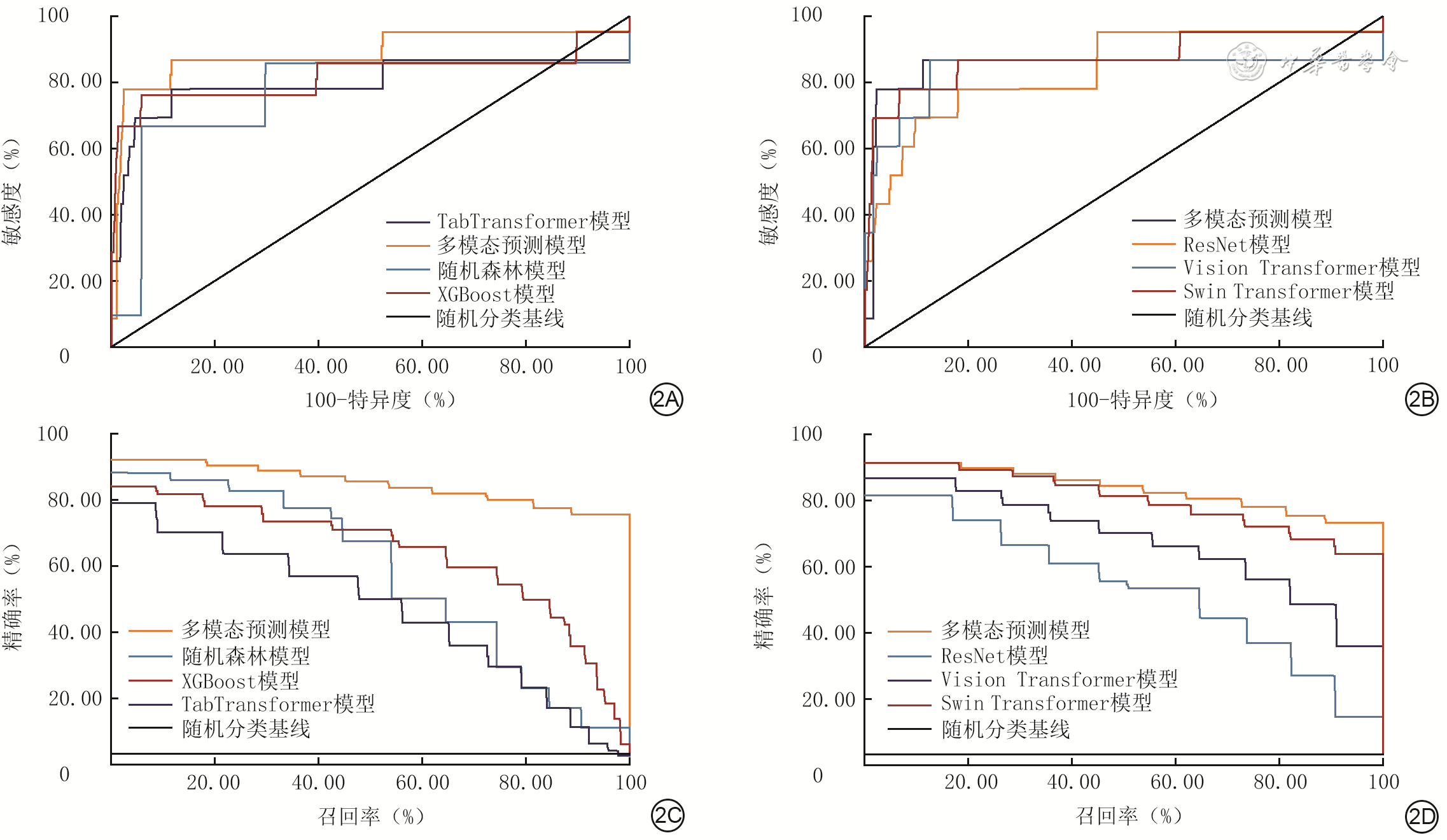
图 2 多模态预测模型与6种对照模型预测性能的比较。2A.临床量表模型与多模态预测模型的受试者操作特征曲线;2B.创面图像模型与多模态预测模型的受试者操作特征曲线;2C.临床量表模型与多模态预测模型的精确率-召回率曲线;2D.创面图像模型与多模态预测模型的精确率-召回率曲线
注:多模态预测模型为多模态婴幼儿烧伤脓毒症风险预测模型的简称;临床量表模型包括随机森林、XGBoost、TabTransformer模型,创面图像模型包括ResNet、Vision Transformer和Swin Transformer模型

图 3 采用多模态婴幼儿烧伤脓毒症风险预测模型对2例婴幼儿烧伤患者进行的创面分割与注意力可视化。3A.入院时婴幼儿患者的烧伤创面原始图像;3B.高年资医师标注的烧伤创面区域金标准;3C.模型的创面区域分割结果;3D.梯度加权类激活映射热图;3E、3F、3G、3H.分别为与图3A、3B、3C、3D对应的另一例婴幼儿患者图像
Table 1. 两组烧伤婴幼儿患者临床资料比较
组别 例数 烧伤总面积[%TBSA,M(Q1,Q3)] Ⅲ度烧伤面积[%TBSA,M(Q1,Q3)] 合并吸入性损伤[例(%)] 热液烫伤[例(%)] 白细胞计数[×109/L,M(Q1,Q3)] 脓毒症组 54 40.0(20.0,60.0) 45.0(30.0,64.0) 11(20.4) 50(92.6) 13.62(11.27,17.85) 非脓毒症组 1 655 10.0(6.0,15.0) 20.0(8.0,35.0) 82(4.9) 1 511(91.3) 13.41(10.03,17.50) 统计量值 Z=8.266 Z=7.945 χ2=4.914 χ2=1.080 Z=1.969 P值 <0.001 <0.001 <0.001 0.280 0.049 注:TBSA为体表总面积,CRP为C反应蛋白,PT为凝血酶原时间;CRP和降钙素原截断值分别为10 mg/L、0.5 ng/mL[18, 19];所有指标均为入院24 h内数据  下载: 导出CSV
Table 2. 多模态婴幼儿烧伤脓毒症风险预测模型与6种对照模型的性能比较(
模型类别 准确率(%) 精确率(%) 召回率(%) 特异度(%) F1分数(%) AUROC DSC(%) 多模态婴幼儿烧伤脓毒症风险预测模型 99.24±0.34 85.1±5.4 90±6 99.52±0.16 88±5 0.931±0.009 95.1±1.3 随机森林模型 97.66±0.29 57.3±6.1 66±8 98.62±0.16 61±3 0.861±0.031 — XGBoost模型 98.19±0.49 47.6±15.4 88±14 98.33±0.39 61±17 0.862±0.025 — TabTransformer模型 97.54±0.65 62.9±1.6 62±12 98.79±0.07 62±7 0.876±0.019 — ResNet模型 97.54±0.39 68.4±6.1 60±7 98.97±0.17 64±6 0.897±0.015 91.8±1.2 Vision Transformer模型 98.60±0.38 75.8±5.6 80±11 99.21±0.16 77±6 0.900±0.015 93.2±1.3 Swin Transformer模型 98.60±0.52 75.8±5.6 81±14 99.21±0.16 78±7 0.916±0.012 93.4±1.5 注:样本数为1 709;AUROC为受试者操作特征曲线下面积,DSC为戴斯相似系数;“—”表示无此统计量值
下载: 导出CSV
Table 3. 多模态婴幼儿烧伤脓毒症风险预测模型与两种不同输入模态模型的消融实验结果比较(
模型类别 准确率(%) 精确率(%) 召回率(%) 特异度(%) F1分数(%) AUROC DSC(%) 多模态婴幼儿烧伤脓毒症风险预测模型 99.24±0.34 85.1±5.4 90±6 99.52±0.16 88±5 0.931±0.009 95.1±1.3 临床量表模型 96.82±0.71 61.4±3.6 61±12 98.21±0.09 61±8 0.844±0.014 — 创面图像模型 97.90±0.66 73.4±5.6 80±14 98.64±0.14 77±8 0.901±0.012 92.2±1.6 注:样本数为1 709;多模态婴幼儿烧伤脓毒症风险预测模型融合了临床表格数据和烧伤创面图像;AUROC为受试者操作特征曲线下面积,DSC为戴斯相似系数;“—”表示无此统计量值
下载: 导出CSV
-

 下载:
下载:




计量
- 文章访问数: 115
- HTML全文浏览量: 50
- PDF下载量: 13
- 被引次数: 0
