





Development and performance evaluation of a laser-induced graphene-based multimodal electrochemical sensor for monitoring the burn wound microenvironment
-
摘要:
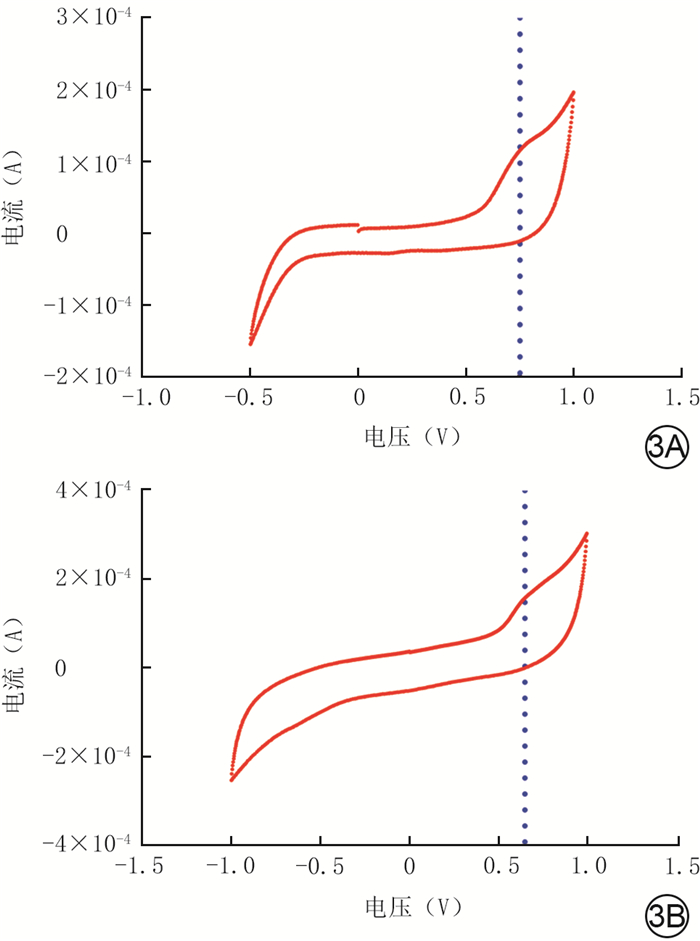
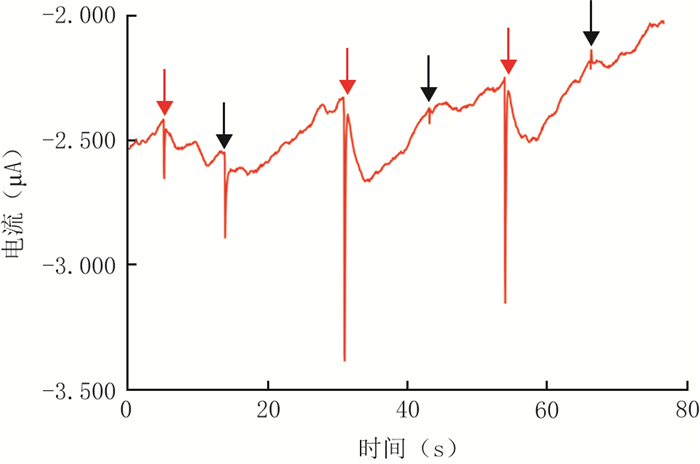
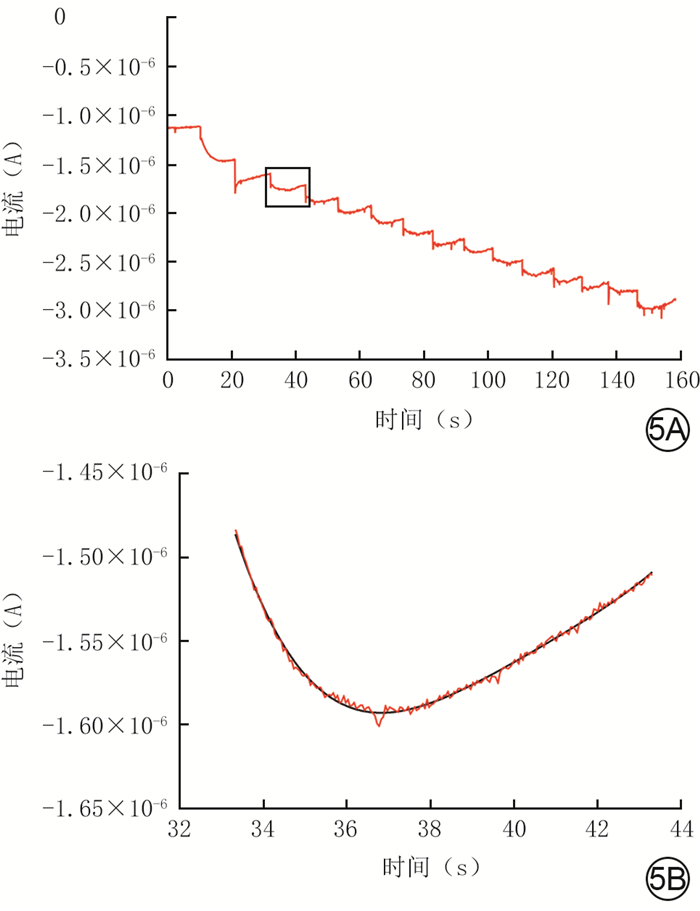
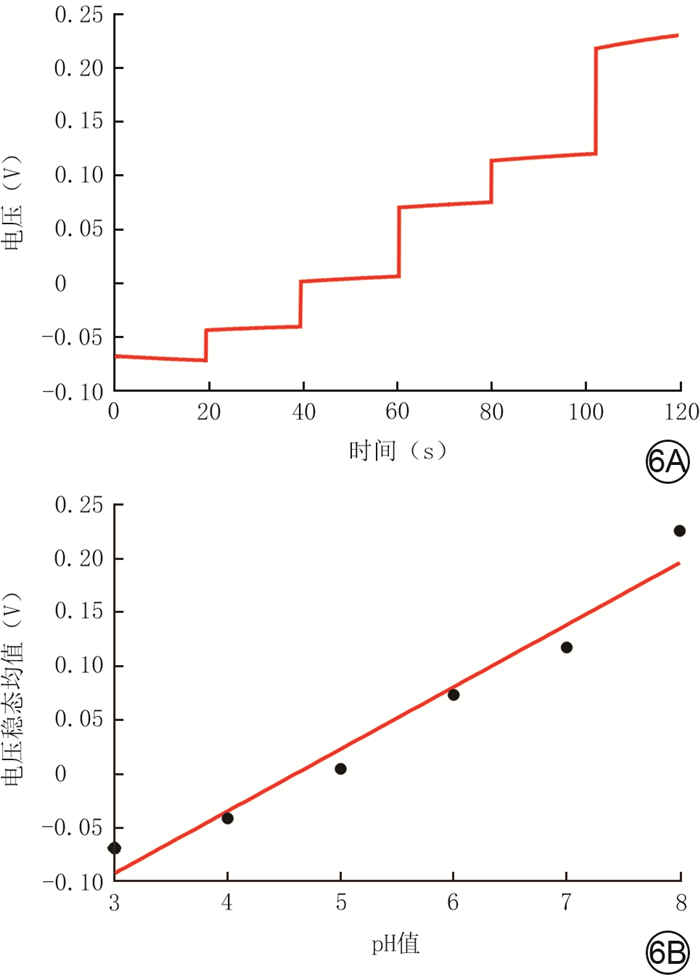
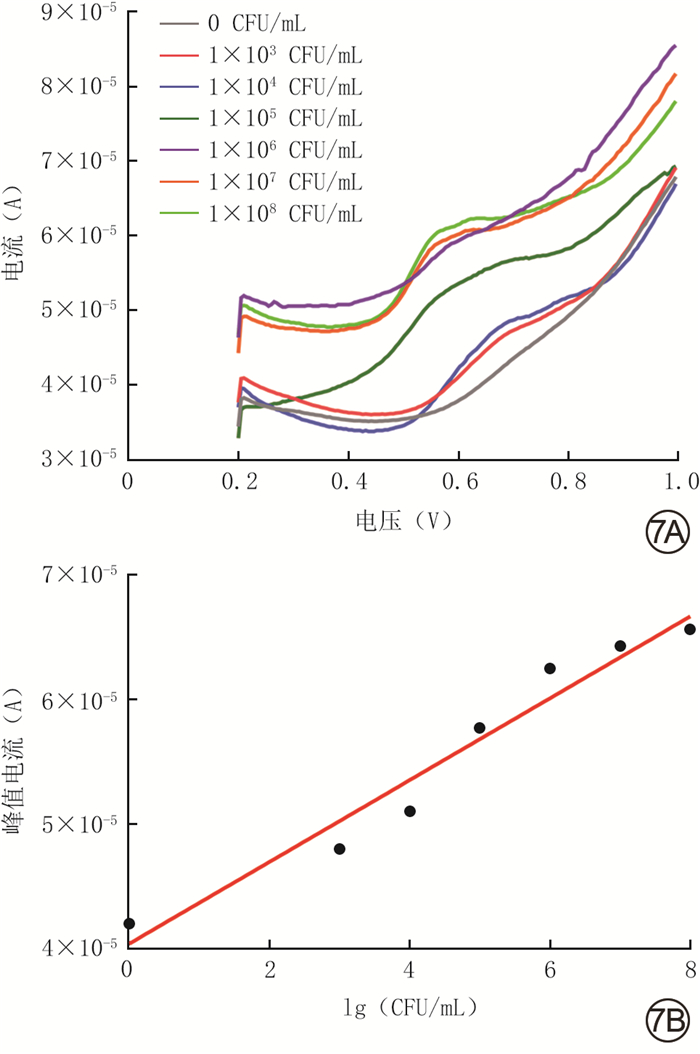
目的 研制一种用于烧伤创面微环境监测的激光诱导石墨烯(LIG)多模态电化学传感器并评估其性能。 方法 该研究为实验研究。分别采用L-乳酸氧化酶、聚苯胺、分选酶A功能化修饰LIG三电极基底, 制备乳酸传感器、pH传感器、细菌传感器, 以组成LIG多模态电化学传感器。应用电化学工作站, 通过循环伏安法评估乳酸传感器和细菌传感器的电化学性能, 并记录伏安特性曲线。应用电化学工作站, 通过计时电流法评估乳酸传感器对乳酸的响应性能(在物质的量浓度为10~60 mmol/L的L-乳酸溶液中测试并记录电流-时间曲线和绘制标定曲线), 通过开路电位法评估pH传感器对pH的响应性能(在pH值为3~8的标准缓冲液中测试并记录开路电位-时间曲线和绘制标定曲线), 通过差分脉冲伏安法评估细菌传感器对金黄色葡萄球菌的响应性能[在1×10³~1×10⁸集落形成单位(CFU)/mL的金黄色葡萄球菌梯度菌液中测试并记录电流-电压曲线和绘制标定曲线]。以上实验中样本数均为3。对乳酸传感器的电流值与乳酸浓度、pH传感器的稳态开路电位平均值与pH值、细菌传感器的峰电流值与细菌浓度值行相关性分析。将配制好的乳酸标准测试体系溶液、pH值标准测试体系溶液、细菌标准测试体系溶液, 各分为30份样本后, 分别采用乳酸传感器和L-乳酸检测试剂盒、pH传感器和精密pH计、细菌传感器和微量分光光度计检测乳酸浓度、pH值、细菌浓度。采用随机数字表法抽取15对配对数据进行比较, 对各传感器测量值与相应标准方法参考值行相关性分析。 结果 伏安特性曲线显示, 乳酸传感器、细菌传感器分别在氧化峰电位约0.74、0.65 V时出现明显的氧化峰电流。乳酸传感器滴加磷酸盐缓冲液后的电流变化值为(0.025±0.041)μA, 明显低于加入L-乳酸溶液后的(0.228±0.117)μA(t=2.85, P < 0.05)。在物质的量浓度为10~60 mmol/L的L-乳酸溶液中, 乳酸传感器的电流值与相应的乳酸浓度呈显著线性相关(r=0.98, P < 0.05)。在pH值为3~8的标准缓冲液中, pH传感器的稳态开路电位平均值与相应的pH值呈显著线性相关(r=0.96, P < 0.05)。在1×10³~1×10⁸ CFU/mL金黄色葡萄球菌梯度菌液中, 细菌传感器的峰电流值与相应的细菌浓度对数值呈显著线性相关(r=0.95, P < 0.05)。L-乳酸检测试剂盒测得的乳酸浓度与乳酸传感器测得的乳酸浓度、pH传感器测得的pH值与精密pH计测得的pH值、细菌传感器测得的细菌浓度的对数值与微量分光光度计测得的细菌浓度的对数值比较, 差异均无统计学意义(P > 0.05), 且均存在明显正相关(r值分别为0.97、0.96、0.95, P < 0.05)。 结论 经功能化修饰后研制的LIG多模态电化学传感器, 实现了对烧伤创面微环境中乳酸浓度、pH值和细菌载量的准确监测, 且结果具有高灵敏度和高稳定性, 为烧伤创面微环境关键指标的非侵入性监测提供了可靠的新思路, 具有较大的临床应用前景。 Abstract:Objective To develop a laser-induced graphene (LIG)-based multimodal electrochemical sensor for monitoring the burn wound microenvironment and to evaluate its performance. Methods This study was an experimental study. LIG three-electrode substrates were functionalized with L-lactate oxidase, polyaniline, and sortase A to fabricate lactate sensor, pH sensor, and bacterial sensor, respectively, thereby constituting the LIG-based multimodal electrochemical sensor. An electrochemical workstation was used to assess the electrochemical performance of the lactate sensor and bacterial sensor by cyclic voltammetry, with voltammetric response curves being plotted. An electrochemical workstation was used to assess the lactate sensor's response to lactate by chronoamperometry (with current-time curve being recorded and calibration curve being plotted during the test in the L-lactic acid solution with a molar concentration of 10-60 mmol/L), the pH sensor's response to pH by open-circuit potential measurement (with open-circuit potential-time curve being recorded and calibration curve being plotted during the test in the standard buffer solutions with pH values ranging from 3 to 8), and the bacterial sensor's response to bacteria by differential pulse voltammetry (with current-voltage curve being recorded and calibration curve being plotted during the test in gradient suspensions of Staphylococcus aureus ranging from 1×10³-1×10⁸ colony forming unit (CFU)/mL). The sample size for all the above experiments was 3. The correlation analysis was performed on the current value of the lactate sensor and the lactate concentration, the average value of steady-state open circuit potential of the pH sensor and the pH value, and the peak current value of the bacterial sensor and the bacterial concentration value. Each of the prepared standard test system solutions for lactate, pH value, and bacteria were all aliquoted into 30 samples. The lactate concentration, pH value, and bacterial concentration were determined by the lactate sensor and a L-lactate assay kit, the pH sensor and a precision pH meter, and the bacterial sensor and a microvolume spectrophotometer, respectively. Fifteen pairs of matched data were selected according to the random number table method for comparison, and the correlation analysis was performed on the measured values of each sensor and the reference values of the corresponding standard methods. Results The voltammetric response curves showed that the lactate sensor and the bacterial sensor exhibited distinct oxidation peak currents at oxidation peak potentials of approximately 0.74 and 0.65 V, respectively. In the lactate sensor, the change in current after addition of phosphate buffered solution was (0.025±0.041) μA, which was significantly lower than that after addition of L-lactate solution (0.228±0.117) μA (t=2.85, P < 0.05). In the L-lactic acid solution with a molar concentration of 10-60 mmol/L, the current value of the lactate sensor was significantly linearly correlated with the lactate concentration (r=0.98, P < 0.05). In the standard buffer solutions with pH values ranging from 3 to 8, the average value of steady-state open circuit potential of the pH sensor was significantly linearly correlated with the corresponding pH values (r=0.96, P < 0.05). In gradient suspensions of Staphylococcus aureus ranging from 1×10³ to 1×10⁸ CFU/mL, the peak current value of the bacterial sensor was significantly linearly correlated with the logarithm of bacterial concentration (r=0.95, P < 0.05). There were no statistically significant differences between the lactate concentrations measured by the lactate sensor and by the L-lactate assay kit, pH values measured by the pH sensor and by the precision pH meter, and logarithmic bacterial concentrations measured by the bacterial sensor and by the microvolume spectrophotometer (P > 0.05), but there were significant positive correlations between the two (with r values of 0.97, 0.96, and 0.95, respectively, P < 0.05). Conclusions After functional modification, the developed LIG-based multimodal electrochemical sensor enables accurate monitoring of lactate concentration, pH value, and bacterial load in the burn wound microenvironment with the results being of high sensitivity and stability. This platform provides a reliable new approach for non-invasive monitoring of the critical indicators of burn wound microenvironment, which shows great prospects for clinical application. 本文亮点(1) 研制了一种激光诱导石墨烯多模态电化学传感器, 可检测烧伤创面乳酸浓度、pH值和细菌载量, 实现了对烧伤创面微环境关键指标的监测。(2) 该传感器在乳酸浓度10~60 mmol/L、pH值3~8和细菌载量1×103~1×108集落形成单位/mL范围内均表现出良好的灵敏度、稳定性和准确性。(3) 该传感器测量值与相应标准方法参考值高度一致, 为临床创面愈合评估和感染预警提供了实时、精准的非侵入性监测新方案。 -
参考文献
(40) [1] 潘玉雪, 褚继萍, 赵梦圆, 等. 慢性难愈创面微环境响应型水凝胶材料的研究进展[J]. 国际生物医学工程杂志, 2023, 46(2): 151-155. DOI: 10.3760/cma.j.cn121382-20221213-00210. [2] Gonzalez MR, Ducret V, Leoni S, et al. Transcriptome analysis of pseudomonas aeruginosa cultured in human burn wound exudates[J]. Front Cell Infect Microbiol, 2018, 8: 39. DOI: 10.3389/fcimb.2018.00039. [3] Wang H, Duan W, Ren Z, et al. Engineered sandwich-structured composite wound dressings with unidirectional drainage and anti-adhesion supporting accelerated wound healing[J]. Adv Healthc Mater, 2023, 12(8): e2202685. DOI: 10.1002/adhm.202202685. [4] Goto T, Saligan LN. Wound pain and wound healing biomarkers from wound exudate: a scoping review[J]. J Wound Ostomy Continence Nurs, 2020, 47(6): 559-568. DOI: 10.1097/WON.0000000000000703. [5] Shao Z, Yin T, Jiang J, et al. Wound microenvironment self-adaptive hydrogel with efficient angiogenesis for promoting diabetic wound healing[J]. Bioact Mater, 2023, 20: 561-573. DOI: 10.1016/j.bioactmat.2022.06.018. [6] Sharifuzzaman M, Chhetry A, Zahed MA, et al. Smart bandage with integrated multifunctional sensors based on MXene-functionalized porous graphene scaffold for chronic wound care management[J]. Biosens Bioelectron, 2020, 169: 112637. DOI: 10.1016/j.bios.2020.112637. [7] Haller HL, Sander F, Popp D, et al. Oxygen, pH, lactate, and metabolism-how old knowledge and new insights might be combined for new wound treatment[J]. Medicina (Kaunas), 2021, 57(11): 1190. DOI: 10.3390/medicina57111190. [8] 吴丽媛, 张晓帅, 卢绮萍. 智能水凝胶结构设计及其在外科医学领域中的应用[J]. 中华实验外科杂志, 2025, 42(2): 388-392. DOI: 10.3760/cma.j.cn421213-20240605-00505. [9] Haaga JR, Haaga R. Acidic lactate sequentially induced lymphogenesis, phlebogenesis, and arteriogenesis (ALPHA) hypothesis: lactate-triggered glycolytic vasculogenesis that occurs in normoxia or hypoxia and complements the traditional concept of hypoxia-based vasculogenesis[J]. Surgery, 2013, 154(3): 632-637. DOI: 10.1016/j.surg.2013.03.007. [10] Morris FC, Jiang Y, Fu Y, et al. Lactate metabolism promotes in vivo fitness during Acinetobacter baumannii infection[J]. FEMS Microbiol Lett, 2024, 371: fnae032. DOI: 10.1093/femsle/fnae032. [11] Ghani QP, Wagner S, Becker HD, et al. Regulatory role of lactate in wound repair[J]. Methods Enzymol, 2004, 381: 565-575. DOI: 10.1016/S0076-6879(04)81036-X. [12] Trabold O, Wagner S, Wicke C, et al. Lactate and oxygen constitute a fundamental regulatory mechanism in wound healing[J]. Wound Repair Regen, 2003, 11(6): 504-509. DOI: 10.1046/j.1524-475x.2003.11621.x. [13] Kitamura F, Semba T, Yasuda-Yoshihara N, et al. Cancer-associated fibroblasts reuse cancer-derived lactate to maintain a fibrotic and immunosuppressive microenvironment in pancreatic cancer[J]. JCI Insight, 2023, 8(20): e163022. DOI: 10.1172/jci.insight.163022. [14] 蔡程浩, 韩春茂, 王新刚. 创面外部微环境因素对创面愈合影响的研究进展[J]. 中华烧伤与创面修复杂志, 2024, 40(5): 489-494. DOI: 10.3760/cma.j.cn501225-20230827-00067. [15] Wang Y, Miao F, Bai J, et al. An observational study of the pH value during the healing process of diabetic foot ulcer[J]. J Tissue Viability, 2024, 33(2): 208-214. DOI: 10.1016/j.jtv.2024.03.015. [16] Xu Y, Chen H, Fang Y, et al. Hydrogel combined with phototherapy in wound healing[J]. Adv Healthc Mater, 2022, 11(16): e2200494. DOI: 10.1002/adhm.202200494. [17] Wang H, Luo R, Chen Y, et al. A sortase A-immobilized mesoporous hollow carbon sphere-based biosensor for detection of gram-positive bacteria[J]. J Electron Mater, 2018, 47: 4124-4135. DOI: 10.1007/s11664-018-6308-4. [18] Sempionatto JR, Lin M, Yin L, et al. An epidermal patch for the simultaneous monitoring of haemodynamic and metabolic biomarkers[J]. Nat Biomed Eng, 2021, 5(7): 737-748. DOI: 10.1038/s41551-021-00685-1. [19] Xuan X, Chen C, Molinero-Fernandez A, et al. Fully integrated wearable device for continuous sweat lactate monitoring in sports[J]. ACS Sens, 2023, 8(6): 2401-2409. DOI: 10.1021/acssensors.3c00708. [20] Wang H, Zhao Z, Liu P, et al. Laser-induced graphene based flexible electronic devices[J]. Biosensors (Basel), 2022, 12(2): 55. DOI: 10.3390/bios12020055. [21] Baranwal J, Barse B, Gatto G, et al. Electrochemical sensors and their applications: a review[J]. Chemosensors, 2022, 10(9): 363. DOI: 10.3390/chemosensors10090363. [22] 梁莉婷, 宋薇, 张超, 等. 原位交联含氧化石墨烯的甲基丙烯酸酐化明胶水凝胶对小鼠全层皮肤缺损创面血管化的影响[J]. 中华烧伤与创面修复杂志, 2022, 38(7): 616-628. DOI: 10.3760/cma.j.cn501225-20220314-00063. [23] 刘振刚, 李鹏富, 杨帆, 等. 基于石墨烯相关材料在外周神经损伤修复中的应用[J]. 中华实验外科杂志, 2023, 40(7): 1448-1450. DOI: 10.3760/cma.j.cn421213-20221213-01400. [24] 沈冯洁, 曹伟男, 纪哲, 等. 氧化石墨烯调控脂肪源间充质干细胞促进糖尿病皮肤创面修复的实验研究[J]. 中华内分泌代谢杂志, 2023, 39(9): 790-796. DOI: 10.3760/cma.j.cn311282-20220925-00554. [25] Avinash K, Patolsky F. Laser-induced graphene structures: from synthesis and applications to future prospects[J]. Materi Today, 2023: 104-136. DOI: 10.1016/j.mattod.2023.10.009. [26] Rafiee M, Abrams DJ, Cardinale L, et al. Cyclic voltammetry and chronoamperometry: mechanistic tools for organic electrosynthesis[J]. Chem Soc Rev, 2024, 53(2): 566-585. DOI: 10.1039/d2cs00706a. [27] Cai YQ, Chen D, Chen Y, et al. An electrochemical biosensor based on graphene intercalated functionalized black phosphorus/gold nanoparticles nanocomposites for the detection of bacterial enzyme[J]. Microchem J, 2023, 193: 109255. DOI: 10.1016/j.microc.2023.109255. [28] Kruse CR, Nuutila K, Lee CC, et al. The external microenvironment of healing skin wounds[J]. Wound Repair Regen, 2015, 23(4): 456-464. DOI: 10.1111/wrr.12303. [29] 李海胜, 罗高兴, 袁志强. 烧伤创面进行性加深防治策略研究进展[J]. 中华烧伤杂志, 2021, 37(12): 1199-1204. DOI: 10.3760/cma.j.cn501120-20200828-00396. [30] Yin M, Li J, Huang L, et al. Identification of microbes in wounds using near-infrared spectroscopy[J]. Burns, 2022, 48(4): 791-798. DOI: 10.1016/j.burns.2021.09.002. [31] Hazenberg CE, van Netten JJ, van Baal SG, et al. Assessment of signs of foot infection in diabetes patients using photographic foot imaging and infrared thermography[J]. Diabetes Technol Ther, 2014, 16(6): 370-377. DOI: 10.1089/dia.2013.0251. [32] Rosa BMG, Yang GZ. Ultrasound powered implants: design, performance considerations and simulation results[J]. Sci Rep, 2020, 10(1): 6537. DOI: 10.1038/s41598-020-63097-2. [33] Madden J, Vaughan E, Thompson M, et al. Electrochemical sensor for enzymatic lactate detection based on laser-scribed graphitic carbon modified with platinum, chitosan and lactate oxidase[J]. Talanta, 2022, 246: 123492. DOI: 10.1016/j.talanta.2022.123492. [34] Ono S, Imai R, Ida Y, et al. Increased wound pH as an indicator of local wound infection in second degree burns [J]. Burns, 2015, 41(4): 820-824. DOI: 10.1016/j.burns.2014.10.023. [35] Yoon JH, Hong SB, Yun SO, et al. High performance flexible pH sensor based on polyaniline nanopillar array electrode[J]. J Colloid Interface Sci, 2017, 490: 53-58. DOI: 10.1016/j.jcis.2016.11.033. [36] Obeng EM, Fulcher AJ, Wagstaff KM. Harnessing sortase A transpeptidation for advanced targeted therapeutics and vaccine engineering[J]. Biotechnol Adv, 2023, 64: 108108. DOI: 10.1016/j.biotechadv.2023.108108. [37] Cai Y, Chen D, Chen Y, et al. An electrochemical biosensor based on graphene intercalated functionalized black phosphorus/gold nanoparticles nanocomposites for the detection of bacterial enzyme[J]. Microchem J, 2023, 193: 109255. DOI: 10.1016/j.microc.2023.109255. [38] 蒋委余, 范佳颖, 樊力铭, 等. 尿路致病性大肠埃希菌毒力因子TcpC在其免疫逃逸中的作用及致病机制研究[J]. 中华微生物学和免疫学杂志, 2024, 44(3): 198-204. DOI: 10.3760/cma.j.cn112309-20231130-00162. [39] Liu J, Ji H, Lv X, et al. Laser-induced graphene (LIG) -driven medical sensors for health monitoring and diseases diagnosis[J]. Mikrochim Acta, 2022, 189(2): 54. DOI: 10.1007/s00604-021-05157-6. [40] 赵世宇, 马玉平, 姚迪, 等. 基于激光诱导石墨烯物理传感器的研究进展[J]. 仪表技术与传感器, 2025(4): 1-9. DOI: 10.3969/j.issn.1002-1841.2025.04.001. -

图 1 LIG三电极基底的结构与柔性形态。1A.红色部分为聚酰亚胺薄膜, 从左至右依次为弧形辅助电极、工作电极和涂覆银/氯化银涂料的参比电极;1B.LIG三电极基底在手中弯曲的形态
注:LIG为激光诱导石墨烯
Figure 1. Structure and flexible morphology of the LIG three-electrode substrate

图 2 未经功能化修饰的和经聚苯胺或L-乳酸氧化酶功能化修饰的LIG三电极基底的表征。2A.未经功能化修饰的LIG三电极基底表面可见连续的网状多孔骨架 扫描电子显微镜×10 000;2B.经聚苯胺功能化修饰的LIG三电极基底表面仍可见网状多孔骨架, 孔隙率降低 扫描电子显微镜×10 000;2C.经L-乳酸氧化酶功能化修饰的LIG三电极基底表面可见L-乳酸氧化酶-壳聚糖复合膜覆盖于网状多孔骨架上 扫描电子显微镜×10 000;2D.为图2A中方框中图形的放大图, 未经功能化修饰的LIG三电极基底的片层表面和孔隙内壁等典型位置可见纳米颗粒分布 扫描电子显微镜×50 000;2E.为图2B中方框中图形的放大图, 经聚苯胺功能化修饰的LIG三电极基底孔隙内壁纳米粗糙度与图2D相比明显降低, 整体表面趋于平滑 扫描电子显微镜×50 000;2F.为图2C中方框中图形的放大图, 经L-乳酸氧化酶功能化修饰的LIG三电极基底表面有直径45~200 nm的酶团簇嵌入并分布于L-乳酸氧化酶-壳聚糖复合膜中 扫描电子显微镜×50 000
注:LIG为激光诱导石墨烯
Figure 2. Characterization of the unfunctionalized and polyaniline or L-lactate oxidase-functionalized LIG three-electrode substrates

图 3 激光诱导石墨烯多模态电化学传感器中乳酸传感器和细菌传感器的伏安特性曲线。3A.乳酸传感器在终物质的量浓度为10 mmol/L的L-乳酸溶液中, 在氧化峰电位为约0.74 V时出现明显的氧化峰电流;3B.细菌传感器在细菌浓度为2×10⁸ CFU/mL的金黄色葡萄球菌菌液中, 在氧化峰电位为约0.65 V时出现明显的氧化峰电流
注:CFU为集落形成单位;蓝色虚线表示伏安特性曲线斜率变化率达到最大时相应的氧化峰电位, 表明在该氧化峰电位下的氧化电流达到峰值
Figure 3. Voltammetric response curves of the lactate sensor and bacterial sensor in the laser-induced graphene-based multimodal electrochemical sensor

图 4 激光诱导石墨烯多模态电化学传感器中乳酸传感器对乳酸的特异性响应
注:黑色箭头指示滴加磷酸盐缓冲液, 红色箭头指示滴加物质的量浓度为100 mmol/L的L-乳酸溶液
Figure 4. Specific response of the lactate sensor to lactate in the laser-induced graphene-based multimodal electrochemical sensor

图 5 激光诱导石墨烯多模态电化学传感器中乳酸传感器的应用测试。5A.在物质的量浓度为10~60 mmol/L的L-乳酸溶液中, 乳酸传感器的电流-时间曲线;5B.为图5A中框选区域的放大图, 显示电流随乳酸浓度变化形成先增后减的波动弧线, 其中曲线的极小电流(绝对值最大点)对应时间与滴加时刻之差为响应时间
Figure 5. Application testing of the lactate sensor in the laser-induced graphene-based multimodal electrochemical sensor

图 6 激光诱导石墨烯多模态电化学传感器中pH传感器的应用测试。6A.在pH值为3~8的标准缓冲液中, pH传感器的开路电位-时间曲线;6B.在pH值为3~8的标准缓冲液中, pH传感器的稳态开路电位平均值与相应的pH值呈显著线性相关, r=0.96, P < 0.001
Figure 6. Application testing of the pH sensor in the laser-induced graphene-based multimodal electrochemical sensor

图 7 激光诱导石墨烯多模态电化学传感器中细菌传感器的应用测试。7A.在1×10³~1×10⁸ CFU/mL金黄色葡萄球菌梯度菌液中, 细菌传感器的电流-电压曲线;7B.在1×10³~1×10⁸ CFU/mL金黄色葡萄球菌梯度菌液中, 细菌传感器的峰电流值与相应的细菌浓度对数值呈显著线性相关, r=0.95, P=0.002
注:CFU为集落形成单位;横坐标lg(CFU/mL)表示菌液浓度(CFU/mL)的以10为底的对数值
Figure 7. Application testing of the bacterial sensor in the laser-induced graphene-based multimodal electrochemical sensor
-

 下载:
下载:



计量
- 文章访问数: 1556
- HTML全文浏览量: 599
- PDF下载量: 23
- 被引次数: 0
