
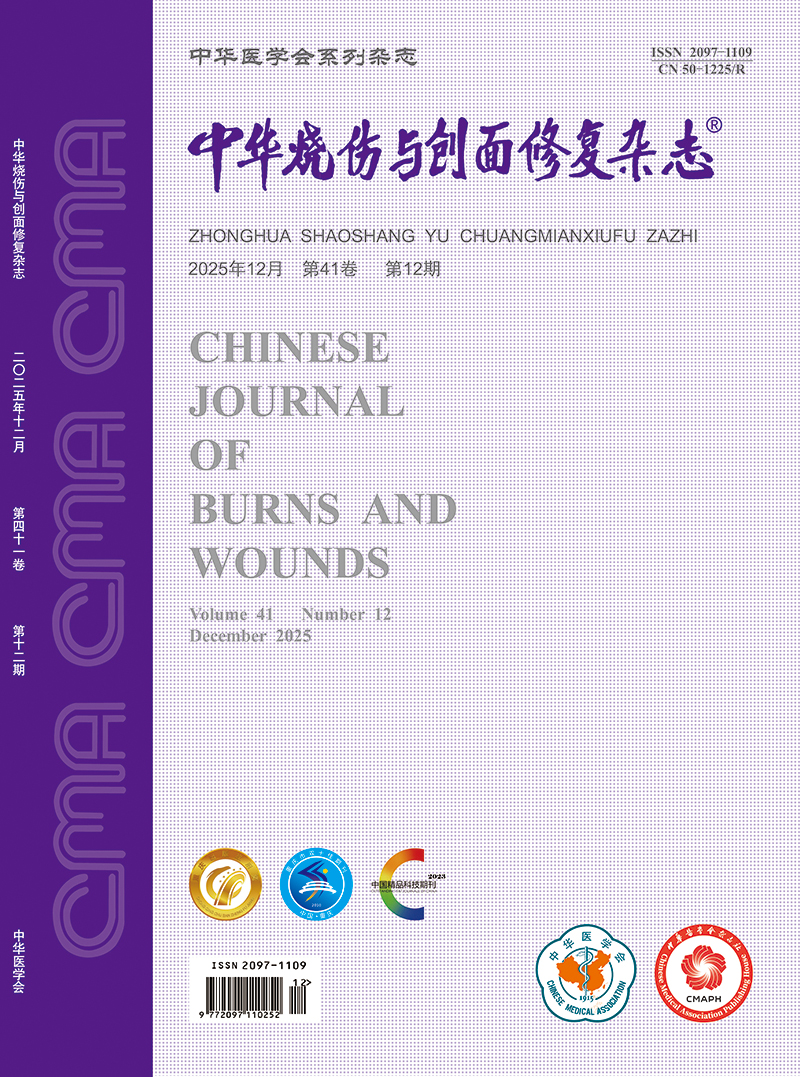
- Medline/PubMed数据库
- Scopus数据库
- PMC数据库
- CSCD
- 北大核心收录期刊
- 统计源期刊
- 我国高质量科技期刊T1级
- 第6届中国精品科技期刊
| Citation: | Shao ZH,Li L,Li CS,et al.Clinical efficacy of free anterolateral thigh flap supplied by non-major artery in the recipient area based on gradient selection in repairing wounds formed after lower limb salvage surgery[J].Chin J Burns Wounds,2025,41(12):1183-1191.DOI: 10.3760/cma.j.cn501225-20250225-00085.

|

| [1] |
DonnellyL,MillsHJ.Clinical assessment and factors influencing treatment strategy and outcomes in complex limb injuries[J].Cureus,2024,16(11):e73347.DOI: 10.7759/cureus.73347.
|
| [2] |
李绍光,何红英,张建政.肢体毁损伤要截肢还是保肢[J].中国骨与关节杂志,2021,10(12):881-884.DOI: 10.3969/j.issn.2095-252X.2021.12.001.
|
| [3] |
朱庆棠,李文军,朱磊,等.严重开放性肢体创伤早期救治专家共识[J].中华显微外科杂志,2023,46(1):7-24.DOI: 10.3760/cma.j.cn441206-20221010-00207.
|
| [4] |
BrunettiB,PetrucciV,TennaS,et al."Extra-anatomical Pedicle Rerouting" an alternative technique to obtain new recipient vessels for microsurgical reconstruction in unfavorable clinical situations[J].J Plast Reconstr Aesthet Surg,2024,91:227-235.DOI: 10.1016/j.bjps.2024.01.055.
|
| [5] |
郑民华,李树春,赵轩.科技创新驱动微创外科的发展[J].中华消化外科杂志,2023,22(4):449-454.DOI: 10.3760/cma.j.cn115610-20230324-00128.
|
| [6] |
中华医学会显微外科学分会,中国医师协会骨科医师分会创伤学组,中国医师协会骨科医师分会外固定学组,等.中国下肢软组织损伤修复指南(2023)[J].中华创伤骨科杂志,2023,25(3):193-201.DOI: 10.3760/cma.j.cn115530-20230110-00015.
|
| [7] |
芮永军,戚剑,唐举玉,等.严重肢体创伤创面早期修复专家共识[J].中华显微外科杂志,2023,46(4):368-382.DOI: 10.3760/cma.j.cn441206-20230407-00062.
|
| [8] |
ZhouHX,HeL,YinD,et al.Modified donor blood flow-preserved cross-leg anterolateral thigh flap procedure for complex lower extremity reconstruction[J].J Orthop Surg Res,2022,17(1):262.DOI: 10.1186/s13018-022-03155-9.
|
| [9] |
徐继胜,朱鑫,陈阳,等.桥式皮瓣联合膜诱导技术修复小腿Gustilo III C型损伤的经验[J].中华显微外科杂志,2020,43(3):288-292.DOI: 10.3760/cma.j.cn441206-20200221-00077.
|
| [10] |
蔡茂林,邓晓文,刘登科,等.小腿后外侧宽蒂双动力皮瓣的解剖学研究及其在足跟部软组织修复中的应用效果[J].中华解剖与临床杂志,2025,30(6):379-385.DOI: 10.3760/cma.j.cn101202-20241026-00314.
|
| [11] |
AbdelmegeedAG,HifnyMA,AbulezzTA,et al.Reliability and safety of cross-leg free latissmus dorsi muscle flap in reconstruction of mutilating leg injuries using end-to-side anastomosis[J].Arch Plast Surg,2023,50(5):507-513.DOI: 10.1055/a-2126-7058.
|
| [12] |
牛峰,张朝,郭永明,等.交腿桥式供血的游离股前外侧穿支皮瓣修复伴有主干血管缺损的小腿感染性创面7例[J].中华显微外科杂志,2024,47(4):416-422.DOI: 10.3760/cma.j.cn441206-20240225-00053.
|
| [13] |
肖飞鹏,柳志锦,刘胜哲,等. 综合评价量表在股前外侧皮瓣修复术后疗效评价中的应用[J].中国美容整形外科杂志,2021,32(6):348-351.DOI: 10.3969/j.issn.1673-7040.2021.06.010.
|
| [14] |
李海,肖顺娥,邓呈亮,等.不同类型游离穿支皮瓣组合在四肢复杂创面修复中的临床应用[J].中华烧伤与创面修复杂志,2023,39(8):758-764.DOI: 10.3760/cma.j.cn501225-20220720-00300.
|
| [15] |
柳志锦,程俊楠,杨林,等.股前外侧区组合穿支皮瓣在严重创伤肢体保肢治疗中的应用效果[J].中华外科杂志,2022,60(5):486-489.DOI: 10.3760/cma.j.cn112139-20210804-00357.
|
| [16] |
刘昆,刘琳琳,马丙涛,等.小腿严重创伤并发坏死感染的保肢策略[J].中国骨与关节杂志,2025,14(3):207-213.DOI: 10.3969/j.issn.2095-252X.2025.03.003.
|
| [17] |
葛成伟,蒋国栋,程俊楠,等.以旋股外侧动脉斜支为蒂并携带阔筋膜的股前外侧穿支皮瓣修复手足毁损性创面并重建功能的效果[J].中华烧伤与创面修复杂志,2024,40(9):842-848.DOI: 10.3760/cma.j.cn501225-20240508-00163.
|
| [18] |
刘飞,闫炜琪,马强,等.股前外侧血流桥接嵌合穿支皮瓣游离移植治疗伴主干动脉缺损的上肢复合组织缺损的临床效果[J].中华烧伤与创面修复杂志,2024,40(2):172-179.DOI: 10.3760/cma.j.cn501225-20231103-00176.
|
| [19] |
ChenCE,MaCY,WangTH,et al.Optimizing primary closure of anterolateral thigh flap donor sites through literature review and clinical analysis[J].Plast Reconstr Surg Glob Open,2025,13(10):e7193.DOI: 10.1097/GOX.0000000000007193.
|
| [20] |
JinW,ChangS,ZhangZ,et al.Parallel cross-leg free flap with posterior tibial artery perforator pedicle propeller cable bridge flap for the treatment of lower extremity wounds: a case series report[J].J Invest Surg,2022,35(7):1572-1578.DOI: 10.1080/08941939.2022.2058127.
|
| [21] |
BaliZU,KaratanB,TuluyY,et al.Preserving the blood flow of the recipient artery in cross-leg free flap procedure for lower extremity reconstruction[J].Int J Low Extrem Wounds,2020,19(3):255-261.DOI: 10.1177/1534734620913414.
|
| [22] |
高成恩,贾永林,张保华,等.茎突-颈动脉综合征2例临床特征分析及文献复习[J].解放军医学杂志,2024,49(10):1156-1162. DOI: 10.11855/j.issn.0577-7402.0044.2024.0506.
|
| [23] |
ShiY,SuY,YangX,et al.Computed tomography angiography-guided precise flap surgery: a new strategy for flap selection, mapping and harvesting[J/OL].Burns Trauma,2024,12:tkae032[2025-02-25].https://pubmed.ncbi.nlm.nih.gov/38957663/.DOI: 10.1093/burnst/tkae032.
|
| [24] |
陈蓁臻,陈穴,文雪刚,等.数字减影血管造影术在治疗中心静脉置管致医源性血管损伤中的临床应用[J].中华消化外科杂志,2024,23(9):1227-1230. DOI: 10.3760/cma.j.cn115610-20240717-00340.
|
| [25] |
刘文剑,张红艳,刘德伍.不同类型的组织瓣修复胫骨近端骨折术后钢板外露伴感染创面的临床效果[J].中华烧伤与创面修复杂志,2023,39(12):1140-1148.DOI: 10.3760/cma.j.cn501225-20231101-00171.
|
| [26] |
LinCH,HsiehYH,LinCH.The medial sural artery perforator flap in lower extremity reconstruction[J].Clin Plast Surg,2021,48(2):249-257.DOI: 10.1016/j.cps.2021.01.003.
|
| [27] |
刘澒洞,周正虎,李雷,等.以腓肠肌内侧头动脉供血的游离股前外侧皮瓣修复小腿复杂创面的临床研究[J].实用临床医药杂志,2024,28(5):99-102,115.DOI: 10.7619/jcmp.20233879.
|
| [28] |
李雷,周正虎,鞠文,等.以膝降动脉为蒂的游离股前外侧穿支皮瓣修复小腿保肢术后创面的临床效果[J].中华烧伤与创面修复杂志,2023,39(5):450-455. DOI: 10.3760/cma.j.cn501225-20220725-00308.
|
| [29] |
PanagatlaP,RavulaP,ChandrashekarP,et al.Sural artery as a recipient vessel for free flaps[J].Indian J Plast Surg,2023,56(1):31-38.DOI: 10.1055/s-0042-1760094.
|
| [30] |
黄永涛,杨林,巨积辉.以旋股外侧动脉各分支为蒂的股前外侧皮瓣临床应用研究进展[J].中国美容整形外科杂志,2023,34(7):412-415.DOI: 10.3969/j.issn.1673-7040.2023.07.009.
|
| [31] |
葛东江,任志勇,魏长月,等.腓肠血管联合游离皮瓣的解剖及临床应用[J].中华骨科杂志,2014,34(10):1042-1049.DOI: 10.3760/cma.j.issn.0253-2352.2014.10.009.
|
| [32] |
刘军,黎逢峰,吴永伟,等.以膝降动脉为受区血管的股前外侧皮瓣在膝关节周围创面的临床应用[J]. 中华显微外科杂志,2018,41(4):324-328.DOI: 10.3760/cma.j.issn.1001-2036.2018.04.003.
|
| [33] |
张文龙,高顺红,于志亮,等.受区吻合旋股外侧动脉降支的游离皮瓣修复小腿软组织严重缺损[J].中华解剖与临床杂志,2017,22(3):213-216.DOI: 10.3760/cma.j.issn.2095-7041.2017.03.008.
|
| [34] |
LiuZ,LiuS,YangL,et al.Reconstruction of large-area wounds in limbs using two flow-through anterolateral thigh perforator flaps[J].Injury,2023,54(10):110979.DOI: 10.1016/j.injury.2023.110979.
|
| [35] |
DongKX,ZhouY,ChengYY,et al.Clinical application of digital technology in the use of anterolateral thigh lobulated perforator flaps to repair complex soft tissue defects of the limbs[J/OL].Burns Trauma,2024,12:tkae011[2025-02-25].https://pubmed.ncbi.nlm.nih.gov/38737342/.DOI: 10.1093/burnst/tkae011.
|
| [36] |
KalaPC,SaradhaR,KatroliaD,et al.Ascending the reconstructive ladder - our experience and outcomes with free anterolateral thigh flap in upper limb trauma[J].J Clin Orthop Trauma,2025,67:103030.DOI: 10.1016/j.jcot.2025.103030.
|
| [37] |
RutlandJW,RohrichRN,LiKR,et al.Lower extremity free tissue transfer in peronea arteria magna: an observational retrospective cohort study of anatomic and microsurgical considerations[J].Microsurgery,2025,45(6):e70079.DOI: 10.1002/micr.70079.
|
| [38] |
PattersonJT,BecerraJA,BrownM,et al.Antibiotic bead pouch versus negative pressure wound therapy at initial management of AO/OTA 42 type IIIB open tibia fracture may reduce fracture related infection: a retrospective analysis of 113 patients[J].Injury,2023,54(2):744-750.DOI: 10.1016/j.injury.2022.12.018.
|
| [39] |
KofoedJS,TuncerFB,KwokAC,et al.Lasting effects of surgically used topical vasodilators on DIEP artery vascular function[J].J Reconstr Microsurg,2025,41(3):219-226.DOI: 10.1055/s-0044-1788326.
|
Figures(4)
Copyright © Chinese Journal of Burns京ICP备07035254号-14
E-mail:shaoshangzazhi@163.com
Supported by:
Beijing Renhe Information Technology Co. Ltd



 DownLoad:


