
- Medline/PubMed数据库
- Scopus数据库
- PMC数据库
- CSCD
- 北大核心收录期刊
- 统计源期刊
- 我国高质量科技期刊T1级
- 第6届中国精品科技期刊
| Citation: | Burns and Trauma Branch of Chinese Geriatrics Society,Critical Care Group of Chinese Burn Association,Editorial Committee of Chinese Journal of Burns and Wounds.Expert consensus update on the clinical diagnosis and treatment of inhalation injury in adults (2025 edition)[J].Chin J Burns Wounds,2025,41(9):811-824.DOI: 10.3760/cma.j.cn501225-20250502-00202.

|

| [1] |
KadriSS, MillerAC, HohmannS, et al. Risk factors for in-hospital mortality in smoke inhalation-associated acute lung injury: data from 68 United States hospitals[J]. Chest, 2016, 150(6): 1260-1268. DOI: 10.1016/j.chest.2016.06.008.
|
| [2] |
豆哲, 张国安. 系统综述我国烧伤患者吸入性损伤的流行病学特征[J].中华烧伤杂志,2021,37(7):654-660. DOI: 10.3760/cma.j.cn501120-20200306-00129.
|
| [3] |
中国老年医学学会烧创伤分会. 吸入性损伤临床诊疗全国专家共识(2018版)[J]. 中华烧伤杂志, 2018, 34(11): 770-775. DOI: 10.3760/cma.j.issn.1009-2587.2018.11.010.
|
| [4] |
陈耀龙, 杨克虎, 王小钦, 等. 中国制订/修订临床诊疗指南的指导原则(2022版)[J].中华医学杂志,2022,102(10):697-703. DOI: 10.3760/cma.j.cn112137-20211228-02911.
|
| [5] |
Milton-JonesH, SoussiS, DaviesR, et al. An international RAND/UCLA expert panel to determine the optimal diagnosis and management of burn inhalation injury[J]. Crit Care, 2023,27(1):459. DOI: 10.1186/s13054-023-04718-w.
|
| [6] |
GuyattGH, OxmanAD, VistGE, et al. GRADE: an emerging consensus on rating quality of evidence and strength of recommendations[J]. BMJ, 2008,336(7650):924-926. DOI: 10.1136/bmj.39489.470347.AD.
|
| [7] |
WalkerPF, BuehnerMF, WoodLA, et al. Diagnosis and management of inhalation injury: an updated review[J]. Crit Care, 2015,19:351. DOI: 10.1186/s13054-015-1077-4.
|
| [8] |
CancioLC. Airway management and smoke inhalation injury in the burn patient[J]. Clin Plast Surg, 2009,36(4):555-567. DOI: 10.1016/j.cps.2009.05.013.
|
| [9] |
HassanZ, WongJK, BushJ, et al. Assessing the severity of inhalation injuries in adults[J]. Burns, 2010,36(2):212-216. DOI: 10.1016/j.burns.2009.06.205.
|
| [10] |
YouK, YangHT, KymD, et al. Inhalation injury in burn patients: establishing the link between diagnosis and prognosis[J]. Burns, 2014,40(8):1470-1475. DOI: 10.1016/j.burns.2014.09.015.
|
| [11] |
ZieglerB, HundeshagenG, UhlmannL, et al. Impact of diagnostic bronchoscopy in burned adults with suspected inhalation injury[J]. Burns, 2019,45(6):1275-1282. DOI: 10.1016/j.burns.2019.07.011.
|
| [12] |
AungMT, GarnerD, PacquolaM, et al. The use of a simple three-level bronchoscopic assessment of inhalation injury to predict in-hospital mortality and duration of mechanical ventilation in patients with burns[J]. Anaesth Intensive Care, 2018,46(1):67-73. DOI: 10.1177/0310057X1804600110.
|
| [13] |
CarrJA, CrowleyN. Prophylactic sequential bronchoscopy after inhalation injury: results from a three-year prospective randomized trial[J]. Eur J Trauma Emerg Surg, 2013,39(2):177-183. DOI: 10.1007/s00068-013-0254-x.
|
| [14] |
蒋南红, 王德运, 席毛毛, 等. 纤维支气管镜气道灌洗治疗特重度烧伤合并重度吸入性损伤患者的回顾性研究[J]. 中华烧伤杂志, 2020, 36(4): 252-259. DOI: 10.3760/cma.j.cn501120-20191203-00451.
|
| [15] |
ConcannonE, Damkat ThomasL, KerrL, et al. Review of indications for endotracheal intubation in burn patients with suspected inhalational injury[J]. Eur Burn J, 2023, 4(2): 163-172. DOI: 10.3390/ebj4020014.
|
| [16] |
American Burn Association. Advanced burn life support course provider manual 2018 update[Z/OL].Chicago: American Burn Association, 2018[2025-05-02]. https://www.readkong.com/page/advanced-burn-life-support-course-provider-manual-2018-3855651. |
| [17] |
ISBI Practice Guidelines Committee, SubcommitteeAdvisory, SubcommitteeSteering. ISBI Practice Guidelines for Burn Care, Part 2[J]. Burns, 2018,44(7):1617-1706. DOI: 10.1016/j.burns.2018.09.012.
|
| [18] |
DingleLA, WainRAJ, BishopS, et al. Intubation in burns patients: a 5-year review of the Manchester regional burns centre experience[J]. Burns, 2021,47(3):576-586. DOI: 10.1016/j.burns.2020.07.019.
|
| [19] |
GaverDP3rd, NiemanGF, GattoLA, et al. The POOR get POORer: a hypothesis for the pathogenesis of ventilator-induced lung injury[J]. Am J Respir Crit Care Med, 2020, 202(8): 1081-1087. DOI: 10.1164/rccm.202002-0453CP.
|
| [20] |
MariniJJ, RoccoPRM, GattinoniL. Static and dynamic contributors to ventilator-induced lung injury in clinical practice. pressure, energy, and power[J]. Am J Respir Crit Care Med, 2020, 201(7): 767-774. DOI: 10.1164/rccm.201908-1545CI.
|
| [21] |
刘晓彬, 朱峰. 从机械能视角再理解呼吸机相关性肺损伤[J]. 中华烧伤杂志, 2021, 37(3): 292-295. DOI: 10.3760/cma.j.cn501120-20200203-00039.
|
| [22] |
张瑞, 何怀武, 隆云. 呼吸机相关性肺血管损伤的研究进展[J/OL]. 中华重症医学电子杂志, 2020, 6(1): 100-103[2025-05-02]. https://icu.cma-cmc.com.cn/CN/ 10.3877/cma.j.issn.2096-1537.2020.030. DOI: 10.3877/cma.j.issn.2096-1537.2020.030.
|
| [23] |
HamahataN, PinskyMR. Heart-lung interactions[J]. Semin Respir Crit Care Med, 2023, 44(5): 650-660. DOI: 10.1055/s-0043-1770062.
|
| [24] |
CarteauxG, ParfaitM, CombetM, et al. Patient-self inflicted lung injury: a practical review[J]. J Clin Med, 2021, 10(12):2738. DOI: 10.3390/jcm10122738.
|
| [25] |
任志国, 朱峰. 自戕性肺损伤的机制和防治研究进展[J]. 中华烧伤杂志, 2021, 37(8): 801-804. DOI: 10.3760/cma.j.cn501120-20200610-00302.
|
| [26] |
Acute Respiratory Distress Syndrome Network, BrowerRG, MatthayMA,et al. Ventilation with lower tidal volumes as compared with traditional tidal volumes for acute lung injury and the acute respiratory distress syndrome[J]. N Engl J Med, 2000,342(18):1301-1308. DOI: 10.1056/NEJM200005043421801.
|
| [27] |
AmatoMB, BarbasCS, MedeirosDM, et al. Effect of a protective-ventilation strategy on mortality in the acute respiratory distress syndrome[J]. N Engl J Med, 1998,338(6):347-354. DOI: 10.1056/NEJM199802053380602.
|
| [28] |
SchultzMJ, HornJ, HollmannMW, et al. Ventilation practices in burn patients-an international prospective observational cohort study[J/OL]. Burns Trauma, 2021,9:tkab034[2025-05-02]. https://pubmed.ncbi.nlm.nih.gov/34926707/. DOI: 10.1093/burnst/tkab034.
|
| [29] |
BatchinskyAI, BurkettSE, ZandersTB, et al. Comparison of airway pressure release ventilation to conventional mechanical ventilation in the early management of smoke inhalation injury in swine[J]. Crit Care Med, 2011,39(10):2314-2321. DOI: 10.1097/CCM.0b013e318225b5b3.
|
| [30] |
FolwellJS, BaselAP, BrittonGW, et al. Mechanical ventilation strategies in the critically ill burn patient: a practical review for clinicians[J]. Eur Burn J, 2021, 2(3): 140-151.
|
| [31] |
CioffiWG, GravesTA, McManusWF, et al. High-frequency percussive ventilation in patients with inhalation injury[J]. J Trauma, 1989,29(3):350-354. DOI: 10.1097/00005373-198903000-00012.
|
| [32] |
CartottoR, EllisS, GomezM, et al. High frequency oscillatory ventilation in burn patients with the acute respiratory distress syndrome[J]. Burns, 2004,30(5):453-463. DOI: 10.1016/j.burns.2004.01.015.
|
| [33] |
YoungD, LambSE, ShahS, et al. High-frequency oscillation for acute respiratory distress syndrome[J]. N Engl J Med, 2013,368(9):806-813. DOI: 10.1056/NEJMoa1215716.
|
| [34] |
ReperP, WibauxO, Van LaekeP, et al. High frequency percussive ventilation and conventional ventilation after smoke inhalation: a randomised study[J]. Burns, 2002,28(5):503-508. DOI: 10.1016/s0305-4179(02)00051-7.
|
| [35] |
ChungKK, WolfSE, RenzEM, et al. High-frequency percussive ventilation and low tidal volume ventilation in burns: a randomized controlled trial[J]. Crit Care Med, 2010,38(10):1970-1977. DOI: 10.1097/CCM.0b013e3181eb9d0b.
|
| [36] |
GuérinC, AlbertRK, BeitlerJ, et al. Prone position in ARDS patients: why, when, how and for whom[J]. Intensive Care Med, 2020,46(12):2385-2396. DOI: 10.1007/s00134-020-06306-w.
|
| [37] |
GattinoniL, TacconeP, CarlessoE, et al. Prone position in acute respiratory distress syndrome. Rationale, indications, and limits[J]. Am J Respir Crit Care Med, 2013,188(11):1286-1293. DOI: 10.1164/rccm.201308-1532CI.
|
| [38] |
AlhazzaniW, ParharKKS, WeatheraldJ,et al. Effect of awake prone positioning on endotracheal intubation in patients with COVID-19 and acute respiratory failure: a randomized clinical trial[J]. JAMA, 2022,327(21):2104-2113. DOI: 10.1001/jama.2022.7993.
|
| [39] |
GuérinC, ReignierJ, RichardJC, et al. Prone positioning in severe acute respiratory distress syndrome[J]. N Engl J Med, 2013,368(23):2159-2168. DOI: 10.1056/NEJMoa1214103.
|
| [40] |
中国老年医学学会烧创伤分会, 中华医学会烧伤外科学分会重症学组. 成人烧伤俯卧位治疗全国专家共识(2022版)[J]. 中华烧伤与创面修复杂志, 2022, 38(7): 601-609. DOI: 10.3760/cma.j.cn501120-20211208-00407.
|
| [41] |
JiangLG, LeBaronJ, BodnarD, et al. Conscious proning: an introduction of a proning protocol for nonintubated, awake, hypoxic emergency department COVID-19 patients[J]. Acad Emerg Med, 2020,27(7):566-569. DOI: 10.1111/acem.14035.
|
| [42] |
PelosiP, BallL, BarbasCSV, et al. Personalized mechanical ventilation in acute respiratory distress syndrome[J]. Crit Care, 2021,25(1):250. DOI: 10.1186/s13054-021-03686-3.
|
| [43] |
PensierJ, de JongA, HajjejZ, et al. Effect of lung recruitment maneuver on oxygenation, physiological parameters and mortality in acute respiratory distress syndrome patients: a systematic review and meta-analysis[J]. Intensive Care Med, 2019,45(12):1691-1702. DOI: 10.1007/s00134-019-05821-9.
|
| [44] |
AmbrosioAM, LuoR, FantoniDT, et al. Effects of positive end-expiratory pressure titration and recruitment maneuver on lung inflammation and hyperinflation in experimental acid aspiration-induced lung injury[J]. Anesthesiology, 2012,117(6):1322-1334. DOI: 10.1097/ALN.0b013e31827542aa.
|
| [45] |
Writing Group for the Alveolar Recruitment for Acute Respiratory Distress Syndrome Trial (ART) Investigators, CavalcantiAB, SuzumuraÉA, et al. Effect of lung recruitment and titrated positive end-expiratory pressure (PEEP) vs low PEEP on mortality in patients with acute respiratory distress syndrome: a randomized clinical trial[J]. JAMA, 2017,318(14):1335-1345. DOI: 10.1001/jama.2017.14171.
|
| [46] |
BrittonGW, KeithAR, HalgasBJ, et al. Extracorporeal organ support for burn-injured patients[J]. Eur Burn J, 2024,5(2):66-76. DOI: 10.3390/ebj5020006.
|
| [47] |
TonnaJE, BoonstraPS, MacLarenG, et al. Extracorporeal Life Support Organization (ELSO) Member Centers Group. Extracorporeal life support organization registry international report 2022: 100,000 survivors[J]. ASAIO J, 2024,70(2):131-143. DOI: 10.1097/MAT.0000000000002128.
|
| [48] |
EldredgeRS, ZhaiY, CochranA. Effectiveness of ECMO for burn-related acute respiratory distress syndrome[J]. Burns, 2019,45(2):317-321. DOI: 10.1016/j.burns.2018.10.012.
|
| [49] |
CartottoR, LiZ, HannaS, et al. The acute respiratory distress syndrome (ARDS) in mechanically ventilated burn patients: an analysis of risk factors, clinical features, and outcomes using the Berlin ARDS definition[J]. Burns, 2016, 42(7): 1423-1432. DOI: 10.1016/j.burns.2016.01.031.
|
| [50] |
AinsworthCR, DellavolpeJ, ChungKK, et al. Revisiting extracorporeal membrane oxygenation for ARDS in burns: a case series and review of the literature[J]. Burns, 2018,44(6):1433-1438. DOI: 10.1016/j.burns.2018.05.008.
|
| [51] |
KennedyJD, ThayerW, BeunoR, et al. ECMO in major burn patients: feasibility and considerations when multiple modes of mechanical ventilation fail[J/OL]. Burns Trauma, 2017,5:20[2025-05-02]. https://pubmed.ncbi.nlm.nih.gov/28649575/.DOI: 10.1186/s41038-017-0085-9.
|
| [52] |
BurkeCR, ChanT, McMullanDM. Extracorporeal life support use in adult burn patients[J]. J Burn Care Res, 2017,38(3):174-178. DOI: 10.1097/BCR.0000000000000436.
|
| [53] |
AsmussenS, MaybauerDM, FraserJF, et al. Extracorporeal membrane oxygenation in burn and smoke inhalation injury[J]. Burns, 2013,39(3):429-435. DOI: 10.1016/j.burns.2012.08.006.
|
| [54] |
ChiuYJ, HuangYC, ChenTW, et al. A systematic review and meta-analysis of extracorporeal membrane oxygenation in patients with burns[J]. Plast Reconstr Surg, 2022,149(6):1181e-1190e. DOI: 10.1097/PRS.0000000000009149.
|
| [55] |
HengX, CaiP, YuanZ, et al. Efficacy and safety of extracorporeal membrane oxygenation for burn patients: a comprehensive systematic review and meta-analysis[J/OL]. Burns Trauma, 2023,11:tkac056[2025-05-02]. https://pubmed.ncbi.nlm.nih.gov/36873286/.DOI: 10.1093/burnst/tkac056.
|
| [56] |
SzentgyorgyiL, ShepherdC, DunnKW, et al. Extracorporeal membrane oxygenation in severe respiratory failure resulting from burns and smoke inhalation injury[J]. Burns, 2018,44(5):1091-1099. DOI: 10.1016/j.burns.2018.01.022.
|
| [57] |
ThompsonJT, MolnarJA, HinesMH, et al. Successful management of adult smoke inhalation with extracorporeal membrane oxygenation[J]. J Burn Care Rehabil, 2005,26(1):62-66. DOI: 10.1097/01.bcr.0000150303.15345.79.
|
| [58] |
Askegard-GiesmannJR, BesnerGE, FabiaR, et al. Extracorporeal membrane oxygenation as a lifesaving modality in the treatment of pediatric patients with burns and respiratory failure[J]. J Pediatr Surg, 2010,45(6):1330-1335. DOI: 10.1016/j.jpedsurg.2010.02.106.
|
| [59] |
O'TooleG, PeekG, JaffeW, et al. Extracorporeal membrane oxygenation in the treatment of inhalation injuries[J]. Burns, 1998,24(6):562-565. DOI: 10.1016/s0305-4179(98)00061-8.
|
| [60] |
HebertS, ErdoganM, GreenRS, et al. The use of extracorporeal membrane oxygenation in severely burned patients: a survey of north american burn centers[J]. J Burn Care Res, 2022, 43(2): 462-467. DOI: 10.1093/jbcr/irab103.
|
| [61] |
VaquerS, de HaroC, PerugaP, et al. Systematic review and meta-analysis of complications and mortality of veno-venous extracorporeal membrane oxygenation for refractory acute respiratory distress syndrome[J]. Ann Intensive Care, 2017,7(1):51. DOI: 10.1186/s13613-017-0275-4.
|
| [62] |
中国病理生理危重病学会呼吸治疗学组. 重症患者气道廓清技术专家共识[J/OL]. 中华重症医学电子杂志, 2020, 6(3): 272-282[2025-05-02]. https://icu.cma-cmc.com.cn/CN/ 10.3877/cma.j.issn.2096-1537.2020.03.007. DOI: 10.3877/cma.j.issn.2096-1537.2020.03.007.
|
| [63] |
张宇翔, 兰美娟, 梁诗雨, 等. 物理性气道廓清技术在吸入性损伤治疗中的应用进展[J]. 中华烧伤与创面修复杂志, 2023, 39(5): 475-480. DOI: 10.3760/cma.j.cn501225-20220608-00226.
|
| [64] |
KuboT, OsukaA, KabataD, et al. Chest physical therapy reduces pneumonia following inhalation injury[J]. Burns, 2021,47(1):198-205. DOI: 10.1016/j.burns.2020.06.034.
|
| [65] |
EnkhbaatarP, PruittBAJr, SumanO, et al. Pathophysiology, research challenges, and clinical management of smoke inhalation injury[J]. Lancet, 2016,388(10052):1437-1446. DOI: 10.1016/S0140-6736(16)31458-1.
|
| [66] |
OnishiA, St AngeK, DordickJS, et al. Heparin and anticoagulation[J]. Front Biosci (Landmark Ed), 2016,21(7):1372-1392. DOI: 10.2741/4462.
|
| [67] |
ElsharnoubyNM, EidHE, Abou ElezzNF, et al. Heparin/N-acetylcysteine: an adjuvant in the management of burn inhalation injury: a study of different doses[J]. J Crit Care, 2014,29(1):182.e1-182.e4. DOI: 10.1016/j.jcrc.2013.06.017.
|
| [68] |
PanahiY, GhaneiM, RahimiM, et al. Evaluation the efficacy and safety of N-acetylcysteine inhalation spray in controlling the symptoms of patients with COVID-19: an open-label randomized controlled clinical trial[J]. J Med Virol, 2023,95(1):e28393. DOI: 10.1002/jmv.28393.
|
| [69] |
McGinnKA, WeigartzK, LintnerA, et al. Nebulized heparin with n-acetylcysteine and albuterol reduces duration of mechanical ventilation in patients with inhalation injury[J]. J Pharm Pract, 2019, 32(2): 163-166. DOI: 10.1177/0897190017747143.
|
| [70] |
CoxCL, McIntireAM, BoltonKJ, et al. A multicenter evaluation of outcomes following the use of nebulized heparin for inhalation injury (HIHI2 study)[J]. J Burn Care Res, 2020,41(5):1004-1008. DOI: 10.1093/jbcr/iraa101.
|
| [71] |
LanX, HuangZ, TanZ, et al. Nebulized heparin for inhalation injury in burn patients: a systematic review and meta-analysis[J/OL]. Burns Trauma, 2020,8:tkaa015[2025-05-02]. https://pubmed.ncbi.nlm.nih.gov/32523966/.DOI: 10.1093/burnst/tkaa015.
|
| [72] |
GlasGJ, HornJ, BinnekadeJM, et al. Nebulized heparin in burn patients with inhalation trauma-safety and feasibility[J]. J Clin Med, 2020, 9(4):894. DOI: 10.3390/jcm9040894.
|
| [73] |
FoncerradaG, LimaF, ClaytonRP, et al. Safety of nebulized epinephrine in smoke inhalation injury[J]. J Burn Care Res, 2017,38(6):396-402. DOI: 10.1097/BCR.0000000000000575.
|
| [74] |
HuangG, LiangB, LiuG, et al. Low dose of glucocorticoid decreases the incidence of complications in severely burned patients by attenuating systemic inflammation[J]. J Crit Care, 2015,30(2):436.e7-436.e11. DOI: 10.1016/j.jcrc.2014.09.016.
|
| [75] |
SpruitMA, RochesterCL, PittaF, et al. Pulmonary rehabilitation, physical activity, respiratory failure and palliative respiratory care[J]. Thorax, 2019,74(7):693-699. DOI: 10.1136/thoraxjnl-2018-212044.
|
| [76] |
TroostersT, JanssensW, DemeyerH, et al. Pulmonary rehabilitation and physical interventions[J]. Eur Respir Rev, 2023,32(168):220222.DOI: 10.1183/16000617.0222-2022.
|
| [77] |
中华医学会灾难医学分会, 中国医师协会急救复苏与灾难医学分会, 中国医学救援协会救援防护分会. ARDS患者肺康复训练专家共识[J].中国急救复苏与灾害医学杂志,2022,17(4):421-426. DOI: 10.3969/j.issn.1673-6966.2022.04.001.
|
| [78] |
JeschkeMG, GauglitzGG, KulpGA, et al. Long-term persistance of the pathophysiologic response to severe burn injury[J]. PLoS One, 2011,6(7):e21245. DOI: 10.1371/journal.pone.0021245.
|
| [79] |
WilliamsFN, HerndonDN, JeschkeMG. The hypermetabolic response to burn injury and interventions to modify this response[J]. Clin Plast Surg, 2009,36(4):583-596. DOI: 10.1016/j.cps.2009.05.001.
|
| [80] |
WonYH, ChoYS, JooSY, et al. Respiratory characteristics in patients with major burn injury and smoke inhalation[J]. J Burn Care Res, 2022, 43(1): 70-76. DOI: 10.1093/jbcr/irab085.
|
| [81] |
WonYH, ChoYS, JooSY, et al. The effect of a pulmonary rehabilitation on lung function and exercise capacity in patients with burn: a prospective randomized single-blind study[J]. J Clin Med, 2020, 9(7):2250. DOI: 10.3390/jcm9072250.
|
| [82] |
El-Sayed AttallaAF, AhmedKT, Abd El MonemM. Effects of inspiratory muscle training on clinical predictors of respiratory muscle strength and lung function in burned patients with inhalation injury[J]. J Burn Care Res, 2023, 44(1): 140-145. DOI: 10.1093/jbcr/irac163.
|
| [83] |
MalikSS, TassadaqN. Effectiveness of deep breathing exercises and incentive spirometry on arterial blood gases in second degree inhalation burn patients[J]. J Coll Physicians Surg Pak, 2019, 29(10): 954-957. DOI: 10.29271/jcpsp.2019.10.954.
|
| [84] |
AllamNM, BadawyMM, ElimyDA. Effect of pilates exercises on pulmonary function, respiratory muscle strength, and functional capacity in patients with inhalation injury after flame thermal burn: a prospective randomized controlled trial[J]. Burns, 2024, 50(9): 107284. DOI: 10.1016/j.burns.2024.10.005.
|
| [85] |
AliZA, EladlHM, AbdelbassetWK, et al. Inhalation injury in adult males: evaluation of the short-term efficacy of transcutaneous electrical acupoint stimulation on pulmonary functions and diaphragmatic mobility after burn: a double-blind randomized controlled study[J]. Burns, 2022, 48(8): 1933-1939. DOI: 10.1016/j.burns.2022.01.015.
|
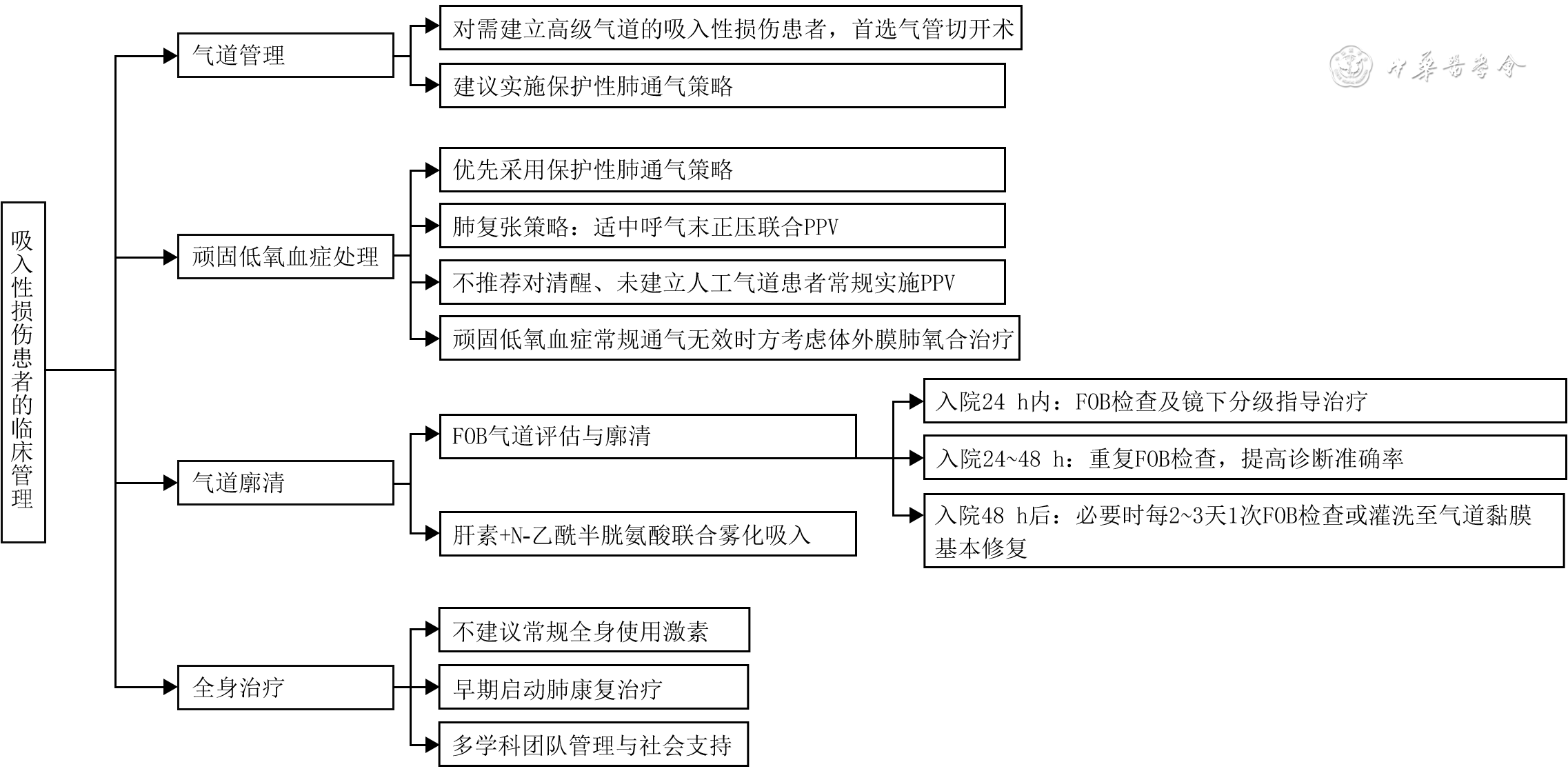
Figures(1) / Tables(1)
Copyright © Chinese Journal of Burns京ICP备07035254号-14
E-mail:shaoshangzazhi@163.com
Supported by:
Beijing Renhe Information Technology Co. Ltd



 DownLoad: