- Medline/PubMed数据库
- Scopus数据库
- PMC数据库
- CSCD
- 北大核心收录期刊
- 统计源期刊
- 我国高质量科技期刊T1级
- 第6届中国精品科技期刊
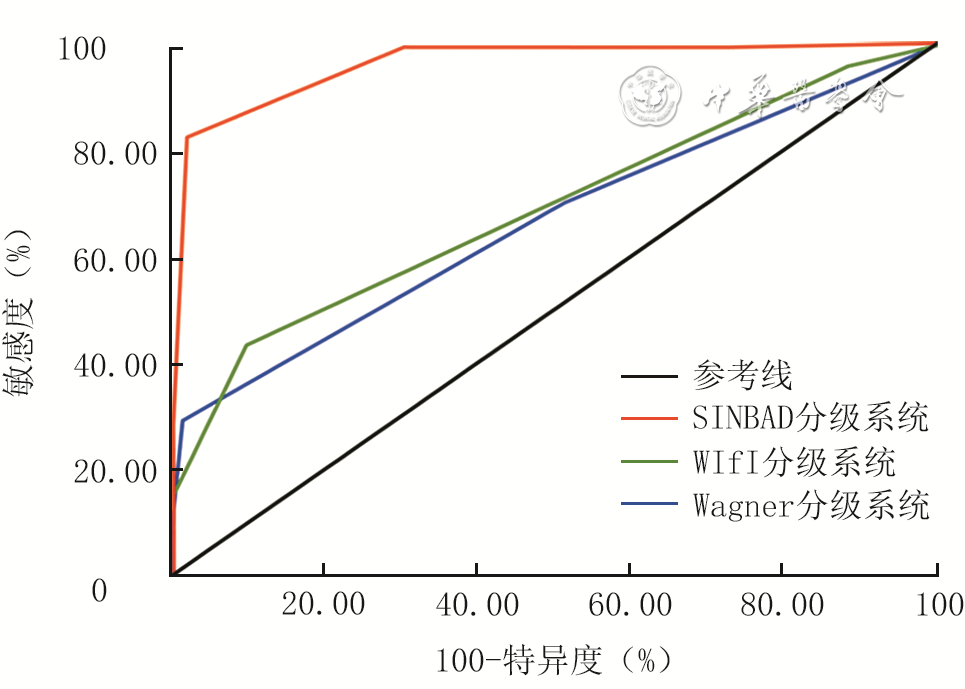
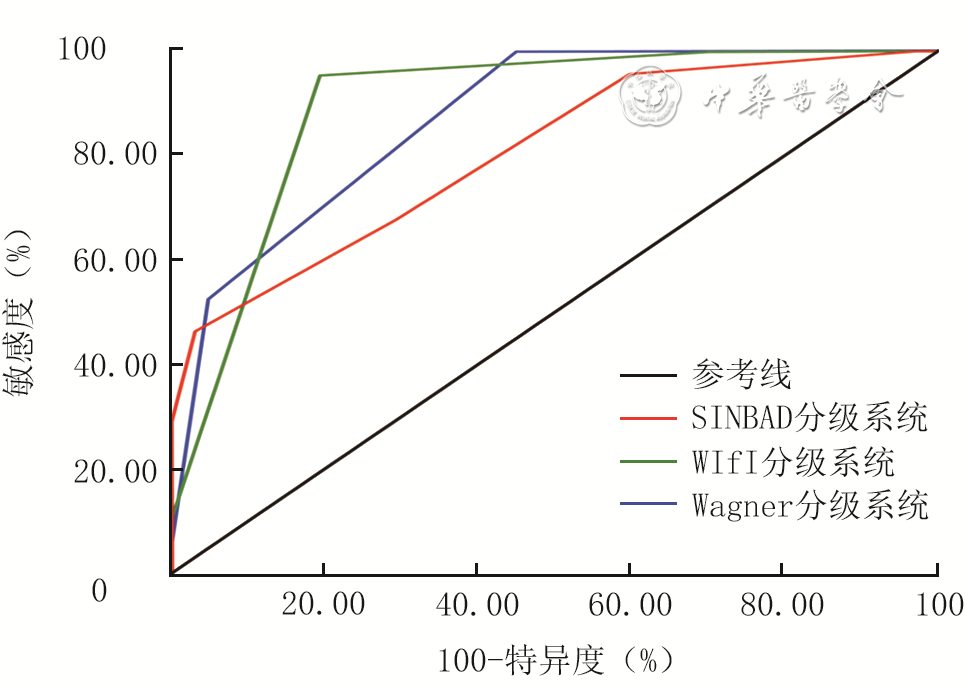
| Citation: | Xu ZH,Duan WZ,Xie WG,et al.Comparison of the predictive efficacy of the Wagner, SINBAD, and WIfI grading systems for short-term wound non-healing and amputation in patients with DFUs[J].Chin J Burns Wounds,2026,42(3):234-243.DOI: 10.3760/cma.j.cn501225-20251129-00494.

|

| [1] |
中华医学会烧伤外科学分会,长三角一体化糖尿病足专病联盟,《中华烧伤与创面修复杂志》编辑委员会.中国糖尿病足防治实践指南(Ⅰ)[J].中华烧伤与创面修复杂志,2025,41(11):1029-1049.DOI: 10.3760/cma.j.cn501225-20250801-00345.
|
| [2] |
中国老年医学学会烧创伤分会,中华医学会烧伤外科学分会,中国医师协会创面修复专业委员会.糖尿病足溃疡合并下肢血管病变的外科诊疗全国专家共识(2024版)[J].中华烧伤与创面修复杂志,2024,40(3):206-220.DOI: 10.3760/cma.j.cn501225-20231122-00202.
|
| [3] |
ArmstrongDG, TanTW, BoultonAJM, et al. Diabetic foot ulcers: a review[J]. JAMA, 2023,330(1):62-75. DOI: 10.1001/jama.2023.10578.
|
| [4] |
JalilianM,ShiriS.The reliability of the Wagner Scale for evaluation the diabetic wounds: a literature review[J].Diabetes Metab Syndr,2022,16(1):102369.DOI: 10.1016/j.dsx.2021.102369.
|
| [5] |
Monteiro-SoaresM,HamiltonEJ,RussellDA,et al.Guidelines on the classification of foot ulcers in people with diabetes (IWGDF 2023 update)[J].Diabetes Metab Res Rev,2024,40(3):e3648.DOI: 10.1002/dmrr.3648.
|
| [6] |
SrMills JL, ConteMS, ArmstrongDG, et al. The society for vascular surgery lower extremity threatened limb classification system: risk stratification based on wound, ischemia, and foot infection (WIfI)[J]. J Vasc Surg, 2014, 59(1): 220-234. e1-2. DOI: 10.1016/j.jvs.2013.08.003.
|
| [7] |
中华医学会糖尿病学分会.中国糖尿病防治指南(2024版)[J].中华糖尿病杂志,2025,17(1):16-139.DOI: 10.3760/cma.j.cn115791-20241203-00705.
|
| [8] |
尹经霞,余丽,蒲丹岚,等.《中国糖尿病防治指南(2024版)》解读[J].重庆医科大学学报,2025,50(5):557-564.DOI: 10.13406/j.cnki.cyxb.003749.
|
| [9] |
王欣,王银煜,戚建武.糖尿病足溃疡创面的发病机制及治疗的研究[J].中华烧伤与创面修复杂志,2025,41(10):928-936.DOI: 10.3760/cma.j.cn501225-20250124-00039.
|
| [10] |
ArmstrongDG,PetersEJ.Classification of wounds of the diabetic foot[J].Curr Diab Rep,2001,1(3):233-238.DOI: 10.1007/s11892-001-0039-1.
|
| [11] |
RembeJD, Aal-JeloM, ShabesP, et al. Predictors of post-amputation complications in major lower limb amputations: the role of WIfI scoring and pre-amputation transcutaneous oximetry (TcPO2)[J]. Int Wound J, 2025, 22(11): e70785. DOI: 10.1111/iwj.70785.
|
| [12] |
BrocklehurstJD. The validity and reliability of the SINBAD classification system for diabetic foot ulcers[J]. Adv Skin Wound Care, 2023, 36(11): 1-5. DOI: 10.1097/ASW.0000000000000050.
|
| [13] |
Charan KundaH, YadavMA, Raj KalpanaTS, et al. Clinical evaluation of diabetic foot ulcers using the SINBAD (Site, Ischemia, Neuropathy, Bacterial Infection, Area, and Depth) scoring system: a prospective study[J]. Cureus, 2025, 17(7): e89044. DOI: 10.7759/cureus.89044.
|
| [14] |
李震寒,陈中沛,余晓霞.糖尿病周围神经病变诊断和治疗的研究进展[J].重庆医科大学学报,2025,50(5):574-578.DOI: 10.13406/j.cnki.cyxb.003772.
|
| [15] |
Monteiro-SoaresM, BoykoEJ, JeffcoateW, et al. Diabetic foot ulcer classifications: a critical review[J]. Diabetes Metab Res Rev, 2020, 36Suppl 1:Se3272. DOI: 10.1002/dmrr.3272.
|
| [16] |
van HaelstSTW, TeraaM, MollFL, et al. Prognostic value of the society for vascular surgery Wound, Ischemia, and foot infection (WIfI) classification in patients with no-option chronic limb-threatening ischemia[J]. J Vasc Surg, 2018, 68(4): 1104-1113.e1. DOI: 10.1016/j.jvs.2018.02.028.
|
| [17] |
KhanMS,JahanN,KhatoonR,et al.Risk factors and clinical outcomes of multidrug-resistant and biofilm-producing infections in diabetic foot ulcers: a two-year cohort study[J].World J Microbiol Biotechnol,2025,41(10):346.DOI: 10.1007/s11274-025-04546-w.
|
| [18] |
汪涛,赵珺,梅家才,等.WIFi分级用于预测糖尿病足合并周围血管病变病人下肢血管再通后伤口愈合效果研究[J].中国实用外科杂志,2016,36(12):1293-1297.DOI: 10.7504/CJPS.ISSN1005-2208.2016.12.11.
|
| [19] |
AlvesDG, FerreiraV, TeixeiraG, et al. Wound, Ischemia, foot infection (WIfi) classification system and its predictive ability concerning amputation-free survival, mortality and major limb amputation in a portuguese population: a single center experience[J]. Port J Card Thorac Vasc Surg, 2024,30(4):51-58. DOI: 10.48729/pjctvs.364.
|
| [20] |
SiracuseJJ,RoweVL,MenardMT,et al.Relationship between WIfI stage and quality of life at revascularization in the BEST-CLI trial[J].J Vasc Surg,2023,77(4):1099-1106.e4.DOI: 10.1016/j.jvs.2022.11.050.
|
| [21] |
中华医学会烧伤外科学分会,长三角一体化糖尿病足专病联盟,《中华烧伤与创面修复杂志》编辑委员会.中国糖尿病足防治实践指南(Ⅱ)[J].中华烧伤与创面修复杂志,2025,41(12):1111-1131.DOI: 10.3760/cma.j.cn501225-20251029-00448.
|
| [22] |
GreenfieldSH,SamarthGM,McGregorAH,et al.A systematic review and meta-analysis on partial foot amputation in diabetic foot ulcers[J].J Vasc Surg,2026,83(3):879-894.e2.DOI: 10.1016/j.jvs.2025.11.005.
|
| [23] |
MabroukM,FoudaA,ElKassabyM.Transmetatarsal amputation versus multiple toes amputations for non-ischemic diabetic foot infection management[J].Surgeon,2026,24(1):39-42.DOI: 10.1016/j.surge.2025.08.005.
|
| [24] |
LiZP, SunJK, FuWP, et al. Optimizing risk management for post-amputation wound complications in diabetic patients: focus on glycemic and immunosuppressive control[J]. World J Diabetes, 2025,16(3):102899. DOI: 10.4239/wjd.v16.i3.102899.
|
| [25] |
梅柯强,刘泽慧,祝蓉,等.2型糖尿病足溃疡加重的危险因素及细菌感染特征分析[J].重庆医科大学学报,2025,50(6):770-777.DOI: 10.13406/j.cnki.cyxb.003761.
|
| [26] |
HuangH, XinR, LiX, et al. Physical therapy in diabetic foot ulcer: research progress and clinical application[J]. Int Wound J, 2023,20(8):3417-3434. DOI: 10.1111/iwj.14196.
|
| [27] |
CarroGV, SaurralR, CarlucciE, et al. A comparison between diabetic foot classifications WIfI, Saint Elian, and Texas: description of wounds and clinical outcomes[J]. Int J Low Extrem Wounds, 2022,21(2):120-130. DOI: 10.1177/1534734620930171.
|
| [28] |
Bravo-MolinaA, Linares-PalominoJP, Vera-ArroyoB, et al.Inter-observer agreement of the Wagner, University of Texas and PEDIS classification systems for the diabetic foot syndrome[J].Foot Ankle Surg,2018,24(1):60-64.DOI: 10.1016/j.fas.2016.10.009.
|
| [29] |
WangSH, ShyuVB, ChiuWK, et al.An overview of clinical examinations in the evaluation and assessment of arterial and venous insufficiency wounds[J].Diagnostics (Basel),2023,13(15):2494.DOI: 10.3390/diagnostics13152494.
|
| [30] |
中华医学会糖尿病学分会糖尿病足与周围血管病学组.中国糖尿病足诊治临床路径(2023版)[J].中华内分泌代谢杂志,2023,39(2):93-102.DOI: 10.3760/cma.j.cn311282-20221014-00583.
|
| [31] |
DayyaD,O'NeillOJ,Huedo-MedinaTB,et al.Debridement of diabetic foot ulcers[J].Adv Wound Care (New Rochelle),2022,11(12):666-686.DOI: 10.1089/wound.2021.0016.
|
| [32] |
ElgzyriT,LarssonJ,NybergP,et al.Early revascularization after admittance to a diabetic foot center affects the healing probability of ischemic foot ulcer in patients with diabetes[J].Eur J Vasc Endovasc Surg,2014,48(4):440-446.DOI: 10.1016/j.ejvs.2014.06.041.
|
| [33] |
ZhaoHJ, WuY, XieYC, et al. Hydrogel dressings for diabetic foot ulcer: a systematic review and meta-analysis[J]. Diabetes Obes Metab, 2024, 26(6):2305-2317. DOI: 10.1111/dom.15544.
|
| [34] |
HostyL,HeatheringtonT,QuondamatteoF,et al.Extracellular matrix-inspired biomaterials for wound healing[J].Mol Biol Rep,2024,51(1):830.DOI: 10.1007/s11033-024-09750-9.
|
| [35] |
AfsharF,DaraieM,MohammadiF,et al.Neutrophil-lymphocyte ratio (NLR); an accurate inflammatory marker to predict diabetic foot ulcer amputation: a matched case-control study[J].BMC Endocr Disord,2025,25(1):120.DOI: 10.1186/s12902-025-01941-0.
|
| [36] |
XieXR, YuMF, XuR, et al. From ulcer to amputation: a systematic review of prognostic models for diabetic foot ulcer amputation[J]. Risk Manag Healthc Policy, 2025,18:3099-3111. DOI: 10.2147/RMHP.S542262.
|
| [37] |
SilvaMA, HamiltonEJ, RussellDA, et al. Diabetic foot ulcer classification models using artificial intelligence and machine learning techniques: systematic review[J]. J Med Internet Res, 2025, 27: e69408. DOI: 10.2196/69408.
|
| [38] |
TaoH,YouL,HuangY,et al.An interpreting machine learning models to predict amputation risk in patients with diabetic foot ulcers: a multi-center study[J].Front Endocrinol (Lausanne),2025,16:1526098.DOI: 10.3389/fendo.2025.1526098.
|
| [39] |
王光娅,王玉,孟宇辰,等.人工智能在糖尿病足中应用的研究进展[J].中华现代护理杂志,2024,30(5):691-695.DOI: 10.3760/cma.j.cn115682-20230217-00566.
|
| [40] |
魏在荣,简扬.糖尿病足创面外科治疗模式探讨[J].中华烧伤与创面修复杂志,2023,39(4):305-310.DOI: 10.3760/cma.j.cn501225-20230213-00044.
|

Figures(3) / Tables(5)
Copyright © Chinese Journal of Burns京ICP备07035254号-14
E-mail:shaoshangzazhi@163.com
Supported by:
Beijing Renhe Information Technology Co. Ltd



 DownLoad: