- Medline/PubMed数据库
- Scopus数据库
- PMC数据库
- CSCD
- 北大核心收录期刊
- 统计源期刊
- 我国高质量科技期刊T1级
- 第6届中国精品科技期刊
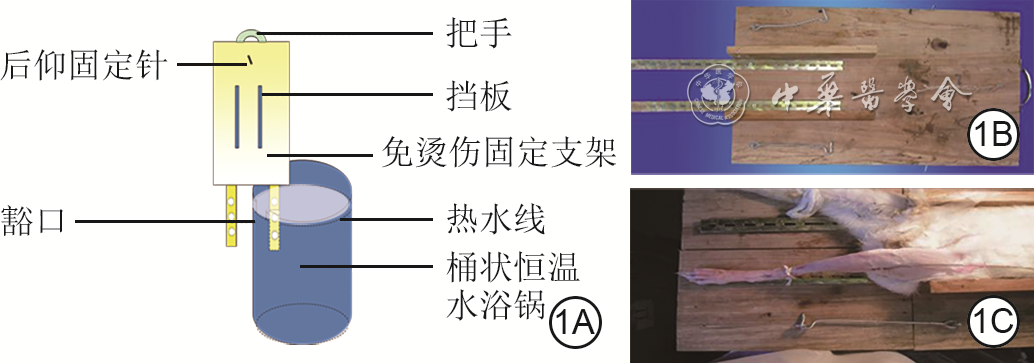
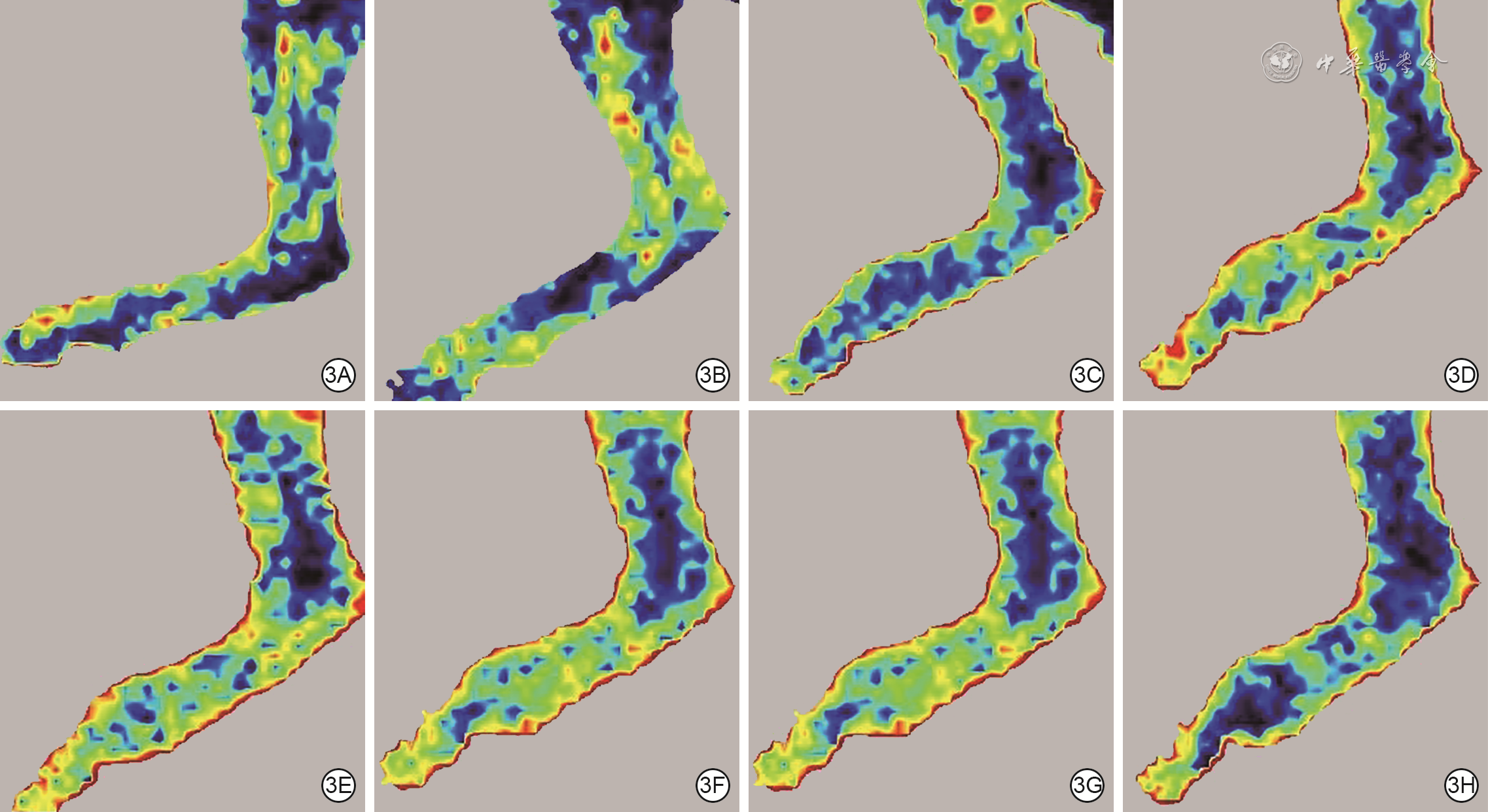
| Citation: | Guan H,Zhang H,Zhang WF,et al.Establishment and efficacy evaluation of a rabbit lower limb partial-thickness scald model[J].Chin J Burns Wounds,2026,42(2):173-181.DOI: 10.3760/cma.j.cn501225-20241028-00418.

|

| [1] |
AlAlwanMA, AlmominHA, ShringarpureSD, et al. Survival from ninety-five percent total body surface area burn: a case report and literature review[J]. Cureus, 2022,14(2):e21903.DOI: 10.7759/cureus.21903.
|
| [2] |
YangJ, TianG, LiuJ, et al. Epidemiology and clinical characteristics of burns in mainland China from 2009 to 2018[J/OL]. Burns Trauma, 2022, 10: tkac039[2024-10-28]. https://pubmed. ncbi. nlm. nih. gov/36196302/. DOI: 10.1093/burnst/tkac039.
|
| [3] |
中华医学会烧伤外科学分会,海峡两岸医药卫生交流协会暨烧创伤组织修复专委会.Ⅱ度烧伤创面治疗专家共识(2024版)Ⅰ:院前急救和非手术治疗[J].中华烧伤与创面修复杂志,2024,40(1):1-18.DOI: 10.3760/cmaj.cn501225-20231019-00120.
|
| [4] |
ChenYR,XiangXD,SunF,et al.Simvastatin reduces NETosis to attenuate severe asthma by inhibiting PAD4 expression[J].Oxid Med Cell Longev,2023,2023:1493684.DOI: 10.1155/2023/1493684.
|
| [5] |
HuX,WangX,HongX,et al.Modification and utility of a rat burn wound model[J].Wound Repair Regen,2020,28(6):797-811.DOI: 10.1111/wrr.12855.
|
| [6] |
SingerAJ,ZhouJW,OsmanOB,et al.Comparison of comparable scald and contact burns in a porcine model: a preliminary report[J].Wound Repair Regen,2020,28(6):789-796.DOI: 10.1111/wrr.12848.
|
| [7] |
QianW,WangS,WangY,et al.Epidemiological and clinical characteristics of burns in the older person: a seven-year retrospective analysis of 693 cases at a burn center in south-west China[J/OL].Burns Trauma,2020,8:tkz005[2024-10-28].https://pubmed.ncbi.nlm.nih.gov/32346542/.DOI: 10.1093/burnst/tkz005.
|
| [8] |
金煦,万佳,段淑芳,等.布鲁顿酪氨酸激酶在内毒素/脂多糖诱导烫伤小鼠肠道细胞焦亡中的作用[J].中华烧伤杂志,2021,37(6):546-554.DOI: 10.3760/cma.j.cn501120-20210119-00027.
|
| [9] |
de Brito MonteiroL, BieerkehazhiS, AijazA, et al.SVF mediates immunometabolic alterations in burn-induced hypermetabolic adipose tissue via mitochondrial transfer[J].Shock,2025,64(2):226-235.DOI: 10.1097/SHK.0000000000002608.
|
| [10] |
刘馨竹,李大伟,蒋敏,等.严重烧伤小鼠肠-胰岛轴功能的变化及其作用[J].中华烧伤与创面修复杂志,2024,40(7):625-633.DOI: 10.3760/cma.j.cn501225-20240520-00189.
|
| [11] |
张月,白晓智,芦帅,等.小鼠深Ⅱ度烫伤创面模型建立及创面缺氧情况检测[J].中华烧伤杂志,2013,29(3):277-280.DOI: 10.3760/cma.j.issn.1009-2587.2013.03.012.
|
| [12] |
WongVW,SorkinM,GlotzbachJP,et al.Surgical approaches to create murine models of human wound healing[J].J Biomed Biotechnol,2011,2011:969618.DOI: 10.1155/2011/969618.
|
| [13] |
DahiyaP.Burns as a model of SIRS[J].Front Biosci (Landmark Ed),2009,14(13):4962-4967.DOI: 10.2741/3580.
|
| [14] |
GurtnerGC,WernerS,BarrandonY,et al.Wound repair and regeneration[J].Nature,2008,453(7193):314-321.DOI: 10.1038/nature07039.
|
| [15] |
ZhouS,ZhangM,XueL,et al.Dopamine-alginate-zinc ion dressings employing synergistic active and passive antimicrobial strategies for enhanced burn wound infection management and accelerated healing[J].Carbohydr Polym,2025,359:123571.DOI: 10.1016/j.carbpol.2025.123571.
|
| [16] |
ZhaoX,LiX,GuoH,et al.Resolvin D1 attenuates mechanical allodynia after burn injury: involvement of spinal glia, p38 mitogen-activated protein kinase, and brain-derived neurotrophic factor/tropomyosin-related kinase B signaling[J].Mol Pain,2023,19:17448069231159970.DOI: 10.1177/17448069231159970.
|
| [17] |
程兴,詹剑华,罗锦花,等.前列地尔对深Ⅱ度烫伤大鼠早期创面愈合的作用[J].中华烧伤杂志,2020,36(4):317-322.DOI: 10.3760/cma.j.cn501120-20190125-00017.
|
| [18] |
Dorsett-MartinWA.Rat models of skin wound healing: a review[J].Wound Repair Regen,2004,12(6):591-599.DOI: 10.1111/j.1067-1927.2004.12601.x.
|
| [19] |
ZuoH,PengD,ZhengB,et al.Regeneration of mature dermis by transplanted particulate acellular dermal matrix in a rat model of skin defect wound[J].J Mater Sci Mater Med,2012,23(12):2933-2944.DOI: 10.1007/s10856-012-4745-9.
|
| [20] |
AhmedIS,ElnahasOS,AssarNH,et al.Nanocrystals of fusidic acid for dual enhancement of dermal delivery and antibacterial activity: in vitro, ex vivo and in vivo evaluation[J].Pharmaceutics,2020,12(3):199.DOI: 10.3390/pharmaceutics12030199.
|
| [21] |
SullivanTP,EaglsteinWH,DavisSC,et al.The pig as a model for human wound healing[J].Wound Repair Regen,2001,9(2):66-76.DOI: 10.1046/j.1524-475x.2001.00066.x.
|
| [22] |
PolomskaAK,ProulxST,BrambillaD,et al.Minimally invasive method for the point-of-care quantification of lymphatic vessel function[J].JCI Insight,2019,4(4):e126515.DOI: 10.1172/jci.insight.126515.
|
| [23] |
梅日庚,耿少辉,林志敏,等.水凝胶创伤修复研究中应用的小型猪模型[J].中国组织工程研究,2024,28(29):4697-4702.DOI: 10.12307/2024.568.
|
| [24] |
朱磊,崔正军,肖京,等.一种猪小面积深Ⅱ度烫伤模型的建立[J].中国实用医刊,2013,40(17):25-27.DOI: 10.3760/cma.j.issn.1674-4756.2013.17.009.
|
| [25] |
刘利兵,于军,张学策,等.新西兰兔烫伤模型的建立[J].第四军医大学学报,2009,30(1):86-88.DOI: 10.3321/j.issn:1000-2790.2009.01.024.
|
| [26] |
陈向军,吴兴,林欢欢,等.负载银和重组人碱性成纤维细胞生长因子的甲基丙烯酸酐化明胶水凝胶对兔深Ⅱ度烧伤创面的影响[J].中华烧伤与创面修复杂志,2022,38(7):640-649.DOI: 10.3760/cma.j.cn501120-20210726-00260.
|
| [27] |
DemyashkinG,TokovA,BelokopytovD,et al.Effects of Satureja montana L. and Origanum vulgare L. hydrolates in rabbit burn wound model: evaluation of inflammatory, antioxidant activity, and pro-regenerative properties in the skin[J].Int J Mol Sci,2025,26(17):8628.DOI: 10.3390/ijms26178628.
|
| [28] |
KangY,LiS,LiuC,et al.A rabbit model for assessing symblepharon after alkali burn of the superior conjunctival sac[J].Sci Rep,2019,9(1):13857.DOI: 10.1038/s41598-019-50286-x.
|
| [29] |
NicoliS,PadulaC,AversaV,et al.Characterization of rabbit ear skin as a skin model for in vitro transdermal permeation experiments: histology, lipid composition and permeability[J].Skin Pharmacol Physiol,2008,21(4):218-226.DOI: 10.1159/000135638.
|
| [30] |
SakhniniL,DairiM,Al-TaitoonN,et al.Determining mechanical properties of rabbit skin with light reflection technique verified with latex[J].J Biomed Opt,2006,11(1):014030.DOI: 10.1117/1.2161169.
|
| [31] |
VantiG,BaniD,SalvaticiMC,et al.Development and percutaneous permeation study of escinosomes, escin-based nanovesicles loaded with berberine chloride[J].Pharmaceutics,2019,11(12):682.DOI: 10.3390/pharmaceutics11120682.
|
| [32] |
XiP,LiY,GeX,et al.Effect of nano-silver hydrogel coating film on deep partial thickness scald model of rabbit[J].Saudi J Biol Sci,2018,25(4):797-800.DOI: 10.1016/j.sjbs.2017.09.002.
|
| [33] |
HuZ,YangP,ZhouC,et al.Marine collagen peptides from the skin of Nile tilapia (Oreochromis niloticus): characterization and wound healing evaluation[J].Mar Drugs,2017,15(4):102.DOI: 10.3390/md15040102.
|
| [34] |
SongC,WenR,ZhouJ,et al.Antibacterial and antifungal properties of a novel Antimicrobial Peptide GK-19 and its application in skin and soft tissue infections induced by MRSA or Candida albicans[J].Pharmaceutics,2022,14(9):1937. DOI: 10.3390/pharmaceutics14091937.
|
| [35] |
HuangC,SunL,XiaoC,et al.Circular RNA METTL9 contributes to neuroinflammation following traumatic brain injury by complexing with astrocytic SND1[J].J Neuroinflammation,2023,20(1):39.DOI: 10.1186/s12974-023-02716-x.
|
| [36] |
XiangY,PanBH,ZhangJ,et al.Suppression of overactivated immunity in the early stage is the key to improve the prognosis in severe burns[J].Front Immunol,2024,15:1455899.DOI: 10.3389/fimmu.2024.1455899.
|
| [37] |
李聪颖,赵学刚,郝嘉文,等.高压电烧伤大鼠肾脏氧化应激损伤的特点及灯盏花素的干预作用[J].中华烧伤与创面修复杂志,2024,40(8):746-755.DOI: 10.3760/cma.j.cn501225-20240222-00070.
|
| [38] |
QinFJ, HuXH, ChenZ, et al. Protective effects of tiopronin against oxidative stress in severely burned patients[J]. Drug Des Devel Ther, 2019,13:2827-2832.DOI: 10.2147/DDDT.S215927.
|
Figures(4) / Tables(2)
Copyright © Chinese Journal of Burns京ICP备07035254号-14
E-mail:shaoshangzazhi@163.com
Supported by:
Beijing Renhe Information Technology Co. Ltd



 DownLoad: